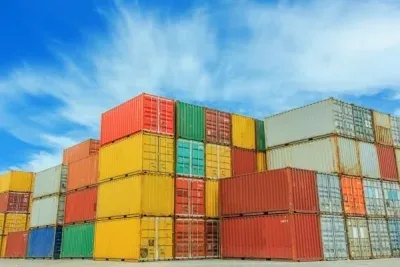
China's $1 trillion trade surplus signals structural weakness, not strength: Analysis

Synopsis
China's $1 trillion-plus trade surplus in 2025 is not a story of export dominance — it is a story of an economy that cannot consume enough at home. Collapsed land revenues, a $1.4 trillion local government arrears burden, and a savings culture baked in by demographics and financial exclusion are the real drivers. Trade barriers, the East Asia Forum argues, will fix none of it.
Key Takeaways
China's trade surplus exceeded $1 trillion in 2025 , a record that has reignited global economic imbalance concerns.
The East Asia Forum report attributes the surplus primarily to a structural savings-investment gap , not industrial policy or currency management.
Land-sale revenues — a key local government funding source — fell from ~10% of GDP in 2021 to under 5% of GDP in 2025 .
Local government payment arrears are estimated at 10 trillion yuan (~7% of GDP) , depressing investment, employment, and household spending.
The report warns that trade barriers and short-term stimulus will not resolve the underlying savings-investment imbalance .
Chinese firms are expanding overseas amid weak domestic demand, intensifying competitive pressure on manufacturers in importing countries.
China's record trade surplus, which surpassed $1 trillion in 2025, has reignited global concerns over economic imbalances — but according to an analysis by the East Asia Forum, the surplus is less a mark of industrial triumph and more a symptom of deep structural fragilities within the Chinese economy. The report argues that exchange-rate management and industrial policy alone do not explain why China continues to export far more than it imports.
Savings Gap, Not Export Prowess, at the Root
The analysis identifies a persistent gap between national savings and domestic investment as the primary driver of China's external imbalance. Demographic pressures — including a skewed gender ratio — have historically encouraged elevated household savings rates. Simultaneously, a financial system that has long favoured state-owned enterprises (SOEs) has forced many private firms to depend on retained earnings to fund growth, further inflating corporate savings.
While China's industrial upgrading and expanding manufacturing capacity have shaped the composition of its trade surplus, the East Asia Forum report concludes they do not fully account for why savings continue to outpace investment at a structural level.
Property Downturn Compounds Fiscal Stress
The surplus has been amplified by a prolonged property market downturn that has severely squeezed local government finances. Land-sale revenues — historically a cornerstone of municipal funding — have collapsed from roughly 10 per cent of GDP in 2021 to under 5 per cent in 2025.
As revenues shrank, heavily indebted local authorities reportedly began delaying payments to contractors and public-sector workers. These arrears are estimated at approximately 10 trillion yuan, or around 7 per cent of GDP, and have weighed on business investment, employment, and household spending, according to the report.
Weak Consumption Driving Overseas Expansion
The East Asia Forum analysis frames the surplus not as a sign of economic strength but as a reflection of weak domestic consumption. Faced with sluggish demand and intensifying competition at home, Chinese firms are increasingly turning to overseas markets — a trend that is sharpening competitive pressures for manufacturers in importing countries worldwide.
Notably, while consumers and downstream industries globally benefit from cheaper and more diverse Chinese products, domestic producers in trade-partner nations face mounting displacement risk. This dynamic has fuelled a wave of trade restrictions, which the report argues are unlikely to resolve the underlying imbalance.
Trade Barriers Won't Fix the Imbalance
The report is pointed in dismissing both protectionist and stimulus-based fixes. 'External rebalancing will be gradual. Trade restrictions abroad will not fix the underlying savings-investment gap, nor will short-term liquidity measures at home,' it stated.
The analysis suggests that durable correction will require structural reforms addressing China's savings behaviour, fiscal architecture, and domestic consumption capacity — changes that are neither quick nor politically straightforward. With global trade tensions already elevated, the trajectory of China's surplus will remain a central fault line in international economic relations in the months ahead.
Point of View
But the East Asia Forum analysis cuts through that by locating the real fault line in China's domestic financial architecture. A financial system skewed toward SOEs, a property sector in structural decline, and a demographic savings culture are not problems that US tariffs or EU anti-dumping duties can fix. What is missing from the global debate is pressure on China to address demand-side reforms — social safety nets, healthcare spending, pension adequacy — that would reduce the household incentive to save. Without that, the surplus will migrate in composition but not in scale, and trade tensions will escalate without resolution.
NationPress
5 Oct 2026
Frequently Asked Questions
Why did China's trade surplus exceed $1 trillion in 2025?
China's trade surplus surpassed $1 trillion in 2025 primarily because national savings persistently outpace domestic investment, according to an East Asia Forum analysis. Structural factors — including demographic pressures that boost household savings and a financial system favouring state-owned enterprises — are identified as the main drivers, rather than exchange-rate manipulation or industrial policy alone.
What role did China's property market downturn play in the surplus?
The prolonged property market downturn severely reduced local government revenues, with land-sale income falling from about 10 per cent of GDP in 2021 to under 5 per cent in 2025. This fiscal squeeze led heavily indebted local authorities to delay payments to contractors and public-sector workers, depressing domestic consumption and investment and widening the surplus further.
How large are China's local government payment arrears?
Local government payment arrears in China are estimated at approximately 10 trillion yuan, equivalent to around 7 per cent of GDP, according to the East Asia Forum report. These delays have weighed on business investment, employment, and household spending.
Will trade barriers reduce China's trade surplus?
According to the East Asia Forum analysis, trade restrictions will not resolve the surplus because they do not address the underlying savings-investment gap. The report states that 'external rebalancing will be gradual' and that neither trade barriers abroad nor short-term liquidity injections at home will fix the structural imbalance.
How does China's trade surplus affect global manufacturers?
As Chinese firms expand overseas in response to weak domestic demand, manufacturers in importing countries face growing competitive pressure. While consumers and downstream industries globally benefit from cheaper products, domestic producers in trade-partner nations are increasingly displaced — a tension that has driven a global wave of tariffs and trade restrictions.