China Capitalizes on Military Opportunities in Africa Amid Western Withdrawal
Synopsis
As Western nations withdraw, China is swiftly filling the military void in Africa, particularly in nations like Senegal and Ghana. This report explores the implications of China's expanding defense partnerships, amidst geopolitical shifts and increasing insurgent threats.
Key Takeaways
China's military presence is growing in Africa, particularly in nations distancing from Western alliances.
Senegal and Ghana are increasing their acquisitions of Chinese defense systems.
Post-coup governments in Burkina Faso and Mali are also ramping up defense procurement from China.
A 'military vacuum' in West Africa is being rapidly filled by China.
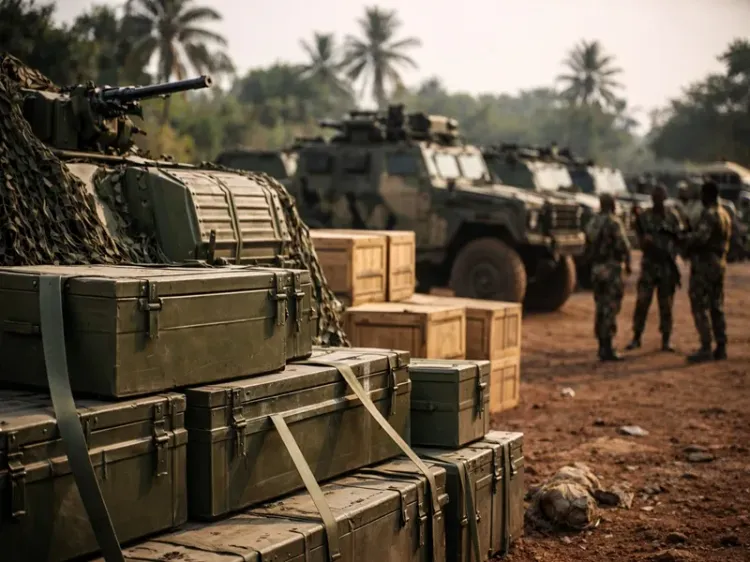
China's strategy includes training military personnel and enhancing defense networks without large troop deployments.
Naypyidaw, March 4 (NationPress) China's expanding military presence in Africa is increasingly noticeable, especially in countries that have distanced themselves from Paris. Senegal and Ghana, historically aligned with France and Western security allies, are now significantly enhancing their procurement of Chinese defense technologies.
Simultaneously, Burkina Faso and Mali, governed by post-coup administrations, are escalating their defense purchases from China in response to escalating insurgent threats, as outlined in a recent report.
'Mekong News Myanmar' highlights that this transition is particularly pronounced in the Sahel region, where Chinese vendors have identified an opportunity to provide military juntas grappling with ongoing insurgencies with affordable, quickly deployable, and low-maintenance equipment.
“The exit of French troops from the Sahel, coupled with Russia's diminished arms supply due to the ongoing conflict in Ukraine, has led analysts to characterize this as a 'military vacuum' in West and Central Africa. However, this void is being filled rapidly by China,” the report indicates.
“This shift began following the series of coups in Burkina Faso, Mali, and Niger starting in 2020, which disrupted long-standing security alliances, particularly with France. The French counter-terrorism operations, once pivotal to the regional security framework, have significantly decreased. Concurrently, Russia has been struggling to maintain its arms supply to foreign clients due to its preoccupations with the war in Ukraine,” it continues.
The report noted that assessments from the Chinese defense sector have openly acknowledged Beijing's growth in African markets.
“A January report in China Military to Civilian, released by the State Administration of Science, Technology and Industry for National Defence, mentioned that the French withdrawal has created ‘space’ for China’s military trade expansion. The analysis, attributed to the state arms exporter China National Aero-Technology Import & Export Corporation, posits that Beijing is capitalizing on cost-effective solutions and flexible financing options to penetrate African markets,” it stated.
Additionally, the report highlighted that arms transfers are just one aspect of Beijing’s increasing influence. Through the 2024–2027 Beijing Action Plan, the Forum on China-Africa Cooperation (FOCAC) has committed to training 6,500 military personnel, indicative of broader institutional engagement.
“This understated strategy avoids large-scale troop deployments. Instead, China is enhancing defense attache networks, engaging in naval port visits, and broadening training exchanges. Furthermore, Chinese private security companies are safeguarding infrastructure tied to Beijing’s economic ventures,” it mentioned.
The report concluded, “While the ‘military vacuum’ narrative may exaggerate the absence of other powers, the data clearly indicates a trend: as Western influences diminish and Russian supply routes constrict, China’s role in the defense landscape of West and Central Africa is methodically expanding, with both commercial and long-term strategic aspirations.”
Point of View
The growing Chinese military presence in Africa represents a significant shift in global power dynamics. While Western nations are retracting, China's strategic moves could reshape security partnerships and influence in the region, necessitating a careful examination of its long-term implications for Africa and the world.
NationPress
21 Sept 2026
Frequently Asked Questions
Why is China expanding its military presence in Africa?
China is leveraging the withdrawal of Western forces and the decreasing influence of Russia to establish stronger defense partnerships in Africa, particularly in response to rising security needs.
What countries are increasing their defense procurement from China?
Countries such as Senegal, Ghana, Burkina Faso, and Mali are significantly increasing their defense acquisitions from China.
What is the significance of the term 'military vacuum'?
The term 'military vacuum' refers to the gap left by the withdrawal of Western and Russian military forces, which China is quickly filling with its defense offerings.
How is China's strategy different from traditional military deployments?
China's approach focuses on lower-profile strategies, such as enhancing defense networks and training programs, rather than large-scale troop deployments.
What are the implications of China's growing influence in African defense?
China's expanding role could alter the balance of power in Africa, impacting regional security dynamics and the nature of international partnerships.