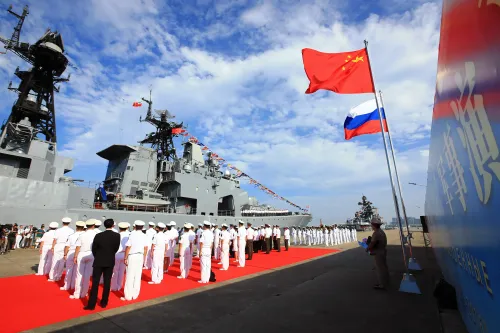
China's inward naval diplomacy signals CCP's weakening grip, report says

Synopsis
China's navy is staying home — and a new report argues that tells you everything. With at least 15 domestic port visits in two years making up nearly 20% of total naval activity, Beijing's retreat from international waters is being read not as restraint but as a symptom of the CCP's eroding authority over its own cadres and public.
Key Takeaways
A report by PML Daily argues China's shift to domestic naval port visits reflects the CCP's weakening grip on cadres and citizens.
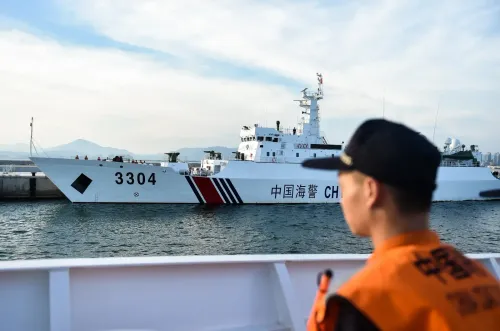
The Chinese Navy conducted at least 15 domestic port visits in the past two years — nearly 20% of its total port activity.
The report describes the pivot as a 'domestic spectacle' aimed at reassuring a 'restless population and sceptical party workers.' Provincial leaders, entrepreneurs, and party cadres are reportedly questioning Beijing 's rigid centralisation.
Younger, globally connected Chinese citizens may interpret the inward turn as stagnation, the report warns, potentially deepening public disillusionment.
China's People's Liberation Army Navy (PLAN) has sharply pivoted toward domestic port visits over the past two years, a shift that analysts say reflects mounting strain within the Chinese Communist Party (CCP) rather than strategic confidence. According to a report published this week by PML Daily, a Uganda-based media outlet, Beijing's retreat from international waters is less a show of strength and more an attempt to shore up loyalty among restless cadres and a sceptical public.
The Inward Turn: What the Numbers Show
The Chinese Navy conducted at least 15 domestic port visits in the past two years, accounting for nearly 20 per cent of its total port activity, according to the report. This marks a measurable increase from earlier periods, when international deployments were the defining feature of China's naval diplomacy. Critics argue the recalibration signals overextension anxiety rather than deliberate strategic restraint.
What the CCP Is Trying to Signal
'China's naval diplomacy is increasingly turning inward, a development that reflects the weakening grip of the Chinese Communist Party on both its cadres and the wider public,' the report stated. 'By retreating from international waters and staging port visits within its own territory, Beijing is attempting to save face, but this strategy exposes cracks in its global ambitions and signals insecurity within the Party itself.'
The report further noted that what was once a confident projection of maritime power abroad has now been 'recalibrated into a domestic spectacle, designed less to impress foreign audiences and more to reassure a restless population and sceptical party workers.'
Internal Fractures and Provincial Dissent
Beyond the naval dimension, the report pointed to widening internal fractures within the CCP. Provincial leaders, entrepreneurs, and party cadres are reportedly questioning Beijing's rigid centralisation, signalling that the Party's authority is under pressure from within its own ranks. The dependence on symbolic displays of military hardware, analysts argue, is itself evidence of a regime seeking to manufacture cohesion it can no longer take for granted.
'The retreat from international waters underscores the CCP's fear of overextension. Deploying ships abroad risks confrontation with other powers and exposes weaknesses that the Party would rather conceal,' PML Daily stated.
The Risk of the Inward Strategy
The report cautioned that the domestic-facing approach carries its own dangers. Younger Chinese citizens — described as more globally connected and critical of insular policies — may interpret the inward naval turn as evidence of stagnation rather than stability. 'Instead of inspiring confidence, the domestic naval displays could deepen the perception that the CCP is disconnected from the realities of an interconnected world,' the report added.
Notably, this analysis comes amid broader international scrutiny of China's military posture in the South China Sea and the Indo-Pacific, where Beijing's assertiveness has drawn pushback from regional powers and Western alliances. The contrast between outward rhetoric and inward naval behaviour, critics argue, is a contradiction the CCP will find increasingly difficult to manage.
What Comes Next
The report concluded that the trajectory of China's naval diplomacy — and its broader global ambitions — will ultimately be determined not by the number of warships paraded at home, but by its capacity to navigate a shifting world order and address rising disillusionment among its own citizens. Whether the CCP's inward recalibration is a temporary stabilisation measure or the beginning of a longer strategic contraction remains, according to analysts, an open question.
Point of View
Not a Western intelligence assessment or peer-reviewed study. That caveat matters. But the core observation — that a navy historically used as a tool of outward power projection is now predominantly staging shows for domestic audiences — is a data point that deserves scrutiny. If the 20% domestic port-visit figure holds, it is a structural shift, not a blip. The deeper question mainstream coverage tends to sidestep is whether the CCP's centralisation drive under Xi Jinping has itself created the internal fractures now requiring reassurance. Tightening control and then needing symbolic gestures to enforce loyalty is a familiar authoritarian paradox — and one that rarely resolves cleanly.
NationPress
10 Oct 2026
Frequently Asked Questions
What is China's 'inward-facing' naval diplomacy?
It refers to the Chinese Navy's increasing focus on domestic port visits rather than international deployments. According to a report by PML Daily, the navy conducted at least 15 domestic port visits in the past two years, accounting for nearly 20% of its total port activity — a marked shift from its earlier outward-facing posture.
Why does the report say this reflects the CCP's weakening grip?
The report argues that the reliance on domestic military spectacles signals the CCP is trying to reassure restless cadres and a sceptical public, rather than projecting genuine confidence. It describes the shift as evidence of internal fractures, with provincial leaders and party workers reportedly questioning Beijing's centralisation.
Who published the report and where?
The report was published by PML Daily, a Uganda-based media outlet, and was cited in coverage dated 16 May. It analyses China's naval posture in the context of the CCP's domestic authority.
What risks does the inward naval strategy carry for China?
The report warns that younger, globally connected Chinese citizens may view the domestic naval displays as a sign of stagnation and irrelevance rather than strength. This could deepen public disillusionment and reinforce the perception that the CCP is out of step with an interconnected world.
How does this relate to China's broader global ambitions?
The report concludes that China's global standing will be shaped not by domestic military parades but by its ability to engage with a changing world order. The retreat from international waters is seen as contradicting Beijing's stated ambitions in the South China Sea and the broader Indo-Pacific.