EU invites Canada to become bloc's first associate member
Synopsis
In an unprecedented move at the State of the Union 2026 in Strasbourg, EU chief Ursula von der Leyen invited Canada to become the first-ever associate member of the 27-nation bloc — a status that has never existed before and whose details are yet to be worked out. With PM Mark Carney in the room, this is the boldest reshaping of Western alliance architecture since Brexit.
Key Takeaways
European Commission President Ursula von der Leyen invited Canada to become the EU's first associate member on 16 September 2026 in Strasbourg .
The 'associate member' status is entirely new — no country has ever held it, and its legal and institutional details are yet to be defined.
Von der Leyen proposed moving beyond CETA to an 'alliance for the future' spanning tech, defence, critical minerals, AI, quantum, and the Arctic .
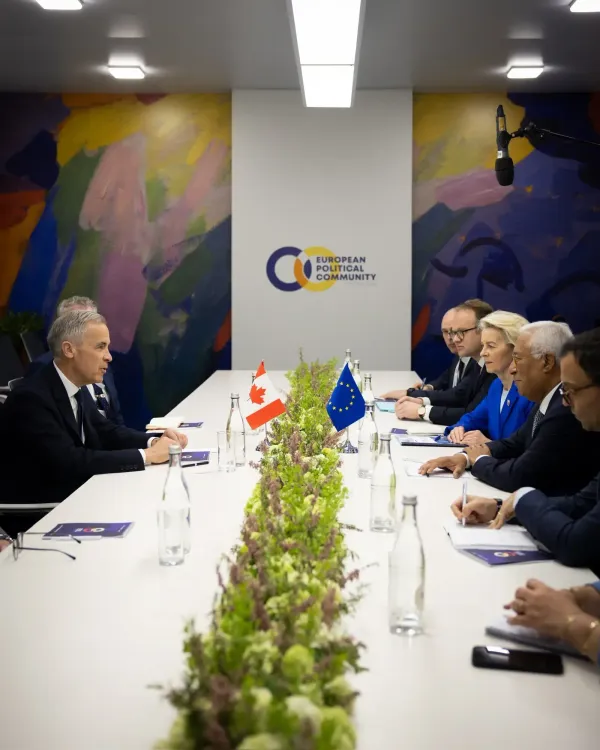
Canadian Prime Minister Mark Carney attended the speech and held bilateral talks with von der Leyen and European Parliament President Roberta Metsola .
Canada's PMO described the partnership as building 'strategic autonomy, resilience, and sovereignty' in a more dangerous world.
Formal negotiations on the framework are expected to follow, with a timeline yet to be announced.
European Commission President Ursula von der Leyen on Wednesday, 16 September 2026, formally invited Canada to become the European Union's first-ever 'associate member' — a novel status with no precedent in the bloc's history — during her State of the Union 2026 address in Strasbourg, France. The announcement, made in the presence of Canadian Prime Minister Mark Carney, signals a significant deepening of transatlantic ties as Western democracies recalibrate their global alliances.
What Von der Leyen Said
Addressing the European Parliament, von der Leyen drew a sweeping picture of shared values and strategic convergence. 'We see the world with the same eyes: from AI to climate change, from the Arctic to geopolitics and we have stood together on Ukraine, on defence, on raw materials and supply chains,' she said, speaking directly to Prime Minister Carney in the chamber.
She outlined plans to advance the relationship beyond the existing Comprehensive Economic and Trade Agreement (CETA) framework, proposing what she called 'an alliance for the future' aimed at 'common prosperity and economic security.' Key pillars include a tech alliance, integration of defence industrial bases, critical minerals and battery cooperation, and joint projects in AI, quantum computing, cybersecurity, and the Arctic. 'This is not a partnership against anyone else but for our common strength,' von der Leyen said.
Canada's Response and PM Carney's Visit
Prime Minister Mark Carney attended the State of the Union address and held separate bilateral meetings with both von der Leyen and European Parliament President Roberta Metsola. Talks reportedly covered critical minerals, energy, defence, research and development, and advanced technologies. Carney also expressed gratitude to Metsola for the invitation to address the European Parliament directly.
A statement from the Canadian Prime Minister's Office described the visit in strategic terms: 'In a more dangerous and divided world, Canada is forging stronger relationships with trusted partners to build greater strategic autonomy, resilience, and sovereignty.' The statement noted that the two sides agreed to 'remain in close contact.'
What 'Associate Member' Actually Means
The status is, notably, entirely new — no country has ever held associate membership in the EU, and the exact legal, institutional, and trade implications remain to be defined. Von der Leyen acknowledged as much, framing it as an intention rather than a concluded arrangement: 'I would like to work with you on opening the door for Canada to being the first associate member,' she said, suggesting formal negotiations lie ahead.
Analysts will watch closely for how the proposal navigates EU treaty frameworks, which do not currently provide for associate membership in any binding sense. The distinction between associate membership and existing deep partnership models — such as those used with Norway or Switzerland — is yet to be clarified.
Geopolitical Context
The invitation arrives at a moment of acute geopolitical flux. Canada and the EU have both faced trade and diplomatic pressure from the United States under changing administrations, and the two sides have visibly sought to diversify strategic partnerships. Von der Leyen's framing — emphasising democracy, multilateralism, and rule-based order — carries a clear subtext about the current transatlantic moment. This comes amid ongoing EU efforts to reduce dependencies in critical supply chains and expand its circle of trusted partners beyond the immediate neighbourhood.
The specific timeline for formalising the associate membership framework will be closely watched in the weeks ahead, as will Canada's domestic political response to the proposal.
Point of View
And bridging that gap will require either creative legal architecture or formal treaty amendment, neither of which is straightforward. The timing is telling: both Brussels and Ottawa are hedging against US unpredictability, and this proposal is as much a geopolitical signal as it is a concrete offer. What's missing from the mainstream coverage is scrutiny of the gap between the soaring rhetoric and the absence of any defined legal framework — without that, 'associate membership' risks becoming a rebranded partnership agreement. The real test will be whether Canada and the EU can design a model that delivers material integration without requiring the full acquis compliance that made Brexit so intractable in reverse.
NationPress
16 Sept 2026
Frequently Asked Questions
What is the EU associate membership proposed for Canada?
It is a new, unprecedented status proposed by European Commission President Ursula von der Leyen on 16 September 2026, which would make Canada the first country to hold associate membership in the 27-nation European Union. The exact legal and institutional details have not yet been defined, and formal negotiations are expected to follow.
Why did the EU invite Canada to become an associate member?
Von der Leyen cited shared values on democracy, climate change, AI, geopolitics, and the Arctic, as well as aligned positions on Ukraine, defence, and supply chains. The move also reflects a broader strategic recalibration by both the EU and Canada to deepen ties with trusted democratic partners amid global geopolitical uncertainty.
Who attended the State of the Union 2026 event in Strasbourg?
Canadian Prime Minister Mark Carney was present at the event in Strasbourg, France, on 16 September 2026. He also held bilateral meetings with von der Leyen and European Parliament President Roberta Metsola, focusing on critical minerals, energy, defence, and advanced technologies.
What does Canada's government say about the EU associate membership proposal?
The Canadian Prime Minister's Office said Canada is 'forging stronger relationships with trusted partners to build greater strategic autonomy, resilience, and sovereignty,' and described the EU as playing a 'central role' in those efforts. The two sides agreed to remain in close contact.
How is EU associate membership different from existing EU partnerships?
Unlike existing deep partnership models with countries such as Norway or Switzerland — which involve EEA membership or bilateral treaties — EU associate membership is a status that has never existed before in the bloc's framework. Its distinction from prior partnership models remains to be legally and institutionally defined.