Global South at UNGA 2026: Developing nations demand climate finance overhaul
Synopsis
At UNGA 2026, nations from Africa, the Caribbean, and the Pacific delivered a unified indictment of the global financial system — arguing it forces the world's most climate-vulnerable countries to borrow for disasters they barely caused. Jamaica's revelation that a single hurricane wiped out 56.7% of its GDP crystallised why income-based lending criteria are no longer fit for purpose.
Key Takeaways
Developing nations from Africa , the Caribbean , and the Pacific demanded a full overhaul of global lending and climate-finance rules at the UN General Assembly on 27 September 2026 .
Samoa called for a multidimensional vulnerability index to replace per-capita income as the primary criterion for lending eligibility.
Jamaica reported that Hurricane Melissa in October 2025 caused losses equal to 56.7% of its annual economic output.
South Africa said African countries spent roughly as much on debt servicing last year as was needed to close the continent's infrastructure financing gap.
India's G20 presidency in 2023 had already advanced multilateral development bank reform — the UNGA demands build on that momentum.
Multiple nations rejected loan-based climate finance, calling it a justice issue: 'Climate finance is not charity,' said Saint Lucia Prime Minister Philip Pierre .
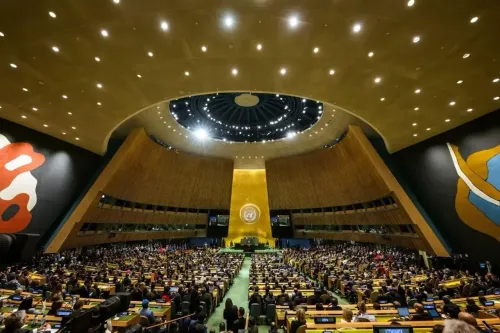
Developing nations from Africa, the Caribbean, and the Pacific used the floor of the UN General Assembly on 27 September 2026 to demand a sweeping overhaul of global lending and climate-finance rules, arguing that the current international financial architecture forces vulnerable countries to borrow repeatedly to repair damage caused overwhelmingly by wealthier, higher-emitting economies.
The Core Grievance
Speaker after speaker linked three compounding crises — climate disasters, rising sovereign debt, and stalled development — to a financial system they described as structurally biased against the Global South. Cameroon Foreign Minister Mbella Mbella acknowledged that resources for development existed but remained out of reach for poorer nations. 'This means reforming the international financial architecture to give countries of the Global South a fair shot,' he said, also calling for implementation of existing commitments ahead of the 2030 Sustainable Development Goals deadline.
Small Island States: Borrowing to Survive
Samoa's Deputy Prime Minister and Finance Minister Mulipola Anarosa Ale Molioo put the injustice in stark terms: 'No nation should have to borrow its way out of a crisis it did so little to create.' She argued that the present architecture failed to account for the distinct circumstances of small island developing states (SIDS) and called for a stronger debt-restructuring framework alongside the adoption of a multidimensional vulnerability index in lending decisions — a mechanism that would weigh exposure to climate shocks and structural risks rather than relying primarily on per capita income.
Saint Lucia Prime Minister Philip Pierre framed climate finance as a matter of survival, not aid. 'Climate finance is not charity,' he said. 'It is about justice, responsibility, and survival.' He noted that loans could not be considered justice when vulnerable countries were compelled to borrow to repair destruction they did not cause.
Saint Vincent and the Grenadines Prime Minister Godwin Friday described climate change as a recurring financial emergency. 'We cannot continue to walk up the down escalator, pretending it is development,' he said, calling for concessional finance calibrated to actual climate exposure and response capacity rather than income-based classifications that can exclude highly vulnerable island economies.
Africa's Debt Dilemma
South Africa Foreign Minister Ronald Lamola widened the argument to encompass the entire African continent. He said many governments were being forced to choose between meeting citizens' needs and satisfying creditors, and that African countries had spent roughly as much servicing debt over the past year as was required to close the continent's infrastructure financing gap. Climate responses, he said, were 'severely constrained by a climate finance architecture stacked against developing nations.'
Jamaica's Hurricane Warning
Jamaica Foreign Minister Kamina Johnson Smith illustrated the scale of climate-driven economic damage with a stark statistic: Hurricane Melissa in October 2025 caused damage and losses estimated at 56.7% of Jamaica's entire annual economic output. 'One hurricane can still erase decades of progress,' she said, calling for climate finance that was more accessible, affordable, and predictable. The example underscored why small island states argue that income classifications alone are an inadequate basis for lending eligibility.
India's Role and the Reform Push
The demands echo a broader reform agenda that India advanced during its G20 presidency in 2023, when it pushed for restructuring multilateral development banks and expanding their capacity to finance development and climate priorities. The UN appeals align with India's wider position that international financial institutions must give developing countries a stronger voice and greater access to capital. Multilateral lenders have faced mounting pressure to expand financing, accelerate post-disaster disbursements, and factor vulnerability into lending criteria — a shift that could reshape how trillions of dollars in climate and development funds are allocated in the years ahead.
Point of View
Yet multilateral institutions have moved slowly. India's G20 reform push in 2023 seeded the vocabulary; the question is whether the 2026 UNGA session can convert rhetorical consensus into binding commitments on debt restructuring and vulnerability-indexed financing — or whether this joins the long catalogue of eloquent speeches that preceded no structural change.
NationPress
27 Sept 2026
Frequently Asked Questions
What did Global South nations demand at UNGA 2026?
Developing nations from Africa, the Caribbean, and the Pacific called for a comprehensive overhaul of global lending and climate-finance rules at the UN General Assembly on 27 September 2026. They argued that the current system forces vulnerable countries to borrow repeatedly to recover from climate disasters they did little to cause, and demanded larger, more accessible, and condition-free climate finance.
What is a multidimensional vulnerability index and why are small island states demanding it?
A multidimensional vulnerability index is a proposed lending criterion that would measure a country's exposure to climate shocks and structural risks, rather than relying mainly on per capita income. Small island states like Samoa argue that income-based classifications can make them appear financially capable while concealing their catastrophic exposure to climate disasters.
How much damage did Hurricane Melissa cause Jamaica?
Hurricane Melissa, which struck in October 2025, caused damage and losses estimated at 56.7% of Jamaica's annual economic output, according to Foreign Minister Kamina Johnson Smith. The figure was cited at UNGA to illustrate how a single climate event can erase decades of national economic progress.
What is Africa's position on climate finance and debt?
South Africa Foreign Minister Ronald Lamola said many African governments are being forced to choose between meeting citizens' needs and satisfying creditors. He noted that African countries spent roughly as much servicing debt over the past year as would be needed to close the continent's entire infrastructure financing gap.
How does India's role connect to the Global South demands at UNGA?
India used its G20 presidency in 2023 to advance reform of multilateral development banks, pushing for greater financing capacity for development and climate priorities. The demands at UNGA 2026 align with India's broader position that international financial institutions must give developing countries a stronger voice and greater access to capital.