Hormuz vessel strike may push South Korea to join US-led maritime mission
Synopsis
Two unidentified flying objects confirmed to have struck South Korean-operated cargo vessel Namu in the Strait of Hormuz, leaving a 7-metre hull rupture. The findings could be the tipping point that pulls Seoul into the US-led Maritime Freedom Construct — a decision Seoul has carefully avoided until now.
Key Takeaways
Two "unidentified flying objects" confirmed to have struck cargo vessel Namu , operated by HMM Co. , in the Strait of Hormuz .
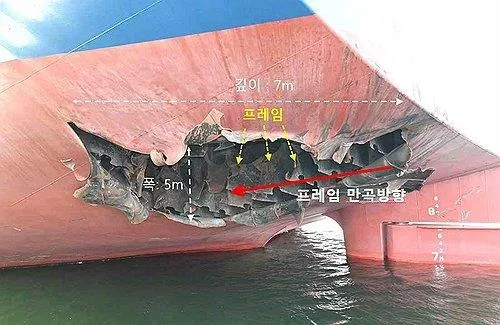
The attack left a 7-metre-wide rupture in the hull; all 24 crew members , including six South Koreans , were unharmed.
South Korea's foreign ministry has not yet identified the objects or attributed responsibility, citing investigation limitations.
US President Donald Trump claimed Iran was behind the strike and pressed Seoul to join Hormuz security efforts.
Seoul is now conducting a "close review" of joining the US-proposed Maritime Freedom Construct (MFC) .
If forces are deployed, the Cheonghae Unit , currently in the Gulf of Aden , is the most likely candidate.
A confirmed strike on a South Korean-operated cargo vessel in the Strait of Hormuz is expected to give Seoul fresh grounds to consider joining US-led missions aimed at safeguarding freedom of navigation in the strategically critical waterway, experts said on Sunday, 10 May.
What the Investigation Found
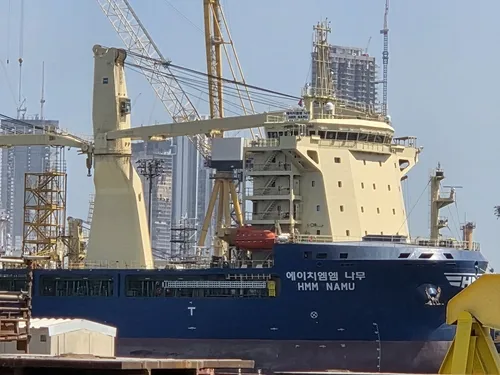
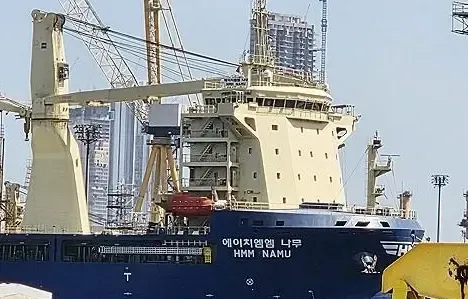
The South Korean foreign ministry released the results of a government investigation confirming that two "unidentified flying objects" struck the cargo vessel, the Namu, one after the other in the Strait of Hormuz last Monday. The Panama-flagged vessel, operated by South Korean shipping firm HMM Co., suffered an explosion and fire while stranded in the strait.
A seven-member government team conducted an on-site investigation aboard the vessel after it was towed to a port in Dubai on Friday. The attack left a 7-metre-wide rupture in the hull. Notably, no injuries or casualties were reported among the 24 crew members on board, including six South Koreans.
The foreign ministry said it has yet to identify the exact model or size of the flying objects due to unspecified "limitations", and added it would not prejudge responsibility for the attack, with further analysis to follow.
Pressure Mounts on Seoul to Act
Experts say the new findings could serve as a turning point for Seoul, which has so far kept a low profile on the possibility of joining the US-proposed Maritime Freedom Construct (MFC) — an initiative aimed at enhancing security-related information sharing in the strait and combining diplomatic action with military coordination.
Following the explosion, US President Donald Trump initially claimed that Iran had "taken some shots" at the cargo ship and pressed Seoul, saying it was time for the country to join a mission to keep shipping moving through the Strait of Hormuz. Analysts say the confirmed findings could further fuel US pressure on Seoul to participate.
What the South Korean Government Said
Foreign ministry spokesperson Park Il said the government would "pursue every possible measure, including cooperation with the international community to prevent a recurrence." He added that a "close review is under way on the issue of joining US plans, including the Maritime Freedom Construct."
The defence ministry said: "We will carefully review our position, taking into account international law, the safety of international sea lanes, the South Korea-US alliance, security conditions on the Korean Peninsula and domestic legal procedures."
Possible South Korean Contributions
Any immediate South Korean contribution in the Strait of Hormuz would likely be non-combat in nature — such as intelligence sharing or the dispatch of liaison officers — as Seoul remains cautious about deploying military assets in the region. If a decision to deploy forces is taken, many observers say Seoul would most likely dispatch the Cheonghae Unit, currently on an anti-piracy mission in the Gulf of Aden off the Somali coast.
The outcome of Seoul's deliberations could have significant implications for the broader US-led coalition effort in the Hormuz corridor, at a time when regional tensions continue to run high.
Point of View
A significant energy supplier. The Namu strike changes that calculus — not because it proves Iranian involvement, which South Korea has deliberately left open, but because the domestic and allied pressure to act is now harder to deflect. The Maritime Freedom Construct is a relatively low-commitment entry point, and Seoul's language — 'close review under way' — signals a policy shift is already in motion. The real question is whether Seoul can find a non-combat formula that satisfies Washington without triggering a diplomatic rupture with Tehran.
NationPress
23 Sept 2026
Frequently Asked Questions
What happened to the South Korean cargo vessel in the Strait of Hormuz?
Two unidentified flying objects struck the Panama-flagged cargo vessel Namu, operated by South Korean firm HMM Co., in the Strait of Hormuz, causing an explosion and fire. The attack left a 7-metre-wide rupture in the hull, though all 24 crew members were reported safe.
What is the Maritime Freedom Construct (MFC)?
The Maritime Freedom Construct is a US-proposed initiative aimed at enhancing security-related information sharing in the Strait of Hormuz and combining diplomatic action with military coordination. South Korea has so far kept a low profile on joining the MFC but is now conducting a formal review.
Has South Korea identified who attacked the Namu?
No. South Korea's foreign ministry said it would not prejudge responsibility and cited limitations in identifying the exact model or size of the objects. Further analysis is ongoing.
What role could South Korea play in Hormuz security?
Any immediate South Korean contribution would likely be non-combat, such as intelligence sharing or liaison officer deployment. If military forces are deployed, the Cheonghae Unit — currently on anti-piracy duty in the Gulf of Aden — is considered the most probable asset.
What did US President Trump say about the attack?
President Donald Trump initially claimed Iran had 'taken some shots' at the cargo ship and pressed South Korea to join efforts to keep shipping moving through the Strait of Hormuz, increasing diplomatic pressure on Seoul to act.