Houthis seize Kharaz base in Lahj, closing in on Yemen's Aden
Synopsis
Houthi forces have seized the Kharaz military base in Yemen's Lahj province, the last major defensive buffer before Aden — and the coalition defending it is visibly fracturing. With the Giants Brigades crumbling and the Southern Transitional Council sitting out the fight, the fall of a city that hosts Yemen's internationally recognised government suddenly looks less unthinkable.
Key Takeaways
Houthi fighters captured the Kharaz military base in Lahj province on 15 November 2026 , advancing toward Aden .
The base was described by a military source as 'a crucial defensive line' for Aden's western approaches and routes to the Bab al-Mandeb Strait .
The Giants Brigades , a key anti-Houthi formation, reportedly suffered rapid and unexpected defeats, signalling a collapse in combat effectiveness.
Divisions between Saudi Arabia and the Southern Transitional Council (STC) have left anti-Houthi ranks fragmented, with the STC largely absent from the current offensive.
Yemen has been at war since 2014 ; the Saudi-led coalition intervened in 2015 but has failed to deliver a decisive outcome.
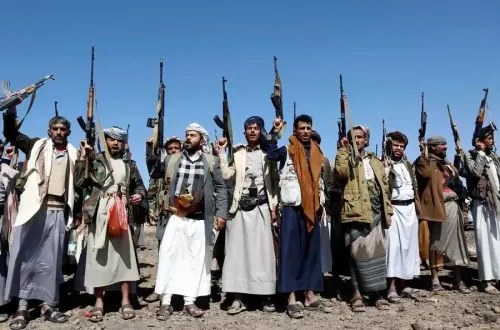
Houthi fighters seized the strategic Kharaz military base and several surrounding mountain positions in the southern Yemeni province of Lahj early Sunday, 15 November 2026, pushing government forces closer to the walls of Aden — the temporary seat of Yemen's internationally recognised government. Two military sources confirmed the development, saying the advance represents one of the most significant battlefield shifts in the region in months.
Key Developments on the Ground
The Kharaz base, located in Lahj's Al-Madaribah wa Al-Arah district, sits near the Bab al-Mandeb Strait and the Gulf of Aden — a vital maritime chokepoint linking the Red Sea to global shipping lanes. Following fierce clashes, government troops were forced to retreat, with one source on the ground calling the loss 'a major battlefield setback,' noting the base had served as 'a crucial defensive line protecting the western approaches to Aden.'
Retreating forces are reportedly constructing new fortifications along Aden's western perimeter to slow any further Houthi advance. 'The Houthis are moving closer to Aden as government forces continue to lose ground,' the source said.
Cracks in the Anti-Houthi Coalition
A second military source attributed the setbacks in part to the faltering performance of the Giants Brigades, a powerful formation previously anchored to Aden. The source described the unit as having suffered 'unexpectedly rapid defeats,' signalling a sharp erosion of its combat effectiveness under current Saudi-led military arrangements.
Crucially, the source also pointed to deepening divisions between Saudi Arabia and the Southern Transitional Council (STC) — an influential separatist bloc with substantial military capability that has, according to reports, largely stayed out of the latest offensive. 'Weakening the southern forces will only give the Houthis more room to advance,' the source warned.
Why Bab al-Mandeb Matters
The Saudi-led coalition's renewed push was aimed specifically at securing the Bab al-Mandeb Strait, through which an estimated 10% of global trade passes. Houthi control or influence over territory adjacent to this chokepoint has already rattled international shipping, with the group having previously targeted commercial vessels transiting the strait. Any further advance toward Aden would tighten their strategic grip on the southern coast.
A Decade of Conflict — and What Comes Next
Yemen has been engulfed in war since late 2014, when Houthi forces seized the capital Sanaa and large swaths of northern Yemen. Saudi Arabia intervened militarily in 2015 in support of the internationally recognised government, triggering what the United Nations has described as one of the world's worst humanitarian crises. Despite years of coalition air power and ground operations, neither side has achieved a decisive breakthrough.
The latest Houthi gains, combined with internal fractures among anti-Houthi factions, could reshape the coalition's military calculus and pressure international mediators to accelerate ceasefire talks. How the STC responds in the coming days will be a critical variable.
Point of View
The geopolitical cost of a Houthi advance to Aden's doorstep extends well beyond Yemen's borders.
NationPress
15 Nov 2026
Frequently Asked Questions
What happened at the Kharaz military base in Yemen?
Houthi fighters seized the Kharaz military base in Lahj's Al-Madaribah wa Al-Arah district on 15 November 2026, forcing government troops to retreat. The base had served as a key defensive line protecting the western approaches to Aden and routes to the Bab al-Mandeb Strait.
Why is the fall of Kharaz strategically significant?
Kharaz sits near the Bab al-Mandeb Strait, a critical maritime chokepoint through which a significant share of global trade passes. Its capture brings Houthi forces closer to Aden, the temporary capital of Yemen's internationally recognised government, and tightens their potential grip on the southern coast.
What is the Southern Transitional Council and why does it matter here?
The Southern Transitional Council (STC) is an influential Yemeni separatist group with substantial military strength. Military sources say it has largely stayed out of the latest anti-Houthi offensive, weakening the coalition at a critical moment and giving Houthi forces more room to manoeuvre.
How long has the Yemen conflict been going on?
Yemen has been at war since late 2014, when Houthi forces seized the capital Sanaa. Saudi Arabia launched a military intervention in 2015 to restore the internationally recognised government, but the conflict has since become a prolonged stalemate with severe humanitarian consequences.
What happens next in Yemen after the Houthi advance?
Retreating government forces are reportedly building new fortifications along Aden's western approaches. The coming days will be shaped by whether the Southern Transitional Council re-engages militarily and how the Saudi-led coalition responds to the loss of Kharaz. International pressure for ceasefire negotiations may also intensify.