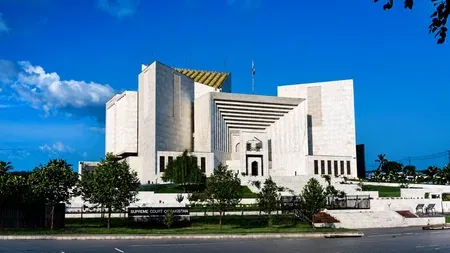
Pakistan courts under executive control after 26th, 27th amendments: ICJ
Synopsis
The International Commission of Jurists has formally declared Pakistan's courts 'captured' — concluding that the 26th and 27th constitutional amendments handed political branches direct control over the Supreme Court, High Courts, and Federal Constitutional Court. The finding marks a stark escalation in international scrutiny of Islamabad's democratic trajectory.
Key Takeaways
The International Commission of Jurists (ICJ) released a report on 19 November 2026 concluding that Pakistan's judiciary has been placed under executive control.
The 26th amendment (passed October 2024 ) and 27th amendment (passed November 2025 ) are cited as the primary instruments of this shift.
The ICJ says the changes violate Article 14 of the ICCPR and the UN Basic Principles on the Independence of the Judiciary .
ICJ Secretary-General Santiago Canton said the government used public frustration with courts as a pretext for political capture, without fixing underlying problems.
The ICJ has called for the offending provisions of both amendments to be revised or repealed .
The report links judicial erosion to broader democratic backsliding and says victims of rights abuses now lack an effective legal remedy.
The International Commission of Jurists (ICJ) has concluded that a series of constitutional changes in Pakistan have effectively placed the country's highest courts under executive control, stripping the judiciary of the independence required under international law. The Geneva-based rights body released its findings on Wednesday, 19 November 2026, in a report titled Judicial Capture: Independence of the Judiciary in Pakistan after the 26th and 27th Constitutional Amendments.
What the ICJ Found
The report examines the legal framework now governing Pakistan's High Courts, the Supreme Court, and the Federal Constitutional Court in light of the country's obligations under international law. It concludes that the amendments, along with the manner in which they were implemented, have stripped Pakistan's top courts of the independence guarantees required under Article 14 of the International Covenant on Civil and Political Rights (ICCPR) and the UN Basic Principles on the Independence of the Judiciary.
The report comes one year after the 27th amendment was passed in November 2025, and two years after the 26th amendment was passed in October 2024.
ICJ Secretary-General's Warning
ICJ Secretary-General Santiago Canton said the two amendments had 'placed Pakistan's highest courts under the control of the executive.' He warned that once courts are captured, there is no institution left to hold the government accountable, and victims of rights abuses are left without recourse.
Canton acknowledged that Pakistan's judiciary had been in need of reform — citing opaque appointment processes and instances of courts overstepping into legislative or executive domains. However, he argued that none of those underlying problems had been addressed. Instead, according to Canton, the government had exploited public frustration with the courts as a pretext to bring them fully under political control.
Impact on Human Rights and Democracy
The ICJ directly linked the erosion of judicial independence to a broader pattern of democratic backsliding in Pakistan. It said the changes had seriously weakened the judiciary's capacity to serve as a check on the government and had undermined victims' right to an effective remedy under Article 2(3) of the ICCPR — a treaty to which Pakistan is a signatory.
Notably, the report frames judicial capture not merely as an institutional concern but as a human rights crisis, arguing that citizens alleging abuses now have no independent forum in which to seek justice.
What the ICJ Is Demanding
The body has called for all provisions within the 26th and 27th amendments that are inconsistent with international standards on judicial independence to be either revised or repealed. The ICJ stopped short of specifying a timeline, but the report signals that international scrutiny of Pakistan's legal reforms is intensifying.
This is not the first time Pakistan's constitutional amendments have drawn international concern — the country's judiciary has faced recurring criticism over interference from both civilian governments and the military establishment. With the ICJ now formally documenting 'judicial capture,' pressure on Islamabad from multilateral human rights bodies is likely to grow.
Point of View
And what much of the coverage underplays, is the cumulative nature of the damage: the 26th amendment alone was alarming; the 27th, passed just a year later, closed the remaining gaps. The government's argument that the reforms addressed a dysfunctional judiciary is not without factual basis — Pakistan's courts have a documented history of overreach — but the ICJ's rebuttal is sharp: none of the actual dysfunction was fixed. The pretext of reform was used to achieve capture. That distinction matters enormously for how the international community should respond, and for whether Pakistan's civil society has any institutional leverage left.
NationPress
20 Nov 2026
Frequently Asked Questions
What is the ICJ report on Pakistan's judiciary about?
The ICJ report, titled 'Judicial Capture: Independence of the Judiciary in Pakistan after the 26th and 27th Constitutional Amendments,' concludes that constitutional changes passed in 2024 and 2025 have placed Pakistan's Supreme Court, High Courts, and Federal Constitutional Court under effective executive control. It finds these changes incompatible with Pakistan's obligations under international human rights law.
What are the 26th and 27th constitutional amendments in Pakistan?
The 26th constitutional amendment was passed in October 2024 and the 27th in November 2025. Together, according to the ICJ, they restructured judicial appointments and governance in ways that transferred control over the country's top courts to the political branches of the state, undermining judicial independence.
Why does the ICJ say this matters for human rights?
The ICJ argues that an executive-controlled judiciary cannot serve as an independent check on government power or provide effective remedies to victims of rights abuses. It says this violates Article 2(3) of the ICCPR, which guarantees the right to an effective remedy — a treaty Pakistan has ratified.
Did the government have any justification for the amendments?
ICJ Secretary-General Santiago Canton acknowledged that Pakistan's judiciary needed reform, citing opaque appointments and instances of judicial overreach. However, he said none of those problems were actually addressed by the amendments — instead, public frustration was used as a pretext to bring courts under government control.
What is the ICJ calling for?
The ICJ has called for all provisions of the 26th and 27th amendments that are inconsistent with international standards on judicial independence to be revised or repealed. The body has not specified a deadline but has signalled that international monitoring of Pakistan's legal framework will continue.