IMF's Limited Flexibility on Fuel Subsidies Poses Economic Risks for Pakistan
Synopsis
Discover how the IMF's shifting stance on Pakistan's fuel subsidies amidst rising global oil prices reveals significant economic challenges for the nation. This report highlights the delicate balance between immediate relief and long-term stability.
Key Takeaways
Global oil prices are impacting Pakistan's economic stability.
The IMF is showing flexibility but insists on fiscal discipline.
Pakistan faces a challenge balancing immediate relief with long-term stability.
Energy sector reforms are critical for economic sustainability.
The geopolitical landscape complicates fiscal planning for Pakistan.
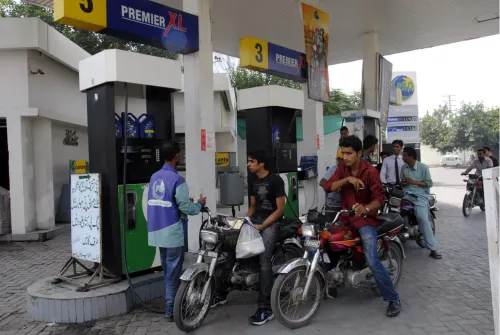
New Delhi, March 31 (NationPress) The recent increase in global oil prices is putting pressure on Pakistan's already vulnerable macroeconomic stability, according to a recent report. The International Monetary Fund (IMF) has shown a new level of tolerance towards Islamabad's choice to maintain domestic fuel prices, indicating a potential shift in strategy.
The report from Dawn points out that while the government’s move to shield citizens from escalating fuel costs is politically logical, it is ultimately economically unfeasible.
Recent conflicts in the West Asian region have added an element of uncertainty to the IMF's backing of Pakistan, complicating fiscal planning efforts.
As a result, the IMF program has transitioned from being a mere tool for stabilisation to a rigorous test of the nation's resilience, as stated in the report.
The IMF’s willingness to accept Pakistan’s approach to keeping fuel prices stable indicates a degree of pragmatic flexibility; however, the organization still mandates strict fiscal discipline and targets for primary surplus.
This situation compels Islamabad to juggle immediate relief efforts with long-term stability, as highlighted by the Pakistan-based media outlet. The ongoing crisis threatens to undermine recent progress in managing inflation, external accounts, and currency stability.
The IMF has also issued a warning that distortions in the energy sector must be addressed and that structural reforms need to be expedited.
“The focus on maintaining a primary surplus while avoiding non-targeted subsidies illustrates a fundamental conflict,” the report noted.
According to the IMF, the strife in the Middle East poses challenges to the economic outlook, as fluctuating energy prices and stricter global financial conditions threaten to elevate inflation and hinder growth and the current account.
The report emphasized that the latest staff-level agreement between the IMF and Pakistan has arrived at a particularly tumultuous time, with interruptions in energy flow through the Strait of Hormuz exerting pressure on the nation’s inflation levels.
“Any prolonged disruption will inevitably spread inflationary pressures across economies reliant on imports, with few being as vulnerable as Pakistan,” the report remarked.
The IMF's expectations for Islamabad to absorb external shocks, safeguard its citizens, and continue fiscal consolidation become increasingly precarious as the Middle East crisis intensifies.
aar/na
Point of View
This report highlights critical economic concerns facing Pakistan as it navigates the complexities of fuel subsidies amidst rising oil prices. The delicate balance between immediate political decisions and sustainable economic policies underscores the need for strategic planning.
NationPress
28 Jul 2026
Frequently Asked Questions
What impact do rising oil prices have on Pakistan's economy?
Rising oil prices can exacerbate inflation, increase fiscal deficits, and challenge economic stability, particularly in import-dependent economies like Pakistan.
How has the IMF responded to Pakistan's fuel subsidy policies?
The IMF has shown a pragmatic flexibility in accepting Pakistan's fuel price policies but maintains that fiscal discipline and structural reforms are essential.
What are the potential risks of maintaining fuel subsidies?
Maintaining fuel subsidies can lead to economic imbalances, increased fiscal pressure, and hinder necessary structural reforms.
How does the Middle East conflict affect Pakistan's economy?
The Middle East conflict creates uncertainty in energy prices, which can lead to inflationary pressures and affect Pakistan's growth and current account.
What is the IMF's stance on Pakistan's economic management?
The IMF expects Pakistan to effectively manage external shocks while ensuring fiscal consolidation and protecting its citizens.