IMF Warns of Global Financial Strain Amid Middle East Conflict
Synopsis
The IMF warns that the ongoing conflict in West Asia is stressing the global economy, with rising debt levels and limited fiscal space hindering government responses. Explore the implications and recommendations for policymakers in these turbulent times.
Key Takeaways
The IMF warns of increased financial strain due to the Middle East conflict.
Governments face high debt levels and limited fiscal space.
Targeted support is preferred over broad fiscal stimulus.
Global public debt could reach 99% of GDP by 2028.
AI poses both opportunities and challenges for fiscal policy.
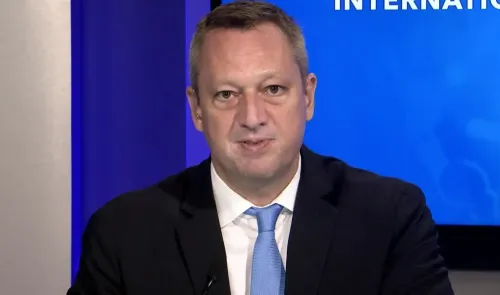
Washington, April 16 (NationPress) The global financial system is under renewed stress due to the ongoing conflict in West Asia, as the International Monetary Fund (IMF) highlights rising debt levels and constrained fiscal capabilities limiting governments' responses. Rodrigo Valdes, Director of the IMF’s Fiscal Affairs Department, noted on Wednesday that “the world economy is facing significant tests due to the Middle East war,” emphasizing that “public finances are increasingly strained across numerous nations.”
The IMF has advised governments against implementing broad fiscal stimulus in light of escalating pressures from higher food and fuel prices. Instead, targeted and temporary assistance should be prioritized to safeguard vulnerable households while maintaining market price indicators.
“Fiscal strategies should avoid discretionary demand stimulus,” Valdes warned, stating that such actions would complicate the central bank’s efforts in controlling inflation.
The Fund cautioned against widespread energy subsidies, labeling them as “fiscally burdensome, regressive, and difficult to dismantle,” while also distorting price signals and causing global repercussions.
IMF officials indicated that attempts by several countries to suppress prices could escalate global inflation. “If all nations pursue this strategy, we will encounter serious challenges,” Valdes remarked, stressing the importance of allowing market prices to reflect scarcity.
Officials clarified that the current economic shock differs from the Covid crisis, as it is primarily driven by supply issues. “Attempting to mitigate a supply shock by boosting demand will lead to increased inflation,” Valdes articulated.
Deputy Director Era Dabla-Norris pointed out that governments are now facing stricter fiscal limits compared to the pandemic era. “Countries have significantly less fiscal flexibility, and debt levels are high globally,” she stated.
While governments have employed a combination of tax reductions, subsidies, and price controls, the IMF observed that responses have been more cautious than during the energy crisis of 2022. Nonetheless, the Fund warned that poorly targeted measures could impose substantial long-term fiscal burdens.
Looking beyond immediate challenges, the IMF raised concerns about deteriorating medium-term debt dynamics. Global public debt is expected to reach 99% of GDP by 2028, with upside risks. In a worst-case scenario, debt could rise to 121% in three years due to geopolitical tensions, market fluctuations, and financial reassessment.
Higher interest rates are exacerbating these issues, with real borrowing costs approximately 0.6 percentage points above pre-pandemic levels. Additionally, shorter debt maturities and a greater reliance on private investors are making markets more susceptible to changes in sentiment.
The IMF recommended that once conditions stabilize, fiscal buffers should be rebuilt promptly. “Rebuilding fiscal buffers is crucial once stability returns, and it should not be delayed,” Valdes cautioned, noting that postponing consolidation would complicate future adjustments.
For low-income nations, the Fund emphasized the urgent need to enhance domestic revenue generation as external assistance diminishes and fiscal pressures increase.
The IMF also pointed out emerging structural challenges, including the financial implications of artificial intelligence. While AI has the potential to enhance tax administration and public service delivery, it may also “transform jobs” and “heighten inequality,” placing additional demands on social protection systems, Dabla-Norris remarked.
The IMF’s evaluation comes as governments contend with ongoing inflation, geopolitical uncertainties, and rising borrowing costs. Global policymakers are faced with the dual challenge of addressing immediate crises while ensuring long-term fiscal health.
Point of View
It is crucial to emphasize the significance of the IMF's warnings regarding the global financial landscape. The ongoing conflict in West Asia and its implications for fiscal policy should be a priority for policymakers, ensuring that immediate responses do not compromise long-term economic stability.
NationPress
7 Oct 2026
Frequently Asked Questions
What is the IMF's stance on fiscal stimulus amid the conflict?
The IMF advises against broad fiscal stimulus, recommending targeted support for vulnerable households instead.
How is the current economic shock different from the Covid crisis?
The current shock is primarily supply-driven, unlike the demand-driven issues seen during the Covid crisis.
What are the projected global public debt levels by 2028?
Global public debt is expected to rise to 99% of GDP by 2028, with potential risks leading it to 121% in severe scenarios.
What fiscal measures does the IMF recommend for low-income countries?
The IMF emphasizes the need for low-income countries to enhance domestic revenue mobilization as external aid decreases.
What challenges does artificial intelligence pose for fiscal policy?
AI may improve tax administration but could also reshape jobs and increase inequality, placing further demands on social protection systems.