Impact of Pakistan's Fuel Price Hike on Economy and Exports

Synopsis
Pakistan's fuel price surge to Rs 458.40 per litre is predicted to trigger food inflation and hamper the economy. A new report cites the IMF's influence and warns of serious repercussions for small businesses and export competitiveness.
Key Takeaways
Petrol prices raised to Rs 458.40 per litre.
Potential for food inflation due to increased production costs.
Impact on small businesses and transport sectors.
Criticism of IMF's stabilization approach .
Call for energy sector reforms beyond just pricing changes.
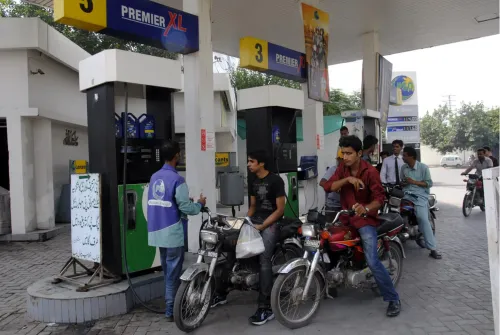
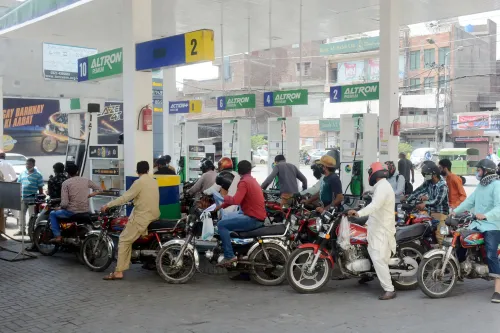
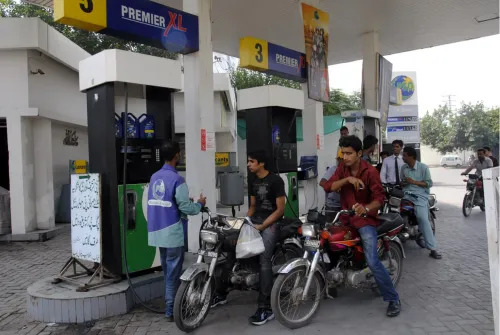
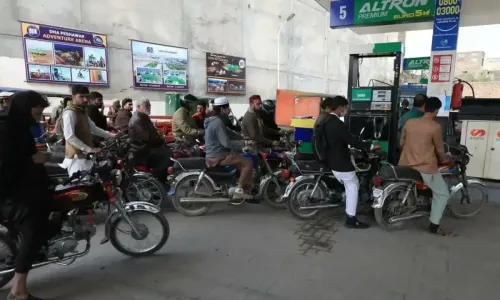
New Delhi, April 6 (NationPress) Pakistan's recent decision to increase petrol prices to Rs 458.40 per litre, with a petroleum levy of Rs 161 per litre, poses a risk of significant structural shock to an already vulnerable economy, according to a new report.
The report from Business Recorder indicates that the price hike, which is required under the conditions of the IMF program, will propagate through supply chains, leading to increased input costs, reduced margins, and ultimately hindering production.
This increase is also intended to generate revenue after the government failed to meet tax targets, but it may severely impact the viability of small and medium enterprises and sectors reliant on transportation.
The report highlights that a 63% rise in petrol and a 75% jump in high-speed diesel prices within a month are not mere adjustments; they reflect systemic issues. The nation’s already high logistics costs compared to its peers are expected to escalate further, diminishing both domestic and export competitiveness.
Moreover, the increase will elevate food production costs, fueling food inflation, yet the government seems to overlook these dangers due to IMF-imposed subsidy caps of Rs 152 billion.
The administration has opted for the simplest solution of fuel taxation, which is broad-based, hard to evade, and straightforward to manage.
Critics of the government argue that as economic activity declines, fuel consumption will also drop, thereby reducing the very revenue that the administration aims to boost. They point out that higher rates can lead to lower collections once a certain threshold is crossed.
Furthermore, the report criticizes the IMF’s approach, suggesting that its standard stabilization measures could place an undue burden on Pakistan’s documented economy given its narrow tax compliance and the prevalence of an informal sector.
The report concludes, “Pakistan has experienced this pattern previously: fiscal tightening without essential reforms results in economic exhaustion and political instability.”
Analysts are calling for the government to emphasize expenditure rationalization over mere revenue generation and to broaden the tax base. They also advocate for comprehensive reforms in the energy sector to extend beyond mere price adjustments and tackle structural inefficiencies.
Point of View
The recent fuel price increase in Pakistan reveals the complex interplay between financial obligations to international entities like the IMF and the pressing need for domestic economic stability. The challenges posed by this hike necessitate a careful evaluation of fiscal strategies to foster sustainable growth.
NationPress
26 Sept 2026
Frequently Asked Questions
What is the new petrol price in Pakistan?
The new petrol price in Pakistan has been set at Rs 458.40 per litre.
How does the fuel price hike affect the economy?
The fuel price hike is expected to inflate input costs, reduce profit margins, and result in food inflation, thereby posing a risk to economic stability.
What is the role of the IMF in this decision?
The IMF's program constraints necessitated this price hike as part of revenue mobilization efforts.
What are the potential impacts on small businesses?
Small and medium enterprises may suffer due to increased operational costs and reduced consumer spending resulting from the fuel price increase.
What recommendations have analysts made?
Analysts recommend prioritizing expenditure rationalization over revenue extraction and implementing structural reforms in the energy sector.