How are India and Belgium Strengthening Their Relations?
Synopsis
In a significant diplomatic meeting, Indian and Belgian diplomats convened in Brussels to strengthen bilateral ties. With discussions spanning trade, education, and collaboration in green technologies, this third round of Foreign Office Consultations heralds a new era of cooperation between the two nations.
Key Takeaways
Enhanced bilateral trade exceeding ten billion euros.
New educational agreements for Indian STEM students.
Focus on green hydrogen collaboration.
Joint defense exercises planned for 2026.
Commitment to a mutually beneficial India-EU FTA.
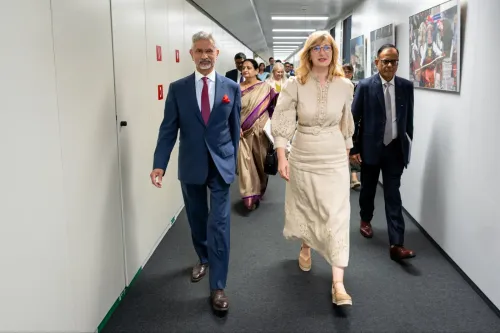
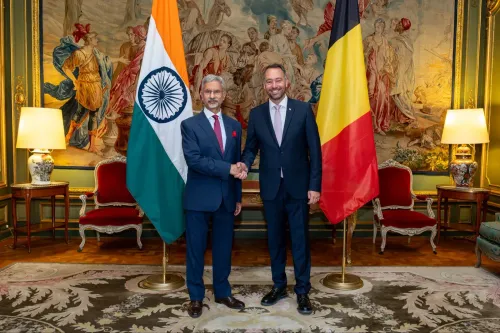
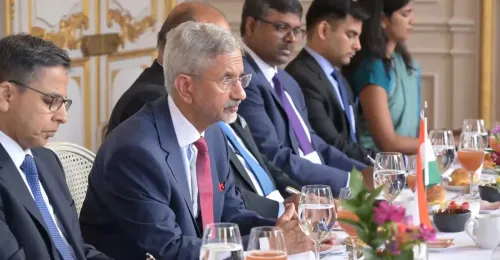
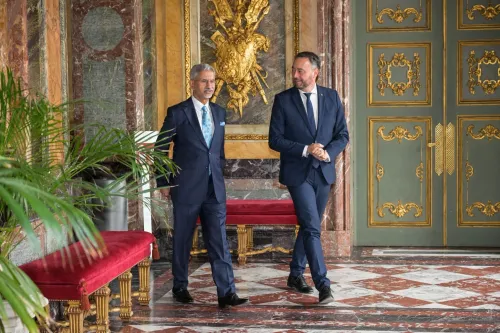
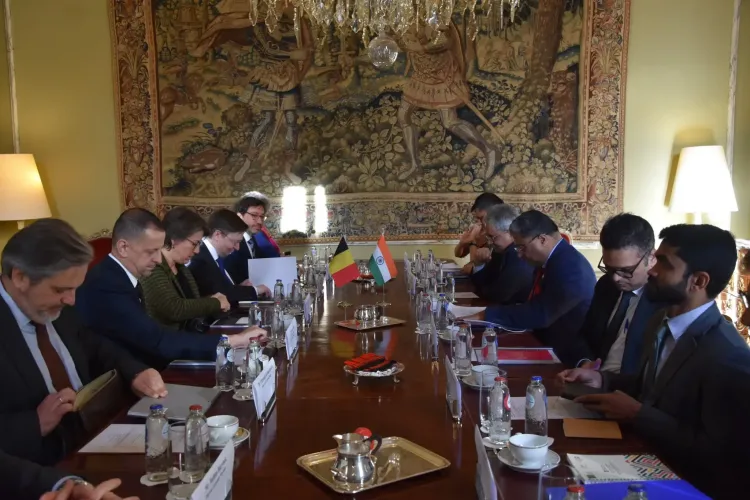
Brussels, Nov 4 (NationPress) Diplomats from India and Belgium convened at the magnificent Egmont Palace for the third round of Foreign Office Consultations between the two nations.
Secretary (West) Sibi George, who oversees India’s engagements in Europe from the South Block, was joined by Theodora Gentzis, the newly appointed President of Belgium’s Federal Public Service Foreign Affairs.
Eight months prior, Princess Astrid led a robust economic mission to Mumbai and Delhi with a delegation of 362 members.
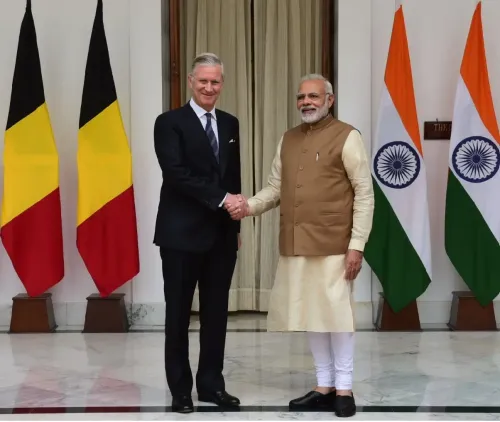
The two-hour dialogue commenced with fond memories of Belgian Deputy Prime Minister Petra De Sutter’s visit to Delhi and External Affairs Minister S. Jaishankar’s stop in Brussels, which have significantly boosted bilateral trade beyond the ten-billion-euro threshold.
Gentzis presented new statistics, revealing that Belgian investments in Indian sectors such as ports, pharmaceuticals, and diamonds have now surpassed four billion euros in total FDI, while Indian IT hubs in Antwerp and Ghent employ more than three thousand Europeans.
The discussion quickly shifted to upcoming priorities. Both nations committed to enhancing cooperation in green hydrogen, leveraging Belgium’s expertise in Zeebrugge and India’s facilities in Gujarat; in semiconductors, with IMEC’s Leuven cleanrooms set to train Indian engineers; and in defense, as joint exercises in the Arabian Sea are already planned for 2026.
Education was an unexpected highlight, with thirty new Memoranda of Understanding (MoUs) facilitating the transfer of five hundred Indian STEM scholars to Flemish universities next autumn, funded by a revitalized Belgian initiative.
The pivotal issue of the India-EU Free Trade Agreement (FTA) was addressed. With EU negotiators stationed in New Delhi until November 7 to discuss dairy quotas and data flows, George and Gentzis synchronized their discussions, aiming for a “balanced, fair and mutually beneficial” agreement by spring 2026, with Belgium advocating for India’s carbon-border adjustments within the Berlaymont.
Multilateral discussions ensued—covering G20 climate finance, UN Security Council reforms, and collaborative efforts to resolve shipping delays in the Red Sea.
The joint communiqué outlined plans for quarterly virtual meetings and a leaders’ summit slated for 2026.
For the numerous Belgian enterprises eyeing India’s infrastructure expansion and the countless Indian students aspiring to explore Leuven’s libraries, Brussels has effectively charted the path forward.
Point of View
It is crucial to recognize the importance of these consultations in fostering mutual growth and understanding between India and Belgium. The discussions not only reflect a commitment to economic collaboration but also highlight the significance of educational exchanges and shared global priorities. In an increasingly interconnected world, such dialogues pave the way for sustainable partnerships.
NationPress
26 Oct 2026
Frequently Asked Questions
What was discussed during the India-Belgium consultations?
The consultations focused on enhancing bilateral trade, cooperation in green technologies, education, and the progress of the India-EU Free Trade Agreement.
How will educational exchanges benefit Indian students?
The agreement includes sending five hundred Indian STEM scholars to Flemish universities, with tuition funded by a Belgian initiative.
What are the key areas of collaboration identified?
Key areas include green hydrogen, semiconductors, and defense, along with a commitment to address multilateral concerns.