India Collaborates with Russia to Tackle Common Challenges During BRICS Chairmanship: EAM Jaishankar
Synopsis
At a recent virtual conference, EAM Jaishankar highlighted India's commitment to enhancing ties with Russia under its BRICS chairmanship, focusing on collaborative efforts to confront shared challenges and boost bilateral trade.
Key Takeaways
India's BRICS chairmanship emphasizes a humanity-first and people-centric approach.
Strengthening ties with Russia to address mutual challenges is a priority.
Bilateral trade aims to reach $100 billion by 2030 .
Deepening cultural connections based on shared appreciation for art and culture.
New consulates in Yekaterinburg and Kazan will enhance diplomatic relations.
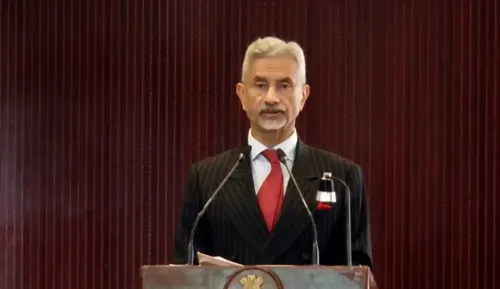
Moscow/New Delhi, March 23 (NationPress) - On Monday, External Affairs Minister (EAM) Jaishankar emphasized that India, under its current BRICS chairmanship, is committed to a humanity-first and people-centric strategy, aiming to enhance collaboration with Russia to tackle mutual challenges within a balanced and inclusive framework.
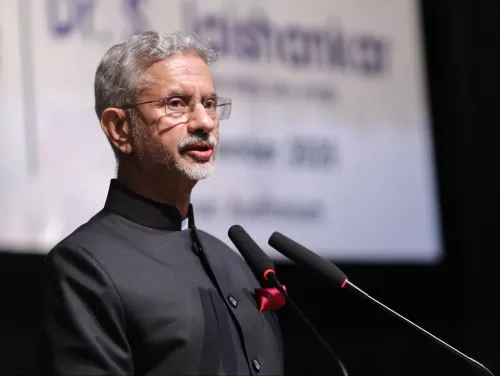
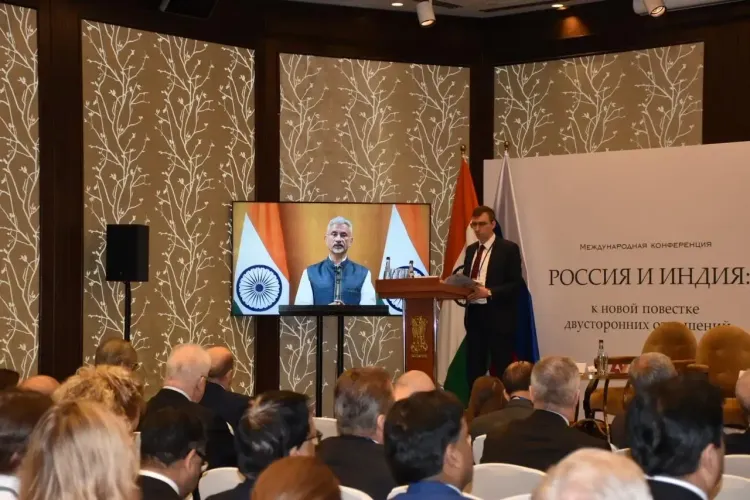
While addressing a conference named 'India and Russia: Towards a New Bilateral Agenda' via virtual means, EAM Jaishankar reiterated New Delhi's steadfast dedication to its enduring partnership with Moscow.
“During our BRICS leadership, India seeks to work closely with Russia to confront shared challenges in a balanced and inclusive manner... I want to reaffirm our unwavering commitment to fortifying our long-standing partnership and cherished friendship,” the EAM stated during his speech.
Reflecting on Russian President Vladimir Putin's recent visit to India in December 2025, he mentioned how it expanded bilateral relations into several new and diverse sectors.
“President Putin's visit to India in December 2025 was groundbreaking, covering various innovative areas such as the mobility of skilled professionals, health and food safety, maritime cooperation, fertilizers, customs and commerce, as well as academic and media collaboration,” EAM Jaishankar remarked.
He further emphasized that both India and Russia aspire to boost bilateral trade from the current $68.7 billion to $100 billion by 2030, doing so in a balanced and sustainable manner. To reach this goal, he stated that both nations must persist in efforts toward finalizing the India–Eurasian Economic Union (EAEU) Free Trade Agreement (FTA), addressing non-tariff barriers, regulatory challenges, and leveraging a skilled Indian workforce.
Highlighting the deepening cultural and civilizational links between the two nations, EAM noted, “Our people-to-people connections continue to flourish, founded on a shared appreciation for art, yoga, Ayurveda, and culture.”
He also mentioned that the exhibition of sacred relics of Shakyamuni Buddha from India in Kalmykia, Russia, last year exemplifies the close cultural bond between the two countries.
EAM Jaishankar expressed confidence that India's new consulates in Yekaterinburg and Kazan would further enhance economic, cultural, and social ties between the two nations.
He asserted that the evolving multipolar world demands greater cooperation through platforms such as BRICS, SCO, G20, and the UN.
EAM Jaishankar praised the collaboration of the Russian International Affairs Council and the Indian Embassy in Moscow for organizing the second consecutive edition of this initiative.
He also conveyed his regards to Russian Foreign Minister Sergei Lavrov, highlighting that India and Russia's unique and privileged strategic partnership is built on trust and mutual respect. EAM stated, “Over decades, our cooperative efforts have fostered regional and global peace, stability, and progress. In the context of today's evolving geopolitical landscape, our partnership continues to strengthen, propelled by frequent high-level exchanges.”
Point of View
India's proactive approach to strengthening ties with Russia during its BRICS chairmanship reflects a strategic commitment to address shared challenges and promote bilateral trade. This partnership, rooted in trust and mutual respect, is crucial for regional stability as both nations navigate complex global dynamics.
NationPress
26 Sept 2026
Frequently Asked Questions
What is the main focus of India's BRICS chairmanship?
India's BRICS chairmanship emphasizes a humanity-first and people-centric approach, aiming to deepen engagements with Russia to address common challenges in a balanced and inclusive manner.
What was discussed during President Putin's last visit to India?
President Putin's visit in December 2025 focused on expanding bilateral engagement into diverse areas, including skilled professionals' mobility, health, maritime cooperation, and more.
What are the trade goals between India and Russia by 2030?
Both nations aim to increase bilateral trade from $68.7 billion to $100 billion by 2030 through balanced and sustainable efforts.
What cultural ties exist between India and Russia?
India and Russia share deep cultural ties, showcasing appreciation for art, yoga, Ayurveda, and significant events like the exposition of sacred relics of Shakyamuni Buddha.
How does India plan to enhance its diplomatic presence in Russia?
India's new consulates in Yekaterinburg and Kazan are expected to strengthen economic, cultural, and social bonds between the two countries.