India-Africa ties built on capacity, not extraction: Report
Synopsis
A new India Narrative report makes a pointed case: India's Africa engagement — $93 billion in trade, $80 billion in investment, 80,000+ trained professionals, and an IIT campus in Zanzibar — is structured around capacity-building, not extraction. As global powers compete for Africa's strategic attention, the report frames India's model as a rare example of a genuinely reciprocal South-South partnership.
Key Takeaways
A new India Narrative report finds India's Africa engagement centres on capacity-building , contrasting it with colonial-era resource extraction.
India-Africa bilateral trade has reached approximately $93 billion , making India one of Africa's largest trading partners.
Indian investment in Africa exceeds $80 billion , spanning telecoms, energy, pharmaceuticals, agriculture, and digital services.
More than 80,000 Africans have received Indian scholarships and training over the past decade, producing engineers, doctors, diplomats, and technicians.
Over 190 lines of credit worth more than $10 billion have funded African infrastructure, from power plants to water systems.
Institutional initiatives include an IIT campus in Zanzibar and a forensic sciences institute in Uganda .
India's engagement with the African continent is rooted in capacity-building and structural transformation rather than resource extraction, according to a new report by India Narrative released on 7 August. The findings highlight a broad sweep of trade, investment, and human-capital initiatives that, the report argues, distinguish India's approach from that of colonial-era powers.
Key Findings of the Report
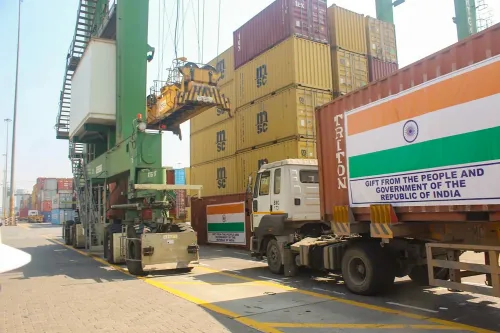
The India Narrative report notes that India deliberately refrains from fostering 'African dependency,' pointing instead to concrete humanitarian and developmental contributions. These include food grain shipments to African nations facing shortages, medical equipment supplied to Africa CDC during health emergencies, and artificial limbs provided to victims of conflict.
Notably, more than 80,000 Africans have benefited from Indian scholarship and training programmes over the past decade, entering careers as engineers, diplomats, doctors, and technicians — a scale of human-capital investment that few bilateral partnerships in the region can match.
Trade and Investment Footprint
India-Africa bilateral trade has climbed to approximately $93 billion, placing India among the continent's largest trading partners. Indian investment in Africa now exceeds $80 billion, spread across telecoms, energy, pharmaceuticals, agriculture, and digital services — sectors that African governments have themselves prioritised for long-term structural transformation, rather than the extraction of raw commodities.
The report further points to more than 190 lines of credit worth over $10 billion, which have financed infrastructure ranging from power plants to water systems across the continent.
Institutional Investments in Human Capital
Beyond financial flows, the report highlights institutional initiatives as evidence of a qualitatively different partnership model. An IIT campus in Zanzibar and a forensic sciences institute in Uganda are cited as examples of India investing directly in African human capital and institutional capacity.
'Too much of Africa's external engagement over the decades has been organised around what can be dug out of the ground and shipped away,' the report observed. By contrast, it argues that Africa's relationship with India — built around 'telecom towers, generic medicines and digital platforms' — 'speaks to a different kind of ambition.'
A Complementary Economic Combination
The report positions the India-Africa partnership as one of the more strategically significant economic combinations of this century, noting that 'Africa's demographic weight and India's technological momentum together represent one of the more compelling economic combinations of this century.'
It acknowledges, however, that India's model is 'imperfect,' describing it as 'a useful, if imperfect, case study in what a genuinely reciprocal partnership can look like' as Africa recalibrates its position in a shifting global order.
As geopolitical competition for African partnerships intensifies among major powers, the report's framing suggests India's development-first posture could serve as a differentiating advantage in the years ahead.
Point of View
But the report is careful to call the model 'imperfect,' which is the right hedge: India's own record on technology transfer, local content requirements, and labour practices in Africa is uneven. The IIT Zanzibar and Uganda forensics institute are genuinely differentiated moves, but they remain symbolic in scale relative to China's infrastructure footprint. The real test of India's 'reciprocal partnership' framing is whether it survives commercial pressure — when Indian pharma or telecom interests conflict with African regulatory priorities, which model wins?
NationPress
22 Sept 2026
Frequently Asked Questions
What does the India Narrative report say about India's engagement with Africa?
The report finds that India's Africa engagement is built around capacity-building — training, institutional investment, and sectoral development — rather than resource extraction. It cites trade of $93 billion, investment exceeding $80 billion, and over 80,000 Africans trained through Indian programmes as evidence of a structurally different partnership model.
How large is India-Africa bilateral trade?
India-Africa bilateral trade has climbed to approximately $93 billion, according to the report, placing India among the continent's largest trading partners. Indian investment in Africa separately exceeds $80 billion across telecoms, energy, pharmaceuticals, agriculture, and digital services.
How many Africans have benefited from Indian training programmes?
More than 80,000 Africans have benefited from Indian scholarship and training programmes over the past decade, the report states. Participants have gone on to work as engineers, diplomats, doctors, and technicians.
What infrastructure has India financed in Africa?
India has extended more than 190 lines of credit worth over $10 billion to African nations, financing projects including power plants and water systems. Institutional investments include an IIT campus in Zanzibar and a forensic sciences institute in Uganda.
How does India's Africa model differ from colonial-era engagement?
The report argues that colonial and some contemporary external engagements in Africa have been organised around commodity extraction. India's model, by contrast, is described as centred on telecom infrastructure, generic medicines, digital platforms, and human-capital development — sectors African governments have prioritised for structural transformation.