India pushes for drought resilience shift at UNCCD CoP17 in Mongolia
Synopsis
At UNCCD CoP17 in Ulaanbaatar, India's Environment Minister Bhupender Yadav made a pointed case that the world must stop treating drought as a disaster to be managed and start treating it as a risk to be prevented. Backed by India's own satellite-driven early warning and community watershed model, the call signals India's ambition to lead the global drought resilience agenda — not just participate in it.
Key Takeaways
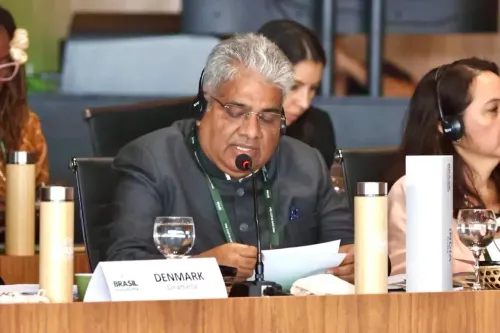
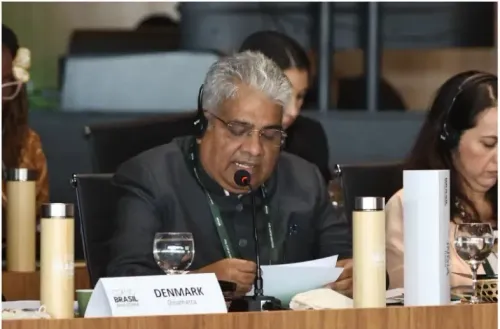
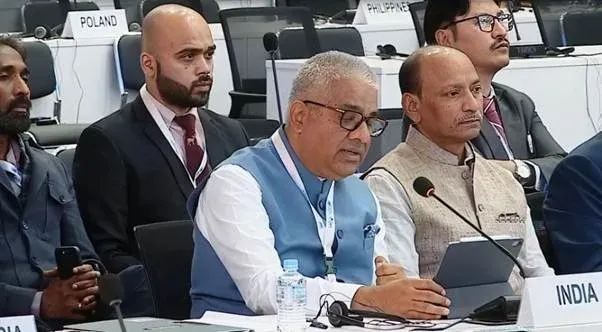
Bhupender Yadav addressed the Ministerial Dialogue at UNCCD CoP17 in Ulaanbaatar, Mongolia on 25 August .
He called for a global shift from reactive drought relief to proactive, technology-enabled resilience .
India uses satellite-based drought assessments and rainfall monitoring to trigger inter-ministerial and state-level preparedness.
A pan-India watershed programme addresses degraded rainfed lands using a ridge-to-valley approach integrated with rural employment schemes.
India offered to share its early warning systems and drought resilience knowledge with other nations.
Yadav stated drought must be treated as a 'predictable, preventable risk' — not a recurring disaster.
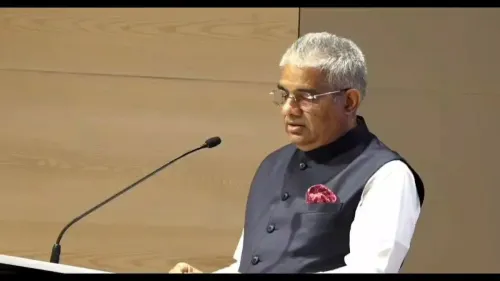
Union Minister for Environment, Forest and Climate Change Bhupender Yadav on Tuesday, 25 August called for a fundamental transformation in how the world responds to drought, speaking at the Ministerial Dialogue on 'Accelerating Drought Resilience' during the 17th Conference of the Parties (CoP17) of the UN Convention to Combat Desertification (UNCCD) in Ulaanbaatar, Mongolia. Yadav argued that drought is no longer a periodic emergency but a structural development crisis threatening water, food, biodiversity, and economic stability worldwide.
The Case for a Paradigm Shift
At the heart of Yadav's address was a direct challenge to the prevailing global model of drought management. He called for moving decisively away from reactive relief operations toward proactive, technology-enabled resilience. In his words, the governing principle must be: 'Preparedness over response, prevention over crisis management, resilience over recovery.'
He framed drought as a 'predictable, preventable risk' rather than a recurring disaster requiring emergency intervention — a framing that, if adopted globally, would shift both budgetary priorities and institutional mandates in member countries.
India's Multi-Institutional Approach
Yadav detailed India's own framework, which integrates early warning systems, mitigation strategies, relief mechanisms, and community resilience across multiple government tiers. Satellite-based drought assessments and rainfall monitoring, he said, trigger coordinated preparedness responses at both the inter-ministerial and state levels, ensuring that a dry spell does not escalate into a full-blown crisis.
Emphasising the link between land health and water availability, the minister invoked a pointed formulation: 'Restore the forest, before the flow' — underscoring India's investment in catchment and riverscape forestry to reduce erosion, improve water retention, and recharge groundwater. River rejuvenation and the revival of traditional water bodies were cited as additional pillars of rural drought resilience, according to the Ministry of Environment, Forest and Climate Change.
Community-Led and Watershed Programmes
Beyond large infrastructure, Yadav highlighted grassroots-level interventions: community-led restoration of springs and recharge zones in India's hill regions, and a pan-India watershed programme targeting degraded rainfed lands through a ridge-to-valley approach. These efforts are supported by community institutions and integrated with rural employment programmes, creating a convergence model that links ecological restoration to livelihood security.
Prevention measures cited included watershed development, water harvesting, afforestation, groundwater recharge, and the promotion of climate-resilient crop varieties, complemented by disaster relief funds, employment guarantees, fodder support, and emergency water supplies where required.
India's Offer to the World
Closing his address, Yadav affirmed India's readiness to share its knowledge, capacities, and early warning technologies with other nations to help build a drought-resilient future globally. He stressed that for the world's most vulnerable populations, drought resilience is not a policy option — it is a matter of survival.
This comes amid growing concern within the UNCCD framework that existing national drought plans remain underfunded and reactive, with CoP17 expected to push for binding commitments on drought preparedness targets. India's intervention positions it as an advocate for systemic reform rather than incremental adjustment.
Point of View
Preventable risk' is a direct rebuke of the global status quo, where emergency relief consistently crowds out long-term resilience investment. The real question is whether CoP17 produces binding preparedness targets or another round of voluntary commitments. India's offer to export its early warning model is strategically significant — but its domestic drought outcomes, particularly in rainfed agriculture, remain uneven. Credibility on the global stage will ultimately depend on how well the ridge-to-valley watershed model scales beyond pilot districts.
NationPress
25 Aug 2026
Frequently Asked Questions
What did India's minister say at UNCCD CoP17 in Mongolia?
Environment Minister Bhupender Yadav called for a fundamental global shift from reactive drought relief to proactive, technology-enabled resilience at the UNCCD CoP17 Ministerial Dialogue in Ulaanbaatar on 25 August. He presented India's integrated model of early warning, watershed development, and community-led restoration as a replicable framework.
What is UNCCD CoP17 and why does it matter?
The 17th Conference of the Parties (CoP17) of the UN Convention to Combat Desertification (UNCCD) is a major multilateral forum where member nations negotiate commitments on land degradation, desertification, and drought resilience. It matters because decisions made here shape national drought policies and international funding priorities for the world's most drought-vulnerable regions.
How does India manage drought through early warning systems?
India uses satellite-based drought assessments and rainfall monitoring to trigger preparedness responses at inter-ministerial and state levels before a dry spell escalates into a crisis. This is complemented by watershed development, groundwater recharge programmes, and community-led spring restoration.
What is India's pan-India watershed programme?
It is a national initiative that targets degraded rainfed lands using a ridge-to-valley approach, supported by community institutions and integrated with rural employment programmes. The programme aims to restore water retention, reduce erosion, and build long-term drought resilience in vulnerable agricultural regions.
Why did India stress 'restore the forest, before the flow' at CoP17?
The phrase encapsulates India's focus on catchment and riverscape forestry as a drought prevention strategy — restoring forest cover to reduce soil erosion, improve water retention, and recharge groundwater before water scarcity becomes acute. Yadav used it to highlight the direct link between land health and water security.