India vs Pakistan poverty gap: World Bank data shows 496 million lifted in India
Synopsis
World Bank data, highlighted in a European Times analysis, reveals one of the sharpest development divergences in South Asia: India lifted 496 million people out of extreme poverty in 12 years, cutting its rate from 27.1% to 2.6%, while Pakistan's rate surged from 16.5% to 23% — leaving it alone among larger South Asian economies in reversing poverty gains.
Key Takeaways
India cut extreme poverty from 27.1% in 2011 to 2.6% in 2023 , lifting roughly 496 million people above the $3-a-day line , per World Bank data.
Employment in India expanded by 134 million between 2017 and 2023 , nearly twice the growth of the working-age population.
Aadhaar -linked direct benefit transfers saved an estimated ₹3.48 lakh crore in leakage by 2024 .
Pakistan's extreme poverty rate rose from 16.5% in 2018-19 to 23.0% by 2024 , an increase of 6.4 percentage points , leaving roughly 58 million below the line.
Pakistan's Gini coefficient widened from 28.4 to 32.7 , signalling rising inequality alongside rising poverty.
Pakistan now accounts for approximately 48% of extreme poor in the World Bank's MNEAP region while holding under a third of its population.
India and Pakistan offer one of the starkest contrasts in modern development history, with World Bank data showing India lifting roughly 496 million people out of extreme poverty between 2011 and 2023, while Pakistan moved sharply in the opposite direction over a comparable period. The findings are drawn from the World Bank's Poverty and Equity Brief, released this month, and cited in an analysis published by European Times.
India's Poverty Decline: The Numbers
According to the World Bank brief, India's extreme poverty rate on the $3-a-day line fell from 27.1 per cent in 2011 to 2.6 per cent in 2023 — one of the fastest declines ever recorded for a large economy. The report attributes this to multiple structural drivers acting in concert rather than any single policy intervention.
Employment expanded by approximately 134 million between 2017 and 2023, nearly twice the growth of the working-age population over the same period. Notably, rural women entered paid work in unprecedented numbers, representing a qualitative shift in labour market participation. Food transfer programmes were extended to cover a majority of the population, while the delivery infrastructure built around Aadhaar identification and direct bank transfers significantly reduced leakage — saving an estimated ₹3.48 lakh crore by 2024, according to the report.
The European Times analysis underscores that these are not government self-assessments but independent evaluations from an institution whose data Pakistan itself cites when convenient.
Pakistan's Reversal: Rising Poverty, Widening Inequality
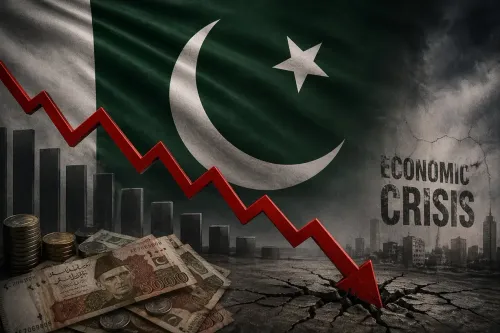
Over the same period, Pakistan's trajectory moved in the opposite direction. The World Bank data shows extreme poverty at the $3-a-day line rising from 16.5 per cent in 2018-19 to 23.0 per cent by 2024 — an increase of 6.4 percentage points, representing a relative jump of close to 40 per cent. This leaves roughly 58 million people below the poverty line.
Pakistan's own Planning Ministry recorded the national poverty rate climbing from 21.9 per cent to 28.9 per cent across the same period. Inequality widened alongside rising poverty, with the Gini coefficient increasing from 28.4 to 32.7, indicating that the burden of economic adjustment fell disproportionately on the most vulnerable households.
Pakistan's Outsized Share of Regional Poverty
The scale of Pakistan's reversal is thrown into sharper relief by its regional position. According to the report, Pakistan now accounts for approximately 48 per cent of the extreme poor across the World Bank's Middle East, North Africa, Afghanistan and Pakistan (MNEAP) region, while holding under a third of the region's population. Its poverty rate runs at roughly 1.6 times the regional average — a gap that has widened significantly in the past five years.
The European Times analysis frames the divergence as a policy choice rather than a fate: while India made poverty elimination the central organising principle of its economic policy, Pakistan reportedly treated the issue as a residual concern, to be addressed only after more powerful institutional interests in Islamabad were satisfied.
What the Contrast Reveals
The India-Pakistan comparison is notable precisely because both nations started from similar developmental baselines at the time of Partition. The divergence since — accelerating sharply after 2018 — reflects distinct policy architectures. India's combination of employment growth, digital welfare delivery via Aadhaar, and food security coverage built a floor under the poor even as the economy grew. Pakistan, critics argue, allowed elite-capture of institutional priorities to crowd out pro-poor spending during successive fiscal crises.
Analysts note this is the first time the World Bank data has placed Pakistan alone among the larger South Asian economies in reversing poverty reduction gains — a distinction that carries significant implications for international development aid and lending conversations ahead.
Point of View
And the gap is not close. What the European Times analysis correctly identifies — but mainstream coverage underplays — is that Pakistan's failure is not a resource problem but a prioritisation problem; the institutional interests in Islamabad consistently outranked the rural poor. India's achievement, meanwhile, is real but unevenly celebrated: the Aadhaar-DBT architecture delivered measurable results, yet the same system raises unresolved civil liberties questions that deserve scrutiny even in a success story. The more consequential point for South Asia watchers is that Pakistan now stands alone in reversing poverty gains among larger regional economies — a fact that will increasingly shape IMF programme conditions, World Bank lending, and bilateral aid calculus in the years ahead.
NationPress
12 Nov 2026
Frequently Asked Questions
How much did India reduce extreme poverty between 2011 and 2023?
India reduced extreme poverty on the $3-a-day line from 27.1 per cent in 2011 to 2.6 per cent in 2023, lifting roughly 496 million people above the threshold, according to the World Bank's Poverty and Equity Brief released this month. The World Bank describes this as one of the fastest declines in extreme poverty ever recorded.
What drove India's poverty reduction, according to the World Bank report?
The World Bank report attributes India's decline to three main factors: employment growth of approximately 134 million jobs between 2017 and 2023, expanded food transfer programmes, and an Aadhaar-linked direct benefit transfer system that cut leakage by an estimated ₹3.48 lakh crore by 2024. Rural women entering paid work in unprecedented numbers was flagged as a particularly significant structural shift.
How has Pakistan's poverty rate changed in recent years?
Pakistan's extreme poverty rate on the $3-a-day line rose from 16.5 per cent in 2018-19 to 23.0 per cent by 2024, a jump of 6.4 percentage points or close to 40 per cent in relative terms, leaving roughly 58 million people below the line. Pakistan's own Planning Ministry data also shows the national poverty rate rising from 21.9 per cent to 28.9 per cent over the same period.
How does Pakistan compare to other South Asian economies on poverty?
Pakistan is reportedly the only larger South Asian economy to have reversed its poverty reduction gains in the recent period, according to the European Times analysis of World Bank data. Pakistan now accounts for roughly 48 per cent of the extreme poor in the World Bank's MNEAP region while holding under a third of the region's population, with a poverty rate approximately 1.6 times the regional average.
What explains the divergence in poverty outcomes between India and Pakistan?
The European Times analysis, citing World Bank data, argues the divergence reflects a fundamental difference in policy priorities: India made poverty elimination the central purpose of economic policy, while Pakistan reportedly treated it as a residual concern to be addressed after more powerful institutional interests in Islamabad were satisfied. Critics note this allowed elite-capture of fiscal resources to repeatedly crowd out pro-poor spending during successive economic crises.