World Bank: India's extreme poverty rate fell to 2.6% in 2023, lifting 496 million people
Synopsis
The World Bank says India lifted 496 million people out of extreme poverty in roughly a decade — a number that exceeds the combined population of the US and Russia. The extreme poverty rate fell from 27.1% in 2011 to just 2.6% in 2023, driven by 7%-plus growth, 17 crore new jobs, and digital social protection. But 57% of India's remaining poor are clustered in a single geographic belt from UP to West Bengal, and the World Bank has flagged measurement caveats.
Key Takeaways
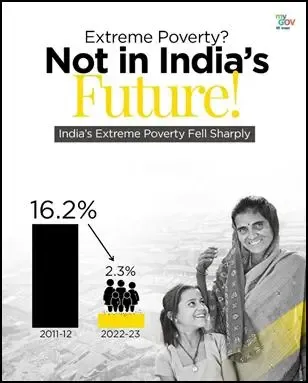
India's extreme poverty rate fell to 2.6% in 2023 from 27.1% in 2011 , according to the World Bank .
An estimated 496 million people were lifted out of extreme poverty — more than the combined population of the US and Russia .
Using the $4.2/day lower middle-income line, poverty declined from 57.7% to 16.1% over the same period.
Over 17 crore jobs were created between 2014 and 2024 ; unemployment dropped from 7.6% to 4.2% .
57% of India's remaining poor are concentrated in a belt from Uttar Pradesh to West Bengal .
The World Bank has cautioned that some gains may partly reflect measurement improvements rather than welfare gains alone.
India's extreme poverty rate plummeted to 2.6% in 2023 from 27.1% in 2011, according to a new World Bank brief, as sustained economic growth, rising household consumption, expanding employment, and broadening social protection programmes collectively lifted an estimated 496 million people out of extreme poverty over the past decade. The scale of the reduction — described in the brief as among the 'fastest poverty declines in the world' — exceeds the combined population of the United States and Russia, and is now being cited as a model for other developing economies.
Scale of the Reduction
Using a higher benchmark — the lower middle-income poverty line of $4.2 per day — the World Bank brief indicates the poverty rate declined to 16.1% from 57.7% over the same period, suggesting the gains extended well beyond the extreme-poverty threshold. The World Bank has, however, cautioned that some of the recorded improvement may partly reflect advances in measurement methodology alongside genuine welfare gains, and not solely on-the-ground progress.
Notably, the gains have not been evenly distributed. The brief flags that 57% of India's remaining poor population is concentrated in a contiguous belt stretching from Uttar Pradesh to West Bengal — a reminder that the aggregate headline masks deep regional inequalities.
Growth, Consumption and Employment
Sustained high economic growth was identified as the primary driver. India's economy averaged over 7% annual expansion during 2022–2025, recovering sharply from the pandemic-induced contraction, and maintained resilient growth across the broader 2010–2025 period. Household spending nearly doubled to $2.24 trillion in 2025, up from $1.24 trillion in 2015, underpinned by rising discretionary spending and premiumisation trends.
Employment creation was a significant secondary driver. According to the report, more than 17 crore jobs were added between 2014 and 2024, averaging 1.7 crore jobs per year. The national unemployment rate fell from 7.6% in 2015 to 4.2% in 2025. Rising female workforce participation was specifically cited as playing a 'significant role' in the poverty reduction record.
Role of Social Protection Programmes
The World Bank brief also attributed a major share of the decline to India's social assistance architecture. Key factors include increased digitalisation for scaling up welfare delivery, women-centric welfare schemes, agricultural and rural support mechanisms, and an overall broadening of social assistance coverage. This comes amid long-running policy debates about whether direct-benefit transfers and food security programmes leave lasting welfare improvements or primarily support consumption during shocks.
Lessons for Developing Countries
The report, cited by The Business Standard (Bangladesh), argues that India's combination of macroeconomic growth, job creation — particularly among women — and digitally-enabled social protection offers a replicable framework for developing nations seeking to compress their poverty timelines. Analysts note, however, that India's size, its pre-existing institutional infrastructure, and the specific sequencing of its reforms make direct replication complex. The World Bank's measurement caveat also signals that peer countries should invest in robust, comparable household survey data before drawing direct comparisons.
With roughly 16% of India's population still below the lower middle-income poverty line, the next phase of reduction will likely be harder to achieve — concentrated geographically, structurally linked to agrarian distress, and more resistant to aggregate growth alone.
Point of View
But the World Bank's own measurement caveat deserves more attention than it typically receives in coverage of this story — survey methodology changes can mechanically shift headline poverty numbers without a single rupee reaching a poor household. The more revealing datapoint is the geographic concentration: 57% of India's remaining poor in a contiguous UP-to-West Bengal belt signals that the easy, growth-led phase of poverty reduction may be over. What remains is structurally harder — agrarian, spatially clustered, and less responsive to aggregate GDP. India's next poverty chapter will be written in state capacity and targeted spending, not national growth averages.
NationPress
9 Nov 2026
Frequently Asked Questions
What does the World Bank report say about India's poverty reduction?
The World Bank brief states that India's extreme poverty rate fell to 2.6% in 2023 from 27.1% in 2011, with approximately 496 million people lifted out of extreme poverty — described as among the fastest poverty declines in the world. The brief attributes this to sustained economic growth, rising employment, higher household consumption, and expanded social protection.
How many jobs did India create between 2014 and 2024?
According to the report, India created over 17 crore jobs between 2014 and 2024, averaging 1.7 crore new jobs per year. The national unemployment rate dropped from 7.6% in 2015 to 4.2% in 2025, with rising female workforce participation cited as a key contributor.
Why has the World Bank issued a caution alongside the positive data?
The World Bank noted that some recent gains in poverty numbers could reflect improvements in measurement methodology alongside genuine welfare improvements, meaning not all of the statistical decline may correspond to actual on-the-ground income gains. This is a standard statistical caveat when survey methods are updated or expanded.
Which regions of India still have the highest poverty concentration?
According to the World Bank brief, 57% of India's remaining poor population is concentrated in a contiguous geographic belt stretching from Uttar Pradesh to West Bengal. This regional disparity highlights that aggregate national progress has not been evenly distributed across states.
What lessons does India's poverty reduction offer to other developing countries?
The report argues that India's combination of high economic growth, broad-based job creation — especially among women — digitally-enabled social protection, and agricultural support offers a potential framework for other developing nations. Analysts note, however, that India's institutional scale and the specific sequence of its reforms make direct replication complex.