India a Pivotal Actor in Global Geoeconomics, Says Ex-Foreign Secretary Nirupama Rao
Synopsis
Former Foreign Secretary Nirupama Rao's new report reframes India's global role: not a passive observer or cautious middle power, but a pivotal state with the economic, diplomatic, and intellectual heft to shape the new global order — if it chooses to lead, not merely react.
Key Takeaways
Former Foreign Secretary Nirupama Rao describes India as a pivotal state in a new report published in India Narrative .
The report warns that assumptions underpinning global politics for three decades post-Cold War are fundamentally shifting.
Trade, technology, finance, and supply chains have all become instruments of geopolitical statecraft , the report argues.
Rao calls for reform, not abandonment of multilateral institutions, framing rules-based cooperation as essential for developing nations.
India's strategic autonomy , demographic vitality, and diplomatic influence position it to actively shape the emerging global order.
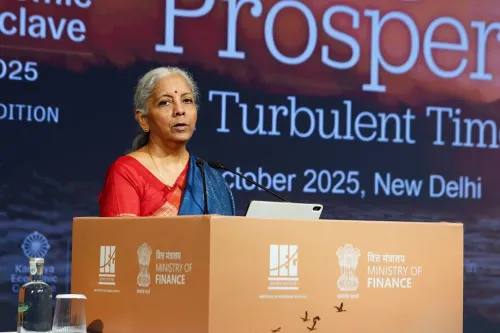
A new report by Nirupama Rao, former Indian Foreign Secretary and distinguished Indian Foreign Service (IFS) officer, argues that India must not approach the current era of global disruption defensively — and that the country possesses the economic, diplomatic, and intellectual capacity to actively shape the future of globalisation and multilateralism. The report, published in India Narrative, was timed to coincide with the Asia Economic Dialogue in New Delhi.
India as a Pivotal State
Rao describes India not merely as a middle power but as a pivotal state. "We have the capacity — economically, diplomatically, and intellectually — to influence that outcome. Not alone, of course, but as a pivotal actor," she writes. India, she argues, retains credibility among developing countries, participates in Western-led initiatives while maintaining strategic autonomy, and possesses demographic vitality, technological talent, and a growing diplomatic footprint.
This positioning, Rao notes, presents both an opportunity and a responsibility. "India cannot control global turbulence, although it can shape its trajectory," she writes.
Why the World Feels So Turbulent
The report identifies a structural shift in the global order: the assumptions that underpinned global politics and economics for three decades after the end of the Cold War are, in Rao's words, shifting beneath our feet. Geopolitics has entered the bloodstream of economics — trade has become strategic leverage, technology has become sovereign territory, finance has become an instrument of coercion, and supply chains have become battlefields.
The report characterises the current transition as inherently unstable. The United States remains the preeminent military and financial power. China has emerged as a comprehensive economic and manufacturing powerhouse, increasingly assertive and capable of projecting power. Russia is described as militarily disruptive, middle powers are more ambitious, and the Global South is more vocal than at any point in recent history.
Geoeconomics Beyond Globalisation
Rao argues that the theme of Geoeconomics Beyond Globalisation is not rhetorical but diagnostic. Economic policy is increasingly intertwined with strategic competition. "Trade restrictions, technology export controls, investment screening, sanctions — all these tools, once considered primarily economic, are now instruments of geopolitical statecraft," she writes. Major powers are no longer merely competing for markets; they are competing for technological primacy, supply chain control, and normative influence.
India's Stance on Multilateralism
The report makes a pointed case for reform over retreat on multilateral institutions. "India has historically valued multilateralism not as an abstract ideal but as a practical necessity. Rules-based cooperation gives developing countries voice and leverage. Reform, not abandonment, should therefore be our guiding principle," Rao states. This comes amid growing global debate about the efficacy of institutions such as the World Trade Organization (WTO) and the United Nations, which critics argue have struggled to adapt to the new geoeconomic reality.
What Comes Next
The report's central message is that the future of globalisation will be shaped by policy choices, institutional choices, and leadership choices — and that India is well-positioned to influence all three. Whether India fully capitalises on this pivotal moment will depend on how proactively it engages with the shifting architecture of global governance in the years ahead.
Point of View
Not just strategic ambiguity. Yet the report's optimism must be weighed against execution — India's multilateral credibility has historically outrun its institutional follow-through. The real test will not be in the eloquence of India's positioning, but in whether it can build durable coalitions among the Global South while sustaining Western partnerships — a balancing act that is becoming harder as great-power competition intensifies.
NationPress
25 Sept 2026
Frequently Asked Questions
What does the report say about India's role in global geoeconomics?
The report argues India is a pivotal state with the economic, diplomatic, and intellectual capacity to shape the future of globalisation and multilateralism. Former Foreign Secretary Nirupama Rao writes that India must approach this era actively, not defensively.
What is driving global economic turbulence according to the report?
The report identifies a structural shift: trade has become strategic leverage, technology has become sovereign territory, finance has become an instrument of coercion, and supply chains have become battlefields. The US, China, Russia, and an increasingly vocal Global South are all competing in ways that make the current transition inherently unstable.
What is India's position on multilateralism according to Nirupama Rao?
Rao argues India has historically valued multilateralism as a practical necessity, not an abstract ideal. She calls for reform of multilateral institutions, not abandonment, stating that rules-based cooperation gives developing countries essential voice and leverage.
Why does the report call India a pivotal state rather than a middle power?
Rao uses the term pivotal state to reflect India's unique positioning — it participates in Western-led initiatives while maintaining strategic autonomy, retains credibility among developing nations, and possesses demographic and technological strengths that give it outsized influence in shaping the emerging global order.
What is the Asia Economic Dialogue referenced in the report?
The Asia Economic Dialogue is a multilateral forum focused on global economic and geopolitical trends. Rao's report notes that such dialogues are particularly relevant now because the foundational assumptions of post-Cold War global politics and economics are rapidly shifting.