India at CBD COP17: Yadav pushes Kunming-Montreal framework, finance for biodiversity
Synopsis
At CBD COP17 in Yerevan, India's Environment Minister Bhupender Yadav put finance squarely on the table — endorsing the Cali Fund, demanding predictable climate finance from developed nations, and showcasing 1,134 protected areas and 103 Ramsar sites as evidence that India is delivering, not just pledging, on biodiversity.
Key Takeaways
Environment Minister Bhupender Yadav delivered India's National Statement at CBD COP17 in Yerevan, Armenia on 27 October 2026 .
India called for the Kunming-Montreal Global Biodiversity Framework to be backed by adequate finance, capacity building, and technology transfer from developed countries.
India endorsed the Cali Fund for benefit sharing from digital sequence information on genetic resources.
India currently has 1,134 protected areas , 103 Ramsar sites , 57 biodiversity heritage sites , and 18 biosphere reserves , including 13 under UNESCO's Man and Biosphere Network.
India's updated National Biodiversity Strategy and Action Plan sets 23 national targets and 142 indicators .
Village-level committees for decentralised access and benefit sharing have been established to enable local community participation.
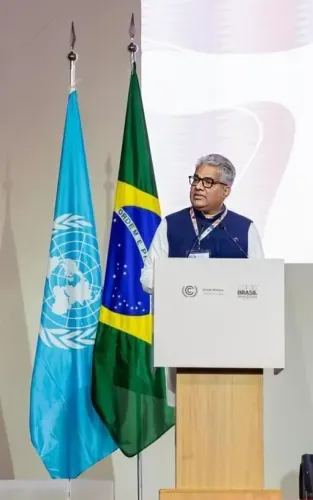
Environment Minister Bhupender Yadav on Tuesday, 27 October 2026, reaffirmed India's commitment to biodiversity conservation at the 17th Conference of the Parties to the Convention on Biological Diversity (CBD COP17) in Yerevan, Armenia, calling for implementation of the Kunming-Montreal Global Biodiversity Framework backed by adequate finance and technology transfer from developed nations.
India's Key Demands at the High-Level Segment
Delivering India's National Statement at the High-Level Segment, Yadav urged that the Kunming-Montreal framework be implemented in line with national priorities, circumstances, and legislation. He stressed that this must be supported by 'adequate and predictable finance, capacity building and technology transfer from developed countries.'
India also expressed support for benefit sharing from digital sequence information on genetic resources through the multilateral mechanism, specifically endorsing the Cali Fund. On emerging scientific frontiers, Yadav advocated a 'science-based, risk-proportionate and precautionary approach' to synthetic biology and bio-safety.
India's Biodiversity Footprint by the Numbers
Yadav highlighted India's substantial progress on the ground. The country now has 1,134 protected areas, 103 Ramsar sites, 57 biodiversity heritage sites, and 18 biosphere reserves — of which 13 are part of UNESCO's Man and Biosphere Network. India's updated National Biodiversity Strategy and Action Plan translates the global framework into 23 national biodiversity targets and 142 indicators, providing a measurable domestic roadmap.
Flagship Programmes Cited on the Global Stage
The minister pointed to several India-led initiatives as models for biodiversity stewardship. These include the International Big Cat Alliance, which advances conservation of the world's seven big cat species and their habitats; the Mangrove Initiative for Shoreline Habitats and Tangible Income (MISHTI) for mangrove restoration; and Amrit Dharohar for wetland conservation.
The Soil Health Card Scheme for sustainable soil management and the Mission Lifestyle for Environment (LiFE) campaign were also cited, alongside the Ek Ped Maa Ke Naam tree-planting drive, framing biodiversity conservation as a broad societal effort rather than a purely governmental one.
Decentralisation and Local Communities
Notably, Yadav underlined India's alignment of domestic legislation with international conventions, and the establishment of village-level committees for decentralised access and benefit sharing. This, he said, enables local communities to participate in and benefit from sustainable biological resource use — a key equity dimension that developing nations have long sought recognition for within global biodiversity negotiations.
India's Broader Diplomatic Position
India's statement at CBD COP17 reflects a consistent diplomatic stance: support for ambitious global biodiversity targets, but conditioned on developed countries fulfilling financing commitments. This comes amid ongoing tensions within the framework over how the $200 billion per year biodiversity finance goal agreed at COP15 in Kunming will actually be mobilised. Yadav concluded by reaffirming India's commitment to working with all parties 'in the true spirit of one earth, one family, one future' — echoing the G20 presidency theme India championed in 2023.
With negotiations continuing in Yerevan, the outcomes of CBD COP17 on finance mechanisms and the Cali Fund's operationalisation will be closely watched by biodiversity-vulnerable nations.
Point of View
With 1,134 protected areas and a granular 142-indicator action plan — while keeping pressure firmly on developed nations to pay up. The Kunming-Montreal framework's $200 billion annual finance pledge remains largely unfulfilled, and India's explicit endorsement of the Cali Fund is a signal that the Global South will not let that slide. What mainstream coverage often misses is the domestic equity angle: village-level access-and-benefit-sharing committees could be transformative for forest-fringe communities, but their actual functioning and reach remain under-documented. The real test of India's biodiversity ambition will not be in Yerevan — it will be in whether those 23 national targets attract independent verification and public reporting.
NationPress
27 Oct 2026
Frequently Asked Questions
What is the CBD COP17 and why is it significant?
CBD COP17 is the 17th Conference of the Parties to the Convention on Biological Diversity, hosted by Armenia in Yerevan in October 2026. It is the principal global forum where nations assess progress on biodiversity commitments and negotiate the financing and mechanisms needed to implement the Kunming-Montreal Global Biodiversity Framework adopted in 2022.
What did India's Environment Minister say at CBD COP17?
Minister Bhupender Yadav called for the Kunming-Montreal framework to be implemented in line with national priorities, supported by adequate and predictable finance, capacity building, and technology transfer from developed countries. He also endorsed the Cali Fund for benefit sharing from digital sequence information on genetic resources.
What is the Kunming-Montreal Global Biodiversity Framework?
It is a landmark international agreement adopted at CBD COP15 in Kunming-Montreal in December 2022, setting global biodiversity targets through 2030 — including protecting 30% of land and oceans. India has translated it into 23 national biodiversity targets and 142 indicators through its updated National Biodiversity Strategy and Action Plan.
What is the Cali Fund that India supports?
The Cali Fund is a multilateral mechanism established to ensure fair and equitable sharing of benefits arising from the use of digital sequence information on genetic resources. India's endorsement signals its support for biodiversity-rich developing nations receiving a share of benefits when their genetic data is used in commercial applications.
How many protected areas and conservation sites does India have?
As of October 2026, India has 1,134 protected areas, 103 Ramsar wetland sites, 57 biodiversity heritage sites, and 18 biosphere reserves, of which 13 are part of UNESCO's Man and Biosphere Network — one of the largest conservation networks among biodiversity-rich nations.