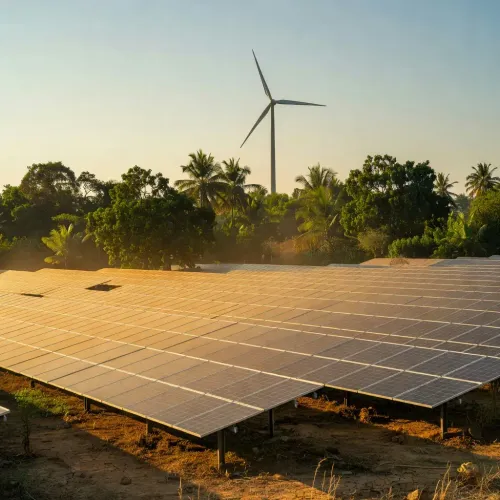
India merges renewable energy and green policy into core development plan: Report

Synopsis
India is no longer treating climate goals as a trade-off against growth — it is baking them directly into its economic model. From the National Solar Mission to green hydrogen and FAME, a new report shows how India's climate architecture is being engineered to deliver energy security, manufacturing jobs, and international influence all at once.
Key Takeaways
A new report finds India is integrating renewable energy , energy efficiency , and green industrial policy into core economic planning rather than treating them as separate priorities.
The strategy traces back to the 2008 National Action Plan on Climate Change , which launched eight National Missions covering clean energy, water, agriculture, and ecosystems.
The National Solar Mission and Perform, Achieve and Trade (PAT) scheme are cited as leading pillars of India's clean energy transformation.
The National Green Hydrogen Mission is projected to cut fossil fuel import dependence and generate new employment across the clean energy value chain.
The FAME programme and state-level policies have accelerated electric vehicle adoption across buses, two-wheelers, and passenger vehicles.
India's climate approach is gaining international visibility, with the country emerging as a model partner for developing nations seeking affordable clean energy pathways.
India is increasingly embedding renewable energy, energy efficiency, and green industrial policy into its mainstream economic planning, treating climate action as a driver of growth rather than a constraint on it, according to a new report published on 30 September. The findings signal a structural shift in how New Delhi frames its development model for both domestic and international audiences.
A Transformed Development Model
The report noted that 'India's climate journey increasingly reflects a broader transformation in its development model,' with climate policies now designed to simultaneously strengthen energy security, encourage manufacturing, attract investment, generate employment, and improve technological capabilities. This marks a decisive departure from earlier frameworks that treated environmental goals as secondary to economic growth targets.
The foundation of this approach traces back to the 2008 National Action Plan on Climate Change, which introduced eight National Missions spanning renewable energy, enhanced energy efficiency, sustainable habitat, water conservation, sustainable agriculture, Himalayan ecosystem protection, the Green India initiative, and strategic knowledge for climate change.
Solar, Hydrogen and Efficiency at the Forefront
Among the flagship programmes, the National Solar Mission has emerged as arguably the most visible pillar of India's clean energy transformation, according to the report. Alongside it, the Perform, Achieve and Trade (PAT) scheme has pushed greater energy efficiency across energy-intensive industrial sectors.
The UJALA LED programme and the National Green Hydrogen Mission are also being deployed to drive industrial competitiveness while cutting emissions. Government estimates indicate that the National Green Hydrogen Mission could meaningfully reduce dependence on imported fossil fuels, attract substantial private investment, and create new employment across the clean energy value chain.
Rapid growth in solar, wind, and hybrid projects has been underpinned by incentives for domestic solar manufacturing under the Production Linked Incentive (PLI) scheme, alongside policies to scale green hydrogen for hard-to-abate sectors.
Electric Mobility and Industrial Competitiveness
The Faster Adoption and Manufacturing of Electric Vehicles (FAME) programme, complemented by state-level policies, has helped accelerate the adoption of electric buses, two-wheelers, and passenger vehicles across the country. The programme represents one of the more tangible consumer-facing dimensions of India's broader green transition.
India's Growing International Climate Profile
The report also noted that India's climate narrative is gaining traction on the global stage. International climate summits have provided a platform for India to extend its experience in climate missions into partnerships — particularly with developing nations seeking affordable pathways to clean energy and climate resilience. This positions India not merely as a recipient of climate finance, but increasingly as a model and partner for the Global South.
As India's green policy architecture matures, the alignment between climate ambition and economic planning is expected to deepen further, with upcoming international commitments likely to reinforce domestic programme targets.
Point of View
For instance, has faced execution delays, and green hydrogen remains commercially unproven at scale. What the report captures is an ambitious narrative; what it does not fully interrogate is whether the incentive structures are calibrated tightly enough to move outcomes, not just announcements. India's international credibility on climate will ultimately rest on verified emissions trajectories, not the elegance of its programme design.
NationPress
30 Sept 2026
Frequently Asked Questions
How is India aligning its development agenda with climate action?
India is integrating renewable energy, energy efficiency, and green industrial policy directly into its economic planning, rather than treating environmental goals as separate from growth objectives. A new report notes that this approach is designed to simultaneously boost energy security, manufacturing, investment, and employment.
What is the National Green Hydrogen Mission and why does it matter?
The National Green Hydrogen Mission is a government programme aimed at scaling green hydrogen production to decarbonise hard-to-abate industrial sectors. According to government estimates, it could reduce dependence on imported fossil fuels, attract substantial private investment, and create new jobs across the clean energy value chain.
What is the FAME programme in India?
FAME — the Faster Adoption and Manufacturing of Electric Vehicles programme — is a central government initiative that, alongside state-level policies, has accelerated the adoption of electric buses, two-wheelers, and passenger vehicles in India. It forms a key consumer-facing pillar of India's green transition.
What were the eight National Missions under India's 2008 climate plan?
The 2008 National Action Plan on Climate Change launched eight missions covering renewable energy, enhanced energy efficiency, sustainable habitat, water conservation, sustainable agriculture, Himalayan ecosystem protection, the Green India initiative, and strategic knowledge for climate change. These missions laid the institutional foundation for India's current climate architecture.
How is India positioning itself internationally on climate change?
India is increasingly using global climate summits to extend its experience in climate missions into international partnerships, particularly with developing countries seeking affordable clean energy and climate resilience pathways. The report suggests India is evolving from a recipient of climate finance into a model and partner for the Global South.