Owaisi Invokes 400 Years of Namaz on Akhilesh's Ayodhya Plan
Synopsis
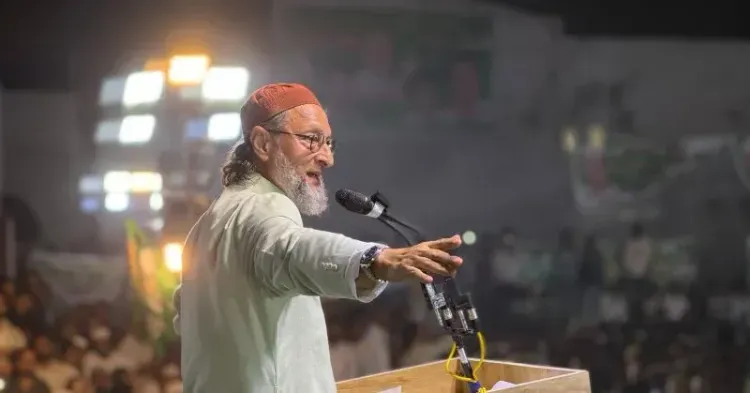
AIMIM president Asaduddin Owaisi responded to Samajwadi Party chief Akhilesh Yadav's reported Ayodhya visit plan by invoking four centuries of Muslim prayer at the Babri Masjid site, reigniting a politically charged debate around the Ram Temple and UP's minority politics.
Key Takeaways
Asaduddin Owaisi publicly referenced 400 years of Namaz offered at the Babri Masjid site in Ayodhya in response to Akhilesh Yadav's reported Ram Temple visit plan.
The Babri Masjid , a 16th-century mosque , was demolished on 6 December 1992 , triggering nationwide communal violence.
The Supreme Court of India awarded the disputed Ayodhya site to a temple trust in November 2019 , enabling construction of the Ram Temple.
Owaisi's remark puts pressure on Akhilesh Yadav and the Samajwadi Party over their Ayodhya stance ahead of Uttar Pradesh political contests.
Ayodhya remains a recurring flashpoint in Indian electoral politics, functioning as a litmus test for opposition parties navigating Hindu and Muslim voter bases simultaneously.
AIMIM president Asaduddin Owaisi sharpened the political temperature around Ayodhya on Sunday, 15 November 2026, invoking four centuries of Muslim prayer at the disputed site in direct response to Samajwadi Party chief Akhilesh Yadav's reported plan to visit the Ram Temple — a remark that cuts straight to the unresolved emotional fault-lines the 2019 Supreme Court verdict left behind.
Owaisi's Pointed Reminder About the Babri Masjid Site
Owaisi's message was spare but loaded: 'Where we offered Namaz for 400 years.' The reference is to the Babri Masjid, the 16th-century mosque that stood at the Ayodhya site until 6 December 1992, when it was demolished by kar sevaks — an event that triggered nationwide communal violence and set off decades of litigation. For Owaisi, the historical claim of continuous worship is not a legal argument (that battle was settled in court) but a moral and political one: a reminder, aimed squarely at Akhilesh Yadav, that the site carries a weight that cannot be wished away by a temple visit.
Why Akhilesh's Ayodhya Visit Is Politically Combustible
Akhilesh Yadav, as president of the Samajwadi Party and former Chief Minister of Uttar Pradesh, leads the principal opposition force in a state where the Ram Temple is the BJP's most potent symbol. Any SP leader's visit to Ayodhya navigates a narrow corridor: appearing to legitimise the temple risks alienating a core Muslim voter base; staying away risks being painted as anti-Hindu. Owaisi's comment — brief, public, pointed — makes that corridor even narrower. It signals to Muslim voters that the SP's Ayodhya calculus will be watched and judged.
A Recurring Flashpoint in UP's Electoral Politics
Ayodhya has never truly left Indian political conversation since the 1980s, when the Ram Janmabhoomi movement transformed the city into a national flashpoint. The Supreme Court's November 2019 verdict awarded the disputed land to a trust for temple construction, acknowledging the mosque's prior existence while ruling in favour of the Hindu petitioners. The temple has since been consecrated, but the verdict resolved the legal question — not the political one. Every major opposition figure who steps into Ayodhya now must reckon with both the new reality and the old wound. Owaisi, who has consistently positioned himself as an uncompromising voice for Muslim constitutional rights, has little incentive to let that reckoning pass quietly.
The exchange is a snapshot of a broader pattern: as Uttar Pradesh politics heats up, Ayodhya functions less as a city and more as a litmus test — for secularism, for Hindu pride, for minority confidence, and for opposition credibility. Owaisi's four-word invocation ensures the test stays on the front page.
Point of View
He draws a clear line for Muslim voters: any SP overture toward the Ram Temple will be scrutinised and contextualised. This is a calculated move in the long game of UP minority politics, where Owaisi has consistently sought to position AIMIM as a harder alternative to the SP's perceived ambiguity on communal issues. The broader arc points to Ayodhya remaining a live electoral variable well beyond the temple's consecration.
NationPress
15 Nov 2026
Frequently Asked Questions
What did Owaisi say about Akhilesh Yadav's Ayodhya visit?
Owaisi invoked four centuries of Muslim prayer at the site, stating 'Where we offered Namaz for 400 years' — a pointed reference to the Babri Masjid that once stood at the Ayodhya location now occupied by the Ram Temple.
What is the Babri Masjid and why is it significant?
The Babri Masjid was a 16th-century mosque in Ayodhya demolished by kar sevaks on 6 December 1992. Its demolition triggered nationwide communal violence and a decades-long legal dispute that the Supreme Court resolved in November 2019 by awarding the site for Ram Temple construction.
Why is Akhilesh Yadav visiting Ayodhya politically sensitive?
As SP chief and leader of the principal UP opposition, Akhilesh Yadav must balance a Hindu voter base that embraces the Ram Temple with a Muslim voter base that views the site's history with pain — making any Ayodhya visit a fraught political calculation.
What was the Supreme Court's 2019 Ayodhya verdict?
In November 2019, the Supreme Court of India awarded the disputed Ayodhya land to a trust for construction of a Ram Temple, acknowledging the mosque's prior existence but ruling in favour of Hindu petitioners based on the balance of evidence.
What is AIMIM's position on the Ayodhya dispute?
AIMIM and its president Owaisi have consistently maintained that the demolition of the Babri Masjid was illegal and that the Muslim community's historical connection to the site must not be erased from public discourse, even after the Supreme Court's verdict.