India's UN Security Council permanent seat bid wins fresh support at UNGA 81
Synopsis
At the 81st UN General Assembly, Portugal and Mauritius gave India direct endorsements for a permanent Security Council seat, while the Marshall Islands backed India through G4 solidarity. With African leaders framing reform as a survival question for the UN itself, this session marks one of the broadest coalitions of reform voices in years — yet the five existing veto-holders remain the decisive obstacle.
Key Takeaways
Portugal and Mauritius explicitly endorsed India's permanent seat bid at the 81st UN General Assembly on 26 September 2026 .
Mauritian Foreign Minister Dhananjay Ramful offered the clearest endorsement, supporting both the G4 and L69 positions on Council reform.
Marshall Islands President Hilda Heine backed India indirectly by affirming support for Japan and its G4 partners .
African leaders , including those from Sierra Leone and Ghana , called reform an imperative for the UN's legitimacy, with Africa's 1.6 billion people still unrepresented among permanent members.
Any Council reform requires approval by two-thirds of the General Assembly and ratification by all five current permanent members , including China , making progress structurally difficult.
India argues its case on the basis of population, economic weight, UN peacekeeping contributions, and its role as a voice of the Global South .
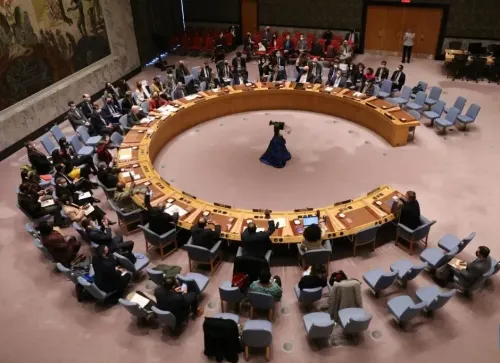
India's campaign for a permanent seat on the UN Security Council received renewed momentum at the 81st United Nations General Assembly debate in New York on 26 September 2026, with Portugal and Mauritius offering explicit endorsements and the Marshall Islands backing India indirectly through the G4 grouping. The fresh support underscores growing international consensus that the Council's composition is a relic of 1945 and must be overhauled to reflect 21st-century geopolitical realities.
Direct Endorsements for India
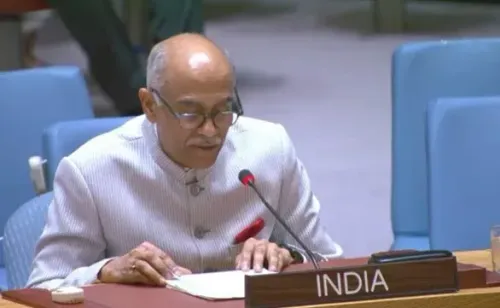
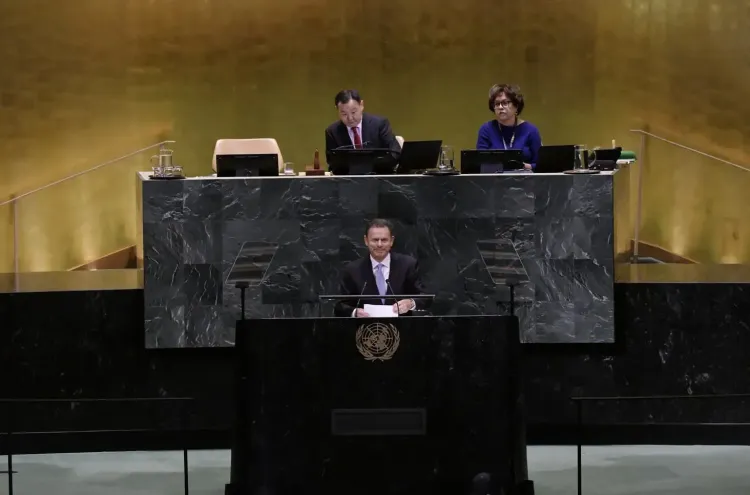
Portuguese Prime Minister Luís Montenegro called for a more representative Council with permanent seats for Africa, Brazil, and India, framing reform as a matter of institutional credibility. The most unambiguous endorsement came from Mauritian Foreign Minister Dhananjay Ramful, who said in his address: 'We support the positions of the G4 and of L69 on Council reform, and we reiterate our support for India's candidature for a permanent seat, commensurate with its constructive role in global affairs.'
Ramful also backed the Common African Position, which calls for no fewer than two permanent and five non-permanent African seats. He argued that any new permanent member should receive the same rights as existing ones — including veto power if the veto is retained — and also supported a dedicated seat for small island developing states.
G4 Solidarity and Japan's Push
Marshall Islands President Hilda Heine offered indirect backing for India through the four-nation G4 bloc, stating: 'The Marshall Islands affirms its longstanding support for Japan — and its G4 partners — to achieve permanent membership on the UN Security Council.' India, along with Brazil, Germany, and Japan, forms the G4, with all four members mutually supporting one another's permanent-seat bids.
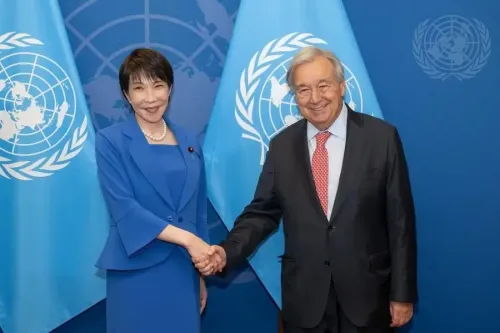
Japanese Prime Minister Sanae Takaichi made Council reform a central demand in her address, though she did not name individual G4 candidates by country. 'We need to transform it without delay into a structure that truly reflects the current realities of the international community,' Takaichi said, adding that a majority of UN members supported expansion in both permanent and non-permanent categories.
Broader Push for Regional Representation
Several leaders framed reform in regional rather than country-specific terms. Finnish President Alexander Stubb proposed at least two new permanent seats for Africa, two for the Asia-Pacific, and one for Latin America, while opposing granting any single state veto power. Saint Lucian Prime Minister Philip J. Pierre called for urgency, saying: 'The prolonged reform process must be concluded quickly to include expanded permanent and non-permanent membership for Africa, the Asia-Pacific, and Latin America and the Caribbean regions.'
African leaders mounted the strongest collective case. Sierra Leone President Julius Maada Bio said, 'The Security Council still reflects the world of 1945. Africa, home to more than 1.6 billion people and the subject of much of the Council's work, still has no Permanent Seat.' Ghanaian President John Dramani Mahama went further, framing reform as existential: 'Security Council reform is not a favour to Africa; it is an imperative for the legitimacy, credibility, and survival of the United Nations.'
Why Reform Remains Stalled
Despite widespread rhetorical agreement that the Council is outdated, substantive reform has remained elusive for decades. Disagreements persist over which nations should receive permanent seats, how regional allocations should be structured, and whether new permanent members should hold veto rights. Critically, any change to the Council's composition requires approval by two-thirds of the General Assembly and ratification by two-thirds of all UN member states, including all five existing permanent members — China, France, Russia, Britain, and the United States. The consent of current veto-holders remains the single hardest political barrier.
India has cited its 1.4 billion-plus population, rising economic weight, extensive UN peacekeeping contributions, and its self-described role as a voice of the Global South as core arguments for permanent membership. This is not the first UNGA session to generate such endorsements, but the volume and diversity of backing at the 81st session add fresh diplomatic pressure on reform negotiations.
What Comes Next
The debate has renewed calls for the stalled Intergovernmental Negotiations (IGN) process to produce a concrete text-based outcome. Observers note that while General Assembly statements build political momentum, converting that momentum into a formal amendment to the UN Charter — the legal mechanism required for reform — remains an arduous multi-year undertaking. The trajectory of India's campaign will depend heavily on whether the P5, particularly China, shift their positions on expanding permanent membership.
Point of View
Meanwhile, is a political dead end: no permanent member will vote to dilute its own veto. India's best near-term strategy may be to build durable text-based coalitions in the Intergovernmental Negotiations process rather than counting endorsement speeches, which cost their givers nothing and bind no one.
NationPress
26 Sept 2026
Frequently Asked Questions
What is India's bid for a permanent UN Security Council seat?
India is campaigning for one of the proposed new permanent seats on the UN Security Council , which currently has five permanent members — the US, UK, France, Russia, and China — and 10 elected non-permanent members. India argues it deserves a seat based on its population, economic size, UN peacekeeping contributions, and its role as a voice of the Global South.
Which countries endorsed India's UNSC bid at UNGA 81?
At the 81st UN General Assembly debate on 26 September 2026 , Portugal and Mauritius offered direct endorsements, while the Marshall Islands backed India indirectly by affirming support for Japan and its G4 partners. India, Brazil, Germany, and Japan form the G4 grouping.
Why is UN Security Council reform so difficult to achieve?
Reforming the Council's composition requires approval by a two-thirds majority of the UN General Assembly and ratification by two-thirds of all UN member states, including all five existing permanent members. Since any of the P5 — the US, UK, France, Russia, or China — can effectively block change, securing their consent is the central obstacle, and none have formally backed a reform package that includes new permanent members.
What is the G4 grouping and how does it relate to India's campaign?
The G4 comprises India , Brazil , Germany , and Japan , four nations that mutually support one another's bids for permanent Security Council seats. The grouping has campaigned collectively at successive General Assembly sessions, arguing that the Council must reflect current economic and demographic realities.
What is the Common African Position on Security Council reform?
The Common African Position calls for Africa to receive no fewer than two permanent seats and five non-permanent seats on a reformed Security Council. African leaders at UNGA 81, including those from Sierra Leone and Ghana , argued this is essential to the UN's legitimacy, noting that Africa — home to over 1.6 billion people — currently holds no permanent representation.