White House: Iran Shoots Down US Apache Over Hormuz
Synopsis
The White House announced on June 9, 2026 that Iran shot down a US Apache helicopter patrolling the Strait of Hormuz. Both pilots are confirmed safe. The incident is one of the most serious direct US-Iran military confrontations in years and raises fears of escalation in a waterway critical to global oil supply.
Key Takeaways
Iran shot down a US Apache helicopter over the Strait of Hormuz on the night of June 8-9, 2026 , according to the White House.
Both pilots aboard the helicopter are confirmed safe and uninjured .
The Strait of Hormuz handles roughly 20 per cent of global oil supply, making any military escalation there an international concern.
The last major US-Iran incident at Hormuz was the June 2019 downing of a US RQ-4 Global Hawk drone — this incident involves a manned aircraft, raising the stakes.
The Pentagon and the Iranian government are expected to issue detailed statements; UN Security Council consultations are possible.
Indian refiners and Gulf energy markets face potential supply-chain risks if the situation escalates.
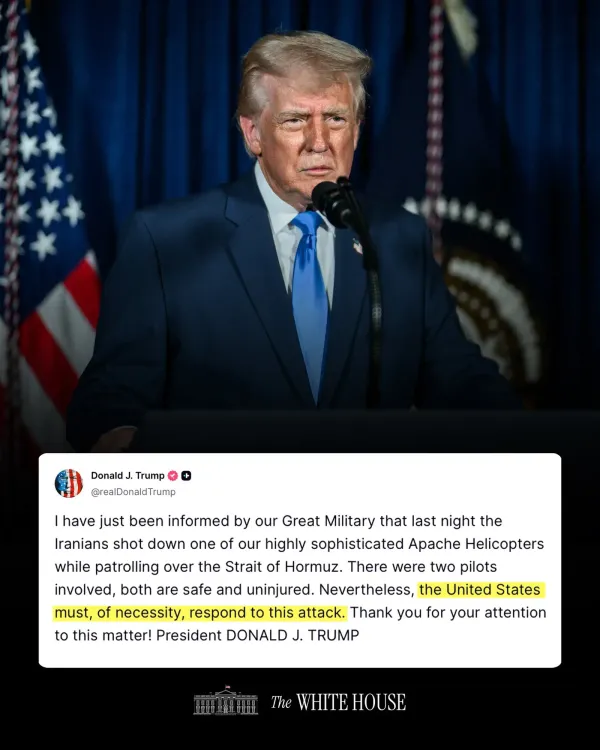
The White House announced on Tuesday, June 9, 2026 that Iran shot down a US Apache helicopter while it was on patrol over the Strait of Hormuz, with the official statement confirming both pilots aboard are safe and uninjured.
Context
The White House post, attributed to the Executive Office of the President, stated: 'I have just been informed by our Great Military that last night the Iranians shot down one of our highly sophisticated Apache Helicopters while patrolling over the Strait of Hormuz. There were two pilots involved, both are safe and uninjured.' The message was cut short, suggesting a longer statement may follow. The incident marks one of the most serious direct US-Iran military confrontations in recent years.
The Strait of Hormuz is a narrow waterway between Iran and Oman and is the world's most critical chokepoint for global oil transit. The United States has maintained continuous naval and air patrols in the region for decades to protect freedom of navigation.
Policy Backdrop
US-Iran military tensions in and around the Strait of Hormuz have periodically spiked over disputes tied to sanctions and Tehran's nuclear programme. In June 2019, Iran shot down a US RQ-4 Global Hawk drone over the same waterway, triggering a sharp escalation in military posturing before both sides stepped back from the brink.
Unlike that drone incident, this episode involves a manned aircraft — an AH-64 Apache helicopter, one of the US Army's most advanced rotary-wing platforms — raising the stakes considerably. The safety of both pilots will likely be a central element of any official response from Washington.
Stakeholders and Impact
The immediate stakeholders are the US military, the Iranian government, and the broader Gulf shipping community that relies on unimpeded passage through the Strait of Hormuz for energy exports. Roughly 20 per cent of global oil supply transits this waterway, making any military escalation there a concern for international energy markets.
Gulf states, including Saudi Arabia, the UAE, and Kuwait, will be watching closely, as any sustained military exchange near the strait could disrupt oil flows and regional stability. Indian refiners, who source a significant portion of crude from the Persian Gulf, would also be exposed to supply-chain risks if the situation deteriorates.
What's Next
Analysts expect the Pentagon to release a detailed account of the incident, including the circumstances of the patrol and the nature of the Iranian action. An Iranian government response — either denying involvement or asserting the helicopter violated its airspace — is also anticipated in the coming hours.
The incident could prompt emergency consultations at the UN Security Council, and pressure will mount on both sides to clarify the chain of events before the situation escalates further. How Washington calibrates its response — diplomatic, economic, or military — will define the next chapter in an already volatile bilateral relationship.
Point of View
And the White House's decision to announce it personally — rather than through the Pentagon — signals a deliberate effort to shape the immediate public and diplomatic narrative. The emphasis on pilot safety may be calibrated to prevent a domestic demand for immediate retaliation while preserving Washington's options. For the broader US-Iran relationship, already strained over nuclear diplomacy and sanctions, this incident risks becoming a trigger point unless both sides find a rapid off-ramp. The episode also underscores the enduring fragility of Gulf security, with consequences that extend well beyond the two principals to energy-importing nations including India.
NationPress
24 Oct 2026
Frequently Asked Questions
Did Iran really shoot down a US Apache helicopter?
Yes, according to an official White House statement on June 9, 2026, Iran shot down a US Apache helicopter that was on patrol over the Strait of Hormuz. Both pilots are confirmed safe.
Were the US pilots killed in the Strait of Hormuz helicopter incident?
No. The White House confirmed that both pilots involved in the incident are safe and uninjured.
Why is the US military patrolling the Strait of Hormuz?
The United States has maintained naval and air patrols in the Persian Gulf for decades to protect freedom of navigation, particularly for oil tankers transiting the Strait of Hormuz, which carries roughly 20 per cent of global oil supply.
Has Iran shot down US military aircraft before?
Yes. In June 2019, Iran shot down a US RQ-4 Global Hawk surveillance drone over the Strait of Hormuz, triggering a sharp but short-lived escalation. The June 2026 incident involving a manned Apache helicopter is considered more serious.
How could the US-Iran helicopter incident affect India?
India sources a large share of its crude oil from the Persian Gulf. Any sustained military escalation near the Strait of Hormuz could disrupt oil shipments and push up energy prices, impacting Indian refiners and consumers.