Trump vows US response after Iran downs Apache helicopter over Strait of Hormuz
Synopsis
Iran shot down a US Apache helicopter over the Strait of Hormuz — one of the world's most critical oil chokepoints — and Trump has vowed a response. With Israel simultaneously warning of a 'far more powerful blow' against Tehran and Iran threatening retaliation, the Middle East is at its most volatile flashpoint in months, and the next move from Washington could reshape the entire regional calculus.
Key Takeaways
Iran shot down a US Apache helicopter patrolling the Strait of Hormuz on the night of 8–9 June ; both pilots were rescued safely.
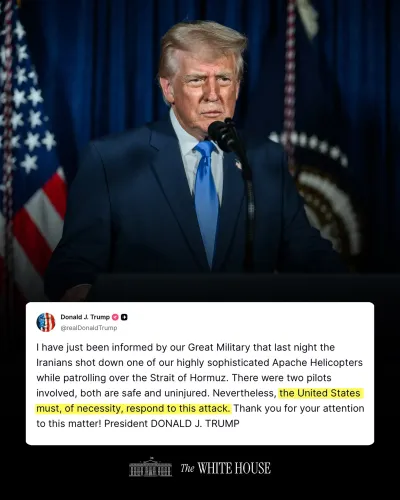
President Donald Trump publicly vowed a US response via a post on Truth Social .
Israeli army commander Eyal Zamir called recent strikes on Iran 'just a preparation' for a 'much more significant and powerful blow.' Iranian chief negotiator Mohammad Bagher Ghalibaf warned on X : 'What goes around comes around,' signalling readiness for further escalation.
UN Secretary-General Antonio Guterres called for an immediate halt to all attacks and urged respect for international law in the Strait of Hormuz .
The strait carries roughly 20% of global oil supplies, making any sustained confrontation there a potential global energy shock.
US President Donald Trump on Tuesday, 9 June declared that the United States will respond after Iran shot down an American Apache helicopter patrolling the Strait of Hormuz. Both crew members were rescued safely following the crash, according to Trump's own account of the incident.
What Trump Said
Trump disclosed the incident through a post on his Truth Social platform, writing: 'I have just been informed by our Armed Forces that last night the Iranians shot down one of our highly sophisticated Apache helicopters while it was patrolling the Strait of Hormuz. There were two pilots on board, both safe and sound. The United States must necessarily respond to this attack.' The statement marked a sharp escalation in rhetoric between Washington and Tehran at an already volatile moment in the region.
Israel Signals a Harder Strike Ahead
The downing of the helicopter coincided with pointed warnings from Israel. Israeli army commander Eyal Zamir, speaking during a visit to a military exercise in the north of the country, described the recent wave of attacks against Iran as 'just a preparation for a much more significant and powerful blow.' He added that the Israel Defense Forces (IDF) 'are prepared to act again and inflict another harsh and far-reaching blow against Iran' and that the armed forces 'continue to maintain the highest level of readiness and preparation to resume operations in Iran.' The remarks suggest the current hostilities are far from a ceiling.
Iran Fires Back With a Warning
Tehran matched the escalatory tone. Iranian chief negotiator Mohammad Bagher Ghalibaf posted on X: 'We prefer the language of diplomacy, but we know others that we master much better. If you don't honour your commitments, we will move on to what we do best. What goes around comes around!' The message, directed at the United States, underscored Iran's position that it retains the option of further military action if diplomatic commitments are not met.
UN Calls for Immediate De-escalation
United Nations Secretary-General Antonio Guterres said he is 'deeply concerned about the new escalation in the Middle East' and called for 'all attacks to cease immediately,' stressing that 'ceasefires in Lebanon, Iran, and Gaza must be fully respected.' Guterres also warned that 'any action that could undermine ongoing diplomatic efforts must be avoided.' On the Strait of Hormuz specifically, he stated that 'the exercise of navigation rights and freedoms, in accordance with international law, must be respected,' and urged all parties to 'take all possible precautions to protect civilians.'
The UN chief separately expressed concern over Israel's decision to close border crossings with Gaza, reiterating his call for the immediate reopening of all crossings to allow large-scale humanitarian aid to flow unimpeded. 'There is no military solution to conflicts in the Middle East,' Guterres concluded. 'The only way forward is dialogue and negotiations.'
Why the Strait of Hormuz Matters
The Strait of Hormuz is among the world's most strategically critical waterways, through which roughly 20% of global oil supplies transit daily. Any sustained military confrontation in or around the strait carries the potential to disrupt energy markets worldwide. This incident is the latest in a series of confrontations that have kept the strait on high alert, and it raises the stakes considerably given simultaneous tensions in Gaza and Lebanon. The international community is watching closely to see whether Washington's promised response will remain rhetorical or translate into direct military action.
Point of View
But also leaves allies and markets with no anchor. The UN's call for dialogue is the right instinct, but Guterres has no enforcement lever, and the three active fronts — Gaza, Lebanon, Iran — are now feeding each other's escalation logic in ways that make a clean diplomatic off-ramp harder to find by the day.
NationPress
24 Oct 2026
Frequently Asked Questions
What happened to the US helicopter over the Strait of Hormuz?
Iran shot down a US Apache helicopter that was patrolling the Strait of Hormuz on the night of 8–9 June. The aircraft crashed, but both crew members on board were rescued safely, according to President Trump's public statement.
How did President Trump respond to the helicopter being shot down?
Trump announced the incident via a post on Truth Social, confirming the shoot-down and stating that 'the United States must necessarily respond to this attack.' He did not specify the nature or timeline of the planned response.
What did Iran say after the incident?
Iranian chief negotiator Mohammad Bagher Ghalibaf posted a warning on X, saying Iran prefers diplomacy but is prepared to escalate if commitments are not honoured, writing: 'What goes around comes around.' Tehran has not officially claimed responsibility for the shoot-down in the reports available.
Why is the Strait of Hormuz so significant?
The Strait of Hormuz is the world's most critical oil chokepoint, through which approximately 20% of global oil supplies pass daily. Any military confrontation there can disrupt energy markets worldwide, with cascading economic consequences for oil-importing nations.
What has the United Nations said about the escalation?
UN Secretary-General Antonio Guterres said he is deeply concerned about the new escalation and called for all attacks to cease immediately. He urged respect for international law in the Strait of Hormuz and reiterated his call for humanitarian crossings into Gaza to be reopened, stressing that there is no military solution to Middle East conflicts.