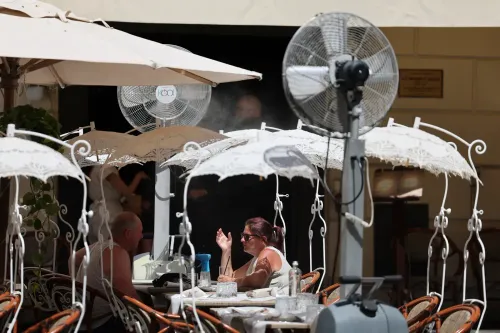
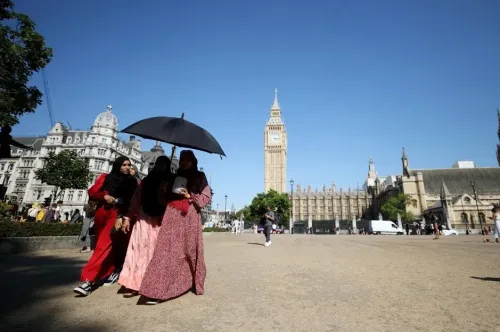
Italy heatwave: 22 cities on red alert, 25 by Tuesday amid Europe crisis

Synopsis
Italy's heatwave emergency has reached a new threshold — 22 cities on maximum red alert on 29 June, rising to 25 by Tuesday — as WHO links over 1,300 deaths across Europe to record heat since 21 June. Temporary relief is forecast from 1 July, but violent storms and a returning African anticyclone mean the crisis is far from over.
Key Takeaways
22 Italian cities were placed on red (Level 3) heat alert on 29 June , with 25 expected by Tuesday .
Cities newly joining the red alert on Tuesday include Cagliari , Catania , and Trieste .
More than 191 million people across Europe have faced temperatures of at least 35 degrees Celsius .
WHO reports over 1,300 excess deaths linked to extreme heat in Europe since 21 June .
Temperatures in France and Germany have been up to 15–20 degrees Celsius above historical averages.
A cold front is expected to bring thunderstorms from Wednesday, 1 July , but violent hailstorms and downbursts pose fresh risks.
Italy placed 22 cities on maximum red alert on Monday, 29 June as a ferocious heatwave continued to grip the country, with the number set to climb to 25 by Tuesday. The surge in alerts reflects worsening heat conditions across the peninsula, part of a broader European emergency that has reportedly claimed more than 1,300 lives since 21 June, according to the World Health Organisation (WHO).
Cities Under Red Alert
According to the latest heatwave bulletin issued by Italy's Ministry of Health, the 22 cities currently on red alert include Rome, Milan, Naples, Florence, Turin, Bologna, Venice, Palermo, Genoa, Bari, Ancona, Bolzano, Brescia, Campobasso, Civitavecchia, Frosinone, Latina, Perugia, Pescara, Rieti, Verona, and Viterbo. By Tuesday, Cagliari, Catania, and Trieste are also expected to be placed under the same maximum alert.
A 'Red Alert' or Level 3 designation signals 'emergency conditions, with possible negative health effects on healthy and active people and not only on at-risk subgroups such as the elderly, very young children, and people with chronic diseases,' as defined by the Ministry.
Europe-Wide Crisis
Italy's ordeal is part of a continent-wide emergency. Germany, the Czech Republic, Poland, and Hungary have all recorded temperatures exceeding 40 degrees Celsius as the heatwave pushes eastward. More than 191 million people across Europe have been exposed to temperatures of at least 35 degrees Celsius, with extreme heat alerts in force across multiple nations.
In recent days, temperatures have soared up to 10 degrees Celsius above historical averages — and as much as 15 to 20 degrees Celsius above average in parts of France and Germany — with peak readings of 40 degrees Celsius recorded in Paris.
WHO Director-General Tedros Adhanom Ghebreyesus stated in a post on X that more than 1,300 excess deaths related to high temperatures have been recorded in Europe since 21 June, adding that the continent is warming at twice the global average — the fastest rate on Earth.
Relief Expected, But Risks Remain
Forecasters indicate the heatwave's grip on Italy will ease from Wednesday, 1 July, when a disturbed weather front descending from Northern Europe is expected to bring thunderstorms and falling temperatures. However, authorities have warned that the collision between cool, unstable air at altitude and the warm, humid air accumulated over the Mediterranean basin could trigger particularly violent storm cells.
The risks include extreme phenomena such as severe hailstorms and downbursts — violent linear wind gusts produced by thunderstorms. Northern Italy is expected to bear the initial brunt, with the disturbance subsequently extending to parts of central and southern Italy.
What Comes After the Storms
Meteorologists caution that the relief may be temporary. After the stormy phase clears, the subtropical African anticyclone is forecast to reassert itself, potentially bringing heat and sunshine back to dominate the Italian summer. The current crisis, while severe, is thus likely to be one chapter in a prolonged season of weather extremes for the region.
Point of View
300-plus heat-related deaths since 21 June is almost certainly an undercount — excess-mortality data typically lags by weeks, and southern European health systems are already under strain. Italy's Ministry of Health bulletin covering 22 cities simultaneously is itself unprecedented in recent memory, yet the political response across Europe remains reactive rather than structural. The real story here is not the heatwave itself but the continent's chronic failure to build heat-resilient urban infrastructure, even as climate science has been predicting precisely these events for over two decades.
NationPress
28 Sept 2026
Frequently Asked Questions
How many Italian cities are on red heat alert?
As of Monday, 29 June, 22 Italian cities are on red (Level 3) heat alert, with the number set to rise to 25 by Tuesday when Cagliari, Catania, and Trieste are also placed under maximum alert. The alerts are issued by Italy's Ministry of Health.
What does a red heat alert mean in Italy?
A red alert, or Level 3, indicates emergency conditions with possible negative health effects not just on vulnerable groups such as the elderly, very young children, and people with chronic diseases, but also on healthy and active people. It is the highest level on Italy's heatwave warning scale.
How many people have died due to the Europe heatwave?
According to WHO Director-General Tedros Adhanom Ghebreyesus, more than 1,300 excess deaths related to high temperatures have been recorded across Europe since 21 June. The WHO has noted that Europe is warming at twice the global average rate.
When will the Italy heatwave end?
Forecasters expect a cold front from Northern Europe to bring thunderstorms and falling temperatures from Wednesday, 1 July. However, authorities warn of risks of violent hailstorms and downbursts before conditions normalise, and the subtropical African anticyclone could return heat to Italy shortly after.
Which other European countries are affected by the heatwave?
Germany, the Czech Republic, Poland, and Hungary have all recorded temperatures above 40 degrees Celsius as the heatwave moves eastward. More than 191 million people across Europe have been exposed to temperatures of at least 35 degrees Celsius, with Paris recording peak temperatures of 40 degrees Celsius.