Is B’desh's JeI Truly Inclusive?
Synopsis
A recent report reveals that while Bangladesh Jamaat-e-Islami has nominated a candidate from the Hindu community, its efforts at inclusivity are questioned. The party's constitution still imposes restrictions that limit full membership for non-Muslims. This article explores the complexities of JeI's claims of inclusiveness.
Key Takeaways
Krishna Nandi is the first Hindu candidate nominated by Jamaat-e-Islami.
Jamaat-e-Islami's constitution limits full membership for non-Muslims.
The party's claimed inclusivity is questioned by many analysts.
Significant constitutional amendments are necessary for true inclusivity.
Critics highlight the party's political opportunism.
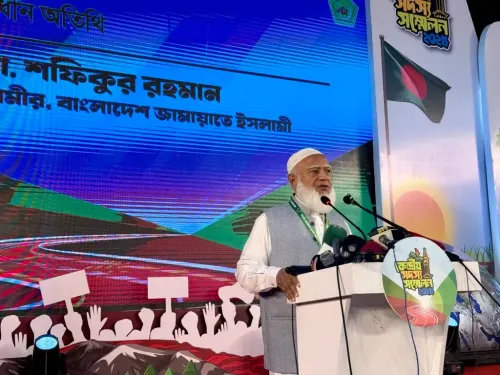
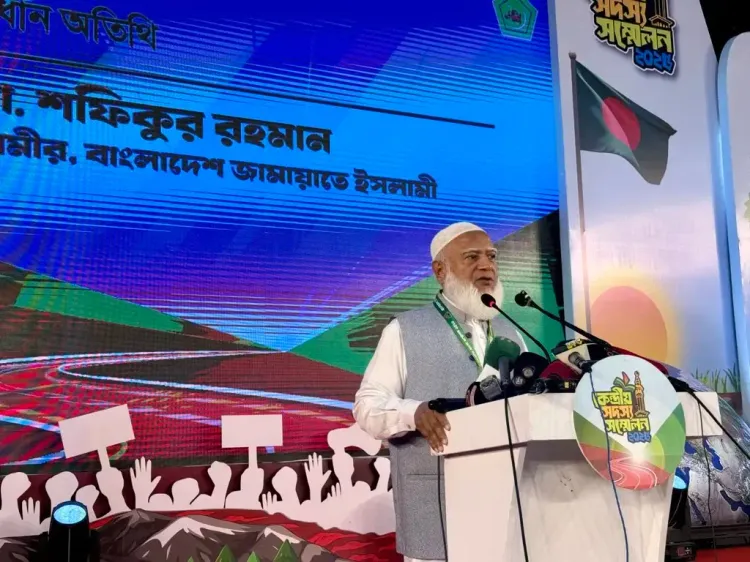
Dhaka, Feb 1 (NationPress) The Bangladesh Jamaat-e-Islami (JeI) has officially selected Krishna Nandi, the leader of the party's Hindu committee in Dumuria Upazila, as its nominee for the Khulna-1 (Dakop–Batiaghata) constituency, seemingly indicating that individuals from diverse faiths are represented within the party.
Nevertheless, the effort by Jamaat-e-Islami to discard its exclusive label and present itself as an inclusive entity fails to achieve true inclusivity without significant revisions to its constitution.
In 2008, Jamaat-e-Islami modified its constitution to permit non-Muslims to join the organization in order to maintain its registration under revised provisions of the Representation of the People Order (RPO), which mandates that party constitutions align with the constitution of Bangladesh and prohibit religious discrimination, as reported by The Business Standard.
However, the preamble, core beliefs, and guiding principles within Jamaat-e-Islami's constitution imply that non-Muslims are excluded from full party membership.
According to Shamim A Zahedy in a report for The Business Standard, "Without substantial amendments to its constitution, the party's effort to abandon its exclusive reputation and position itself as an inclusive organization—akin to political parties accessible to all citizens—remains insufficient for achieving genuine inclusivity."
The party's constitution states that any citizen or non-Muslim of Bangladesh can join Jamaat-e-Islami; however, full membership remains unattainable for non-Muslims. As stated in Section 11 of the Jamaat constitution, "Any non-Muslim citizen of Bangladesh can be an associate member of Jamaat-e-Islami if he/she expresses solidarity with the political and economic programs of Jamaat-e-Islami." Consequently, Krishna Nandi and other Hindus who have recently joined the party do not attain full membership.
As highlighted by The Business Standard, "The party's fundamental faith section explicitly outlines its ideology in strictly Islamic terms, asserting belief in Allah and the prophethood of Muhammad as central to its identity. The preamble asserts that there is no God but Allah, that all natural laws are governed solely by Him, and that Prophet Muhammad (Peace be upon him) is the last and final prophet for all humanity.
"It further states that the Quran, revealed by Allah, and the life of Prophet Muhammad (Peace be upon him) serve as the only model and ideology that humans can follow. Such standards are nearly impossible for non-Muslims to adhere to," it added.
For full membership in Jamaat-e-Islami, individuals must adhere to Islamic practices. Section 7 of the party's constitution specifies that a person can become a member only if they fulfill all Farz (mandatory Islamic duties), avoid income and behaviors contrary to submission to Allah, and refrain from engaging with organizations whose policies oppose Islam. The responsibilities of a party member are closely tied to Islamic practices as outlined in Section 9 of the Jamaat-e-Islami constitution.
"A member must understand the 'boundaries of Shariah as determined by Allah; shape their beliefs, faith, thoughts, outlook, and actions in accordance with the Quran and the Sunnah; avoid all forms of affection and close association with individuals who disobey religious tenets and those who have deviated from Allah except for the cause of Islam; establish strong connections with believers; and demonstrate adherence to the foundational principles of Islam," wrote Shamim A Zahedy in a report for The Business Standard.
"These requirements are based on religious practices, rather than being purely ideological, effectively making full membership inaccessible to non-Muslims and ensuring that only Muslims can progress within the party's structures and policymaking. Such contradictions expose Jamaat-e-Islami's feeble attempt to appear inclusive, revealing the party's indecision and political opportunism," he added.
Point of View
We maintain a neutral stance on this topic. While the Bangladesh Jamaat-e-Islami claims to be inclusive by nominating a Hindu candidate, the underlying constitutional barriers reveal a significant gap between their claims and the reality. This dichotomy raises questions about the authenticity of their inclusivity efforts and their commitment to representing all citizens.
NationPress
27 Sept 2026
Frequently Asked Questions
What is the significance of Krishna Nandi's nomination?
Krishna Nandi's nomination represents an effort by the Bangladesh Jamaat-e-Islami to project an inclusive image, reflecting diversity within its ranks. However, it raises questions about the actual inclusivity of the party given its constitutional restrictions.
Can non-Muslims become full members of Jamaat-e-Islami?
No, non-Muslims cannot attain full membership in Jamaat-e-Islami. They can only become associate members, which limits their rights and participation within the party.
What does the Jamaat-e-Islami constitution state about membership?
The constitution allows non-Muslims to become associate members if they align with the party's political and economic programs, but full membership is reserved for Muslims who adhere to specific religious practices.
Is the claim of inclusivity by Jamaat-e-Islami genuine?
Many critics argue that the claim is not genuine, as the constitution's requirements for full membership are primarily based on Islamic practices, effectively excluding non-Muslims from significant roles within the party.
What are the implications of the party's constitutional amendments?
The amendments aimed to allow non-Muslims to join but still maintain a structure that prioritizes Islamic beliefs, raising concerns about true representation and equality within the party.