Ro Khanna challenges 8 AI giants on jobs and dignity after Pope Leo XIV talks
Synopsis
After meeting Pope Leo XIV at the Vatican, Silicon Valley Congressman Ro Khanna sent formal letters to the CEOs of eight AI giants — including Google, Microsoft and OpenAI — demanding they explain how their policies align with the Pope's new encyclical on human dignity. It is a rare moment where papal ethics and Big Tech accountability collide on Capitol Hill.
Key Takeaways
Congressman Ro Khanna sent letters to CEOs of Amazon, Anthropic, Apple, Google, Meta, Microsoft, Nvidia and OpenAI on 22 August .
The letters demand alignment with Pope Leo XIV 's encyclical Magnifica humanitas , focused on human dignity and equality in AI development.
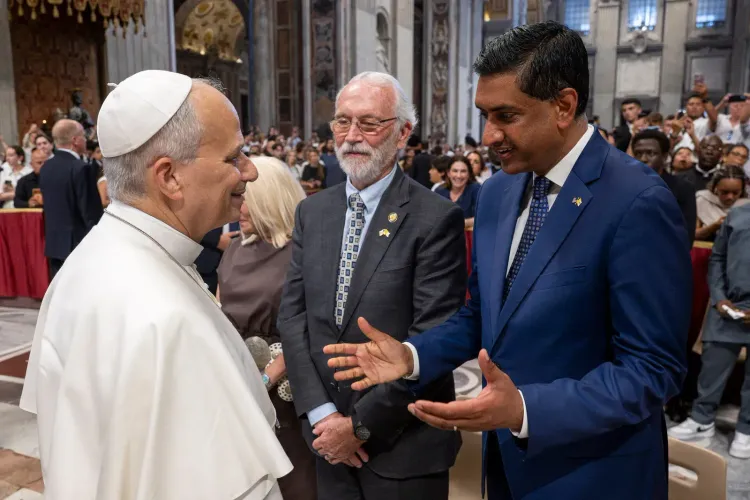
Khanna met Pope Leo XIV during a bipartisan congressional visit to Vatican City , part of a wider European tour covering Germany, Italy and the UK .
The delegation also discussed religious freedom in China , competition with Beijing and AI safety with a leading AI expert.
Khanna represents California's 17th Congressional District (Silicon Valley) and is ranking member of the House Select Committee on the Chinese Communist Party .
Indian-American Congressman Ro Khanna has formally challenged the chief executives of eight major technology companies — Amazon, Anthropic, Apple, Google, Meta, Microsoft, Nvidia and OpenAI — to explain how their artificial intelligence policies protect jobs, human dignity and equality. The letters, sent following a bipartisan congressional visit to Vatican City last week, ask each CEO to align their AI development with the ethical principles outlined in Pope Leo XIV's debut encyclical, Magnifica humanitas.
The Vatican Meeting That Sparked the Letters
Khanna co-led a bipartisan congressional delegation to Europe covering Germany, Italy and the United Kingdom. In Vatican City, the delegation attended Pope Leo XIV's general audience, where Khanna spoke directly with the pontiff about Magnifica humanitas and praised his call to protect human dignity amid the rapid expansion of AI.
The delegation also met Monsignor Daniel Pacho, Under Secretary of the Secretariat of State, with discussions spanning religious freedom in China, values-based foreign policy and the Pope's emerging role as a global voice on ethical AI development. Members separately met a leading AI expert, covering model distillation, safety guardrails and data centre expansion.
What Khanna Is Demanding from Tech CEOs
'I was honored to meet with Pope Leo, who has offered, more clearly than any other global leader, an ethical framework for AI grounded in two fundamental principles: human dignity and equality,' Khanna said.
'Every technology leader should follow this framework. That is why I am calling on the CEOs of major AI companies to answer for how their policies align with Magnifica humanitas, including how they will prevent mass unemployment and ensure that technology remains in the service of human beings,' he added.
The letters place some of the world's most influential corporations at the centre of an intensifying debate over AI's social and economic consequences — notably, the risk of large-scale job displacement as automation accelerates across industries.
Silicon Valley Congressman, Global Stakes
Khanna represents California's 17th Congressional District, which lies at the heart of Silicon Valley and includes communities deeply embedded in the technology industry. That geography lends his questions about AI employment and corporate accountability particular weight: he is, in effect, asking the industry on his own doorstep to justify its trajectory.
He also serves as ranking member of the House Select Committee on the Chinese Communist Party, which examines US strategic competition with China across economic and national security dimensions — including critical technology and supply chains. The Vatican visit was woven into that broader mandate, with discussions on Beijing's global influence and religious freedom in China featuring alongside the AI ethics agenda.
AI Ethics Meets Geopolitics
Notably, the delegation's European tour connected two distinct but converging concerns: the ethical governance of AI and the strategic competition with China. The talks examined the need to prevent excessive concentrations of power as new technologies develop — a concern that resonates both in the context of Big Tech consolidation and Beijing's state-directed AI ambitions.
Whether the targeted CEOs respond substantively remains to be seen. Khanna's move, however, signals a growing congressional appetite to hold AI companies accountable not just on safety and security grounds, but on the broader social contract their technologies imply.
Point of View
However, is enforcement. Letters from a ranking minority member carry political signal, not legal weight. The real test is whether this translates into committee hearings, legislative proposals or remains a high-profile gesture. Given that Khanna's district houses the very companies he is challenging, the tension between constituent interest and accountability is also worth watching.
NationPress
6 Oct 2026
Frequently Asked Questions
Why did Ro Khanna write to AI company CEOs?
Congressman Ro Khanna wrote to the CEOs of eight major AI companies — Amazon, Anthropic, Apple, Google, Meta, Microsoft, Nvidia and OpenAI — after meeting Pope Leo XIV at the Vatican. He asked them to explain how their AI policies align with the Pope's encyclical Magnifica humanitas , which calls for protecting human dignity and preventing mass unemployment caused by AI.
What is Magnifica humanitas?
Magnifica humanitas is Pope Leo XIV's first encyclical, which sets out an ethical framework for artificial intelligence grounded in two principles: human dignity and equality. Khanna described it as the clearest ethical framework on AI offered by any global leader.
Who is Ro Khanna and why does his challenge matter?
Ro Khanna is an Indian-American congressman representing California's 17th Congressional District, which covers Silicon Valley. He is also ranking member of the House Select Committee on the Chinese Communist Party. His district's deep ties to the tech industry give his questions about AI employment and corporate responsibility particular relevance.
What did the congressional delegation discuss at the Vatican?
The delegation attended Pope Leo XIV's general audience and met Monsignor Daniel Pacho, Under Secretary of the Secretariat of State. Discussions covered religious freedom in China, values-based foreign policy and the Pope's leadership on ethical AI. Members also met a leading AI expert to discuss model distillation, safety guardrails and data centre expansion.
How does this connect to US-China competition?
The European tour was partly shaped by the House Select Committee on the Chinese Communist Party's mandate. Discussions at the Vatican and elsewhere covered Beijing's global influence, religious freedom in China and the strategic implications of AI development — linking the ethics agenda directly to national security concerns.