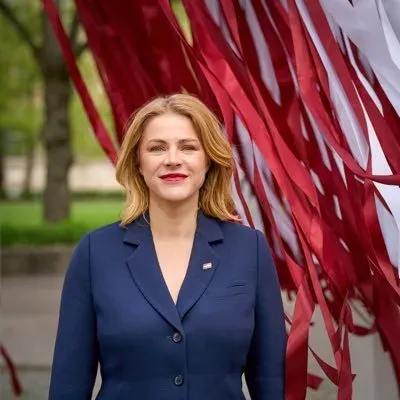
Latvia PM Evika Silina resigns after coalition collapse over defence row
Synopsis
Latvia’s government has collapsed after PM Evika Silina resigned on 14 May, triggered not by the drone airspace breach itself but by a coalition fight over who should replace the defence minister. The Progressives’ refusal to back her nominee — Colonel Raivis Melnis — forced Silina’s hand, exposing how fragile Baltic coalition politics can be even amid heightened security pressures on NATO’s eastern flank.
Key Takeaways
PM Evika Silina announced her resignation on 14 May , calling it “the right decision in this situation.” The government collapsed after coalition partner Progressives withdrew support on 13 May .
The crisis originated with the resignation of Defence Minister Andris Spruds following Ukrainian drones entering Latvian airspace from Russia and hitting an oil storage facility.
Silina had nominated Colonel Raivis Melnis as replacement defence minister; the Progressives’ refusal to back him precipitated the final break.
Latvia’s President will hold consultations with Saeima faction representatives at Riga Castle on 15 May to begin forming a new government.
Latvia’s defence budget stands at nearly 5 per cent of GDP , described as the “historically largest funding” for the sector.
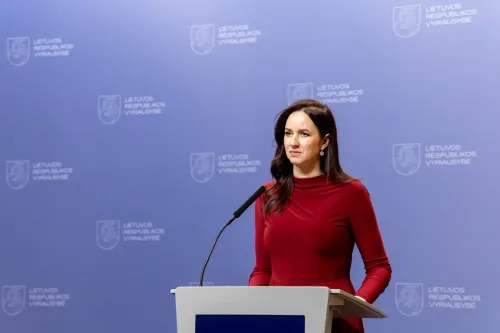
Latvian Prime Minister Evika Silina on Thursday, 14 May announced her resignation from office, describing the move as “the right decision in this situation” amid a government crisis triggered by the withdrawal of coalition support. The Latvian government will continue in a caretaker capacity until new cabinet ministers are formally approved.
What Triggered the Resignation
The immediate catalyst was the decision by coalition partner Progressives to withdraw support from the government on Wednesday, 13 May, effectively collapsing the ruling coalition. Andris Suvajevs, leader of the Progressives parliamentary faction, had warned that the government would fall if a vote of no confidence against Silina proceeded in the Saeima (Latvian parliament) on Thursday. Notably, as recently as Wednesday, Interior Minister Rihards Kozlovskis of the New Unity party had stated that Silina did not plan to resign.
Silina’s Own Words
In a pointed statement, Silina squarely blamed political manoeuvring within the coalition. “At this moment, political jealousy and narrow party interests have taken precedence over responsibility. Seeing a strong candidate for the post of defence minister — Colonel Raivis Melnis, whom I nominated to replace the resigned Progressives’ minister Andris Spruds — political windbags have chosen a crisis – a government crisis. That is why I am announcing my resignation. This is not an easy decision, but it is the right decision in this situation,” she said.
The Defence Minister Row That Started It All
The chain of events began the previous week when Defence Minister Andris Spruds resigned after Ukrainian drones, entering Latvian airspace from Russia, struck an oil storage facility on Latvian territory. On 10 May, Silina publicly demanded Spruds’ resignation, posting on X that he had “lost my trust and that of the public.”
In her X post, Silina wrote: “The drone incident that occurred this week clearly demonstrated that the political leadership of the defense sector has failed to fulfill its promise of safe skies over our country. The public has entrusted the sector with the historically largest funding — nearly 5 per cent of GDP. That is an enormous responsibility that demands clear results.”
She had nominated Colonel Raivis Melnis — a military professional with education in London and active experience in Ukraine — to head the defence ministry. The Progressives’ refusal to back Melnis’s appointment set off the final rupture.
What Happens Next
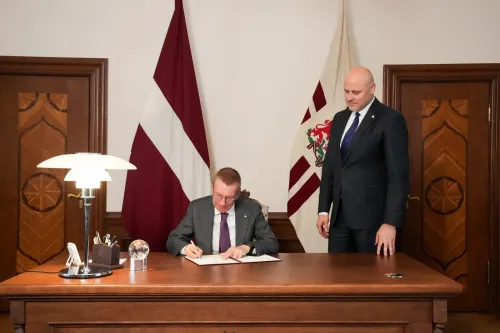
Latvia’s President has formally received Silina’s resignation. Consultations with representatives of the Saeima factions are scheduled to take place at Riga Castle on Friday, 15 May, to determine the path toward forming a new government. The caretaker government will remain in place until a successor administration is confirmed.
Point of View
A prolonged government formation process carries real strategic risk. The incoming administration will need to resolve the defence leadership question fast, or risk signalling institutional weakness at the worst possible moment.
NationPress
13 Oct 2026
Frequently Asked Questions
Why did Latvian PM Evika Silina resign?
Evika Silina resigned on 14 May after coalition partner Progressives withdrew their support from the government, leaving her facing a likely vote of no confidence in the Saeima. She cited “political jealousy and narrow party interests” over her nomination of Colonel Raivis Melnis as the new defence minister as the immediate cause.
What caused the Latvian government coalition to collapse?
The coalition collapsed after the Progressives refused to back Silina’s nominee for defence minister, Colonel Raivis Melnis, following the resignation of the previous defence minister Andris Spruds. Spruds had stepped down after Ukrainian drones crossed into Latvian airspace from Russia and struck an oil storage facility.
Who is Colonel Raivis Melnis and why was he nominated?
Colonel Raivis Melnis is a military professional with a background in Latvia’s National Armed Forces, military education in London, and current work experience in Ukraine. Silina nominated him to bring a professional, non-political approach to the defence ministry after the drone airspace incident exposed what she called a failure of political leadership in the sector.
What happens to Latvia’s government now that Silina has resigned?
The caretaker government will continue to perform its duties until a new cabinet is approved. Latvia’s President has received the resignation and will hold consultations with Saeima faction representatives at Riga Castle on 15 May to determine how a new government will be formed.
What was the drone incident that started the crisis?
Ukrainian drones entered Latvian airspace from Russia and struck an oil storage facility on Latvian territory. The incident prompted Silina to demand the resignation of Defence Minister Andris Spruds on 10 May, citing his failure to ensure ‘safe skies’ despite the sector receiving nearly 5 per cent of GDP in funding.