Malawi imposes 21-day quarantine, border screening to block DRC Ebola spread

Synopsis
Malawi hasn't recorded a single Ebola case — but it isn't waiting. With the DRC's outbreak now at 11,613 confirmed cases and 5,678 deaths since May 2026, Lilongwe has moved decisively: mandatory 21-day quarantine for DRC travellers, daily monitoring for those from Uganda, Kenya, and Nigeria, and health screening at every entry point. It's a containment bet before the virus reaches its borders.
Key Takeaways
Malawi's Ministry of Health and Sanitation issued a travel advisory signed by Secretary Dan Namarika to prevent Ebola importation from the DRC .
Travellers from or transiting through the DRC must undergo mandatory 21-day self-isolation with daily health monitoring.
Travellers from or via Uganda , Kenya , or Nigeria face 21 days of daily monitoring by health professionals.
All incoming travellers must complete an online Traveller Health Declaration Form and undergo temperature screening at all ports of entry.
The DRC outbreak, ongoing since May 2026 , has recorded 11,613 confirmed cases and 5,678 deaths , according to Africa CDC .
Malawi has recorded zero Ebola cases since the current outbreak began.
Malawi's Ministry of Health and Sanitation has issued a formal travel advisory and stepped up border surveillance to prevent the importation of Ebola virus disease from the Democratic Republic of the Congo (DRC), where the current outbreak has killed more than 5,678 people since it began in May 2026. The directive, signed by Secretary for Health and Sanitation Dan Namarika, introduces mandatory screening and quarantine rules for all travellers entering the country.
Key Measures at the Border
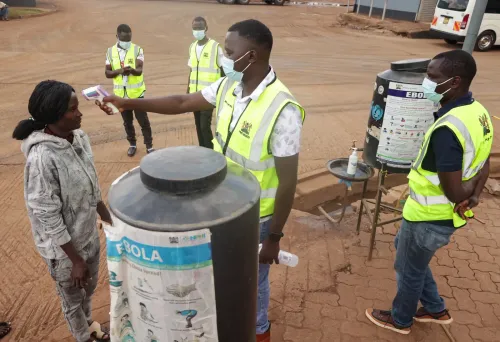
All travellers arriving in Malawi are now required to complete an online Traveller Health Declaration Form through the ministry's designated portal before or upon arrival, supplying accurate contact details for potential public health follow-up. Health screening — including body temperature checks — will be conducted at all points of entry, covering airports, land border crossings, and inland ports.
Quarantine Rules by Country of Origin
The directive draws a distinction based on the traveller's origin. Those arriving from or transiting through the DRC must undergo a mandatory 21-day self-isolation with daily monitoring by health professionals. Travellers arriving from or transiting through Uganda, Kenya, or Nigeria will face 21 days of daily health monitoring, though self-isolation is not explicitly mandated for this group under the advisory.
The ministry has urged travellers, transport operators, and border stakeholders to strictly adhere to infection prevention and control protocols and to comply with guidance from port health officers.
Scale of the DRC Outbreak
According to data from the Africa Centres for Disease Control and Prevention (Africa CDC), the DRC has recorded 11,613 confirmed cases and 5,678 deaths in the ongoing outbreak, which began in May 2026. Malawi has not reported any confirmed Ebola cases since the outbreak started, making these measures a preemptive containment strategy rather than a response to in-country transmission.
What Is Ebola and How Does It Spread
According to the World Health Organization (WHO), Ebola is a severe and often fatal illness affecting humans and other primates. The virus is first transmitted to people from wild animals — including fruit bats, porcupines, and non-human primates — before spreading between humans through direct contact with blood, secretions, organs, or other bodily fluids of infected individuals, as well as contaminated surfaces and materials such as bedding and clothing.
What Comes Next
With the DRC outbreak showing no signs of immediate containment, border health agencies across southern and eastern Africa are under growing pressure to enforce preventive protocols. Malawi's measures reflect a broader regional effort to build a cordon before cases reach countries with weaker health infrastructure. Sustained compliance from transport operators and cross-border traders — who often face economic pressure to minimise delays — will be a critical test of the directive's effectiveness.
Point of View
Not after. But the advisory's real test will be enforcement, not language. Land border crossings and inland ports are notoriously difficult to monitor across southern Africa, and 21-day self-isolation requirements have historically struggled with compliance when economic livelihoods depend on cross-border movement. The distinction the directive draws between DRC (self-isolation) and Uganda, Kenya, and Nigeria (monitoring only) also raises questions about how transmission risk is being assessed, given that none of those three countries are currently the primary outbreak zone. With the DRC reporting over 11,600 cases, the region cannot afford enforcement gaps.
NationPress
22 Nov 2026
Frequently Asked Questions
What new Ebola rules has Malawi introduced for travellers?
Malawi now requires all incoming travellers to complete an online Traveller Health Declaration Form and undergo temperature screening at every point of entry. Travellers from or transiting through the DRC must complete a mandatory 21-day self-isolation with daily monitoring, while those from Uganda, Kenya, or Nigeria face 21 days of daily health monitoring.
Why has Malawi introduced these Ebola measures?
The measures are a preemptive response to the ongoing Ebola outbreak in the DRC, which has recorded 11,613 confirmed cases and 5,678 deaths since May 2026, according to the Africa CDC. Malawi has not recorded any Ebola cases but is acting to prevent importation before the virus reaches its borders.
Has Malawi recorded any Ebola cases?
No. As of the latest advisory, Malawi has not recorded any confirmed Ebola cases since the current DRC outbreak began in May 2026. The travel advisory is a preventive containment measure, not a response to in-country transmission.
How does Ebola spread between people?
According to the World Health Organization, Ebola spreads through direct contact with blood, secretions, organs, or other bodily fluids of infected individuals, as well as contact with contaminated surfaces such as bedding or clothing. The virus initially reaches humans from wild animals including fruit bats, porcupines, and non-human primates.
Which countries are covered under Malawi's enhanced Ebola monitoring?
Travellers from or transiting through the DRC face mandatory 21-day self-isolation. Travellers from or transiting through Uganda, Kenya, and Nigeria are subject to 21 days of daily monitoring by health professionals without an explicit self-isolation requirement under the current directive.