Mexico to continue 'mirror' ops with US after Tamaulipas border shooting
Synopsis
After a reported shooting involving US Coast Guard personnel near Tamaulipas, Mexico and the US activated pre-agreed 'mirror' patrol operations on both sides of the border — with Mexico deploying 500 military and National Guard personnel even as its government said it could not verify shots came from the Mexican side. The episode lays bare the tightrope Mexico walks: cooperating with Washington on security while insisting on sovereignty and constitutional limits.
Key Takeaways
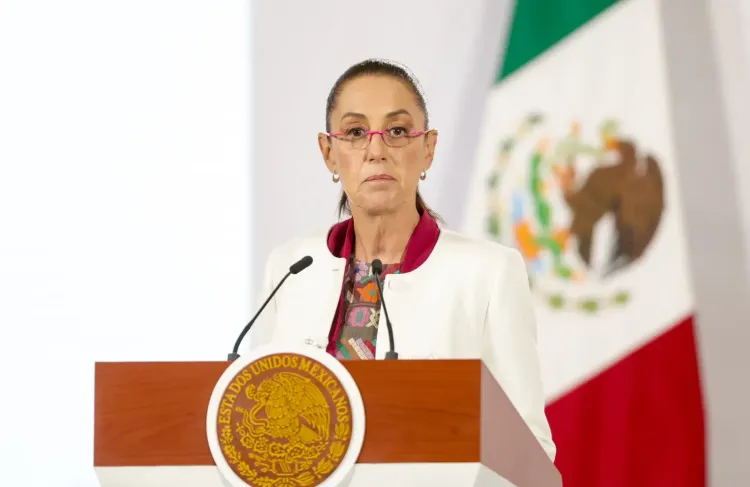
Mexican President Claudia Sheinbaum confirmed on 7 October that 'mirror' border operations with the US in Tamaulipas will continue following a reported shooting near US Coast Guard personnel.
Mexico deployed 500 military and National Guard personnel to the Tamaulipas border area as part of coordinated patrols.
US Ambassador Ronald Johnson said on X that Mexico fielded 159 naval personnel , 11 vehicles , and 2 drones , while the US deployed approximately 500 military personnel on the northern side.
Mexico's government said it could not verify that shots were fired from the Mexican side of the border.
Sheinbaum stressed that cooperation must follow principles of 'sovereignty, territorial integrity, mutual trust, and coordination without subordination.'
Mexican President Claudia Sheinbaum on Tuesday, 7 October confirmed that Mexico will maintain coordinated 'mirror' patrol operations with the United States along their shared border in Tamaulipas state, following a reported shooting incident involving US Coast Guard personnel in the area. Sheinbaum stressed that any bilateral security cooperation must respect Mexico's sovereignty and constitutional framework.
What Mirror Operations Mean
Speaking at her daily press conference at the National Palace in Mexico City, Sheinbaum described the mirror operations as a previously agreed mechanism designed to prevent misinterpretation of troop movements on either side of the border. 'We decided to undertake the mirror operations, which is something that had previously been agreed on. One has already taken place and another is taking place to avoid any situation of misinterpretation,' she said.
She added that Mexico seeks to maintain 'a good relationship with the United States ... particularly in security ... in accordance with our Constitution and our laws.'
The Shooting Incident and US Response
The incident came after US Ambassador to Mexico Ronald Johnson said on Sunday, in a post on the social media platform X, that US Coast Guard personnel had come under fire along the border near Tamaulipas. In a separate post, Johnson noted that Mexico had deployed 159 naval personnel, 11 vehicles, and two drones on its side of the border, while the US had deployed approximately 500 military personnel on the northern side.
'Together, we intend to patrol both sides of our shared border, protect our communities, and make it more difficult for criminal and terrorist organizations to operate,' Johnson wrote, adding that any threats from 'criminal or terrorist elements on either side of the border will be swiftly addressed.'
Mexico's Position on the Shooting
Mexico's government said it could not verify that any shots were fired from the Mexican side of the border. Despite that caveat, authorities moved quickly, deploying 500 military and National Guard personnel to the Tamaulipas region as part of coordinated patrols. Sheinbaum underscored that bilateral security cooperation must adhere to the principles of 'sovereignty, territorial integrity, mutual trust, and coordination without subordination.'
Broader Context and What Comes Next
The episode highlights the delicate balance Mexico navigates between security cooperation with Washington and protecting its constitutional principles of non-intervention. This comes amid heightened US scrutiny of the Mexico border, with American military assets already positioned along the frontier. Mexico maintains active communication channels with the US Northern Command and the Coast Guard, suggesting the operational framework will remain in place as both sides work to prevent further incidents. The durability of the mirror-operations arrangement — and the unresolved question of who fired the shots — will likely shape the next phase of US-Mexico border security talks.
Point of View
Signalling that the political cost of appearing uncooperative with Washington currently outweighs the optics of acting on unverified US claims. The unresolved forensics of the shooting are consequential: if evidence does emerge that fire came from Mexican territory, it will intensify pressure on Sheinbaum to go further than coordination allows. The episode also tests whether 'coordination without subordination' is a workable doctrine or a formula that will crack under the next incident.
NationPress
7 Oct 2026
Frequently Asked Questions
What are the 'mirror operations' Mexico and the US are conducting?
Mirror operations are coordinated border patrols in which both countries deploy forces simultaneously on their respective sides of the shared boundary in Tamaulipas. The arrangement was previously agreed upon and is designed to prevent misinterpretation of troop movements and reduce the risk of cross-border incidents.
What triggered the latest US-Mexico border security response?
US Ambassador Ronald Johnson said on Sunday that US Coast Guard personnel came under fire along the border near Tamaulipas. Mexico said it could not verify that shots were fired from its side but nonetheless deployed 500 military and National Guard personnel to the area as a precaution.
How many forces have been deployed on each side of the border?
According to Ambassador Johnson, Mexico deployed 159 naval personnel, 11 vehicles, and 2 drones, while the US positioned approximately 500 military personnel on the northern side of the border.
What is Mexico's position on sovereignty in this security cooperation?
President Sheinbaum has made clear that any cooperation with the US must adhere to principles of 'sovereignty, territorial integrity, mutual trust, and coordination without subordination.' Mexico frames the arrangement as a joint effort consistent with its Constitution, not a concession of operational control to Washington.
Who is Ronald Johnson and why is his statement significant?
Ronald Johnson is the US Ambassador to Mexico. His posts on X were the first public confirmation from the American side of both the reported shooting and the scale of joint deployments, making them the primary sourced evidence for the incident before any formal US government statement was issued.