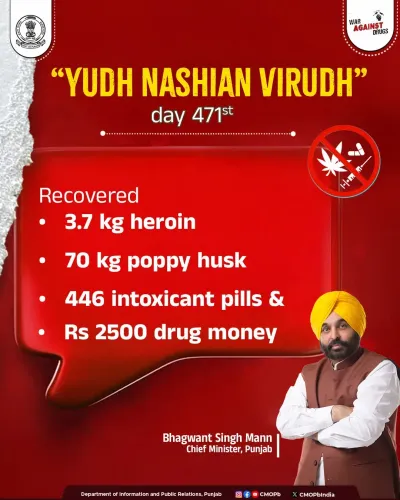
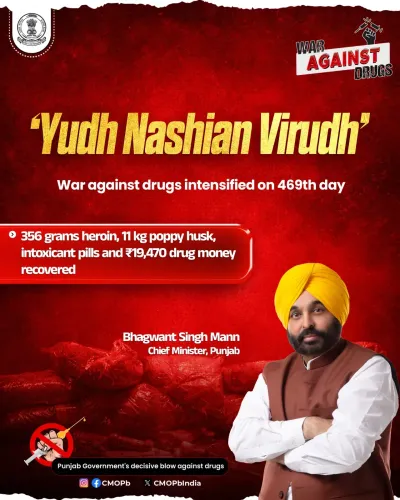
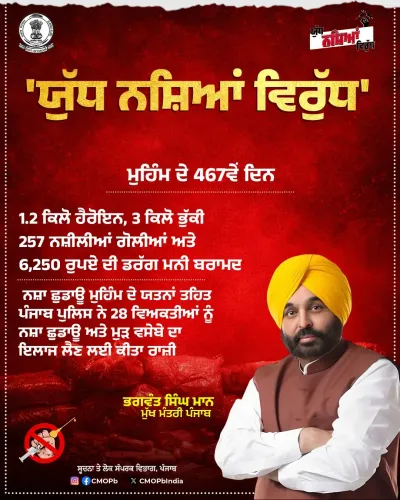
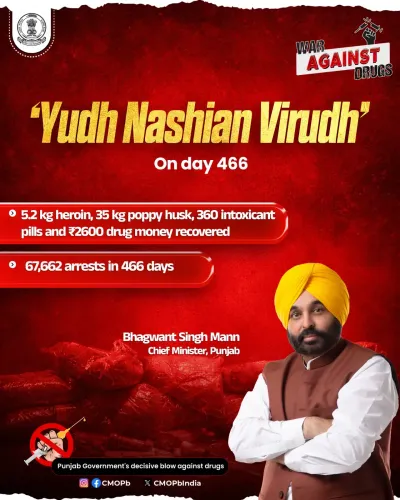
Punjab Police hits Day 629 of Yudh Nashian Virudh, arrests cross 94,000
Synopsis
On Day 629 of the 'Yudh Nashian Virudh' campaign, Punjab Police seized 6.2 kg heroin, 2.5 kg opium, 10 kg poppy husk, 82 intoxicant tablets, and ₹1.88 lakh in drug money, bringing total arrests under the drive to 94,085 since its launch under CM Bhagwant Mann.
Key Takeaways
Day 629 of the 'Yudh Nashian Virudh' anti-drug campaign was reported by the Chief Minister's Office of Punjab on 21 November 2026 .
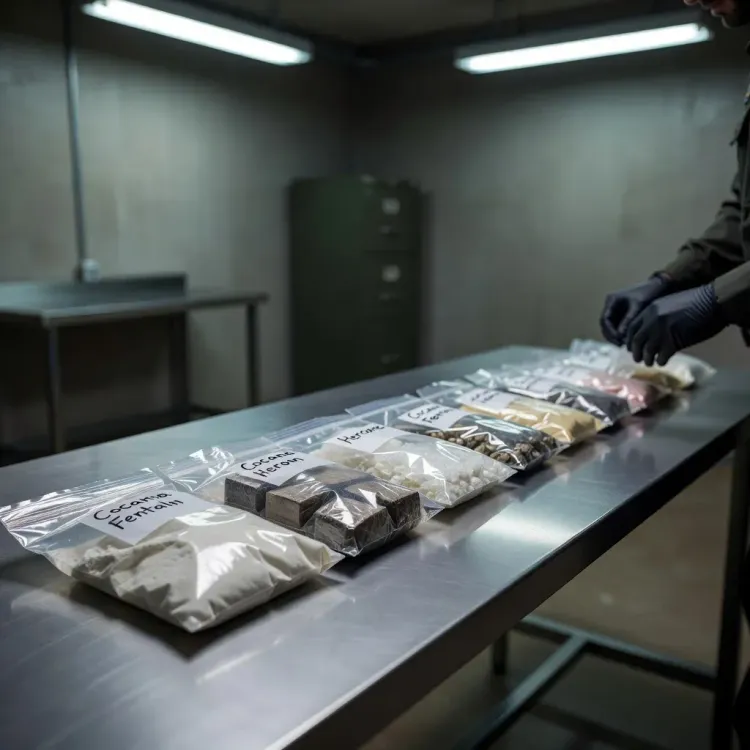
Single-day seizures included 6.2 kg heroin , 2.5 kg opium , 10 kg poppy husk , 82 intoxicant tablets/capsules , and ₹1.88 lakh in drug money.
Cumulative arrests under the campaign have reached 94,085 drug smugglers over 629 days.
The campaign was launched by Chief Minister Bhagwant Mann's government after the AAP came to power in Punjab in March 2022 .
Punjab's border with Pakistan makes it a key transit zone for heroin and other narcotics entering India.
Analysts note that enforcement data must be paired with rehabilitation outcomes to assess the campaign's full impact.
Nearly 630 consecutive days into one of India's most sustained state-level anti-narcotics campaigns, Punjab Police showed no sign of slowing down — seizing 6.2 kg of heroin, 2.5 kg of opium, 10 kg of poppy husk, and 82 intoxicant tablets and capsules, along with ₹1.88 lakh in drug money, in a single day's operations on Saturday, 21 November 2026. The Chief Minister's Office of Punjab confirmed the milestone, pushing the campaign's cumulative arrest tally to 94,085 drug smugglers in 629 days.
What one day's haul reveals about the campaign's scale
The daily seizure breakdown tells a layered story. Heroin — the drug most closely associated with Punjab's proximity to the Pakistan border and the broader 'Golden Crescent' trafficking corridor — remains the headline narcotic. But the simultaneous recovery of opium, poppy husk, and pharmaceutical intoxicants signals that enforcement teams are sweeping across the full spectrum of the state's drug supply chain, from border-linked hard narcotics to locally circulating substances.
The ₹1.88 lakh in drug money recovered in a single operation, while modest in isolation, reflects the campaign's explicit focus on following the financial trail — a tactic that targets the economic engine of trafficking networks, not just individual couriers.
629 days of 'Yudh Nashian Virudh' — the campaign's arc
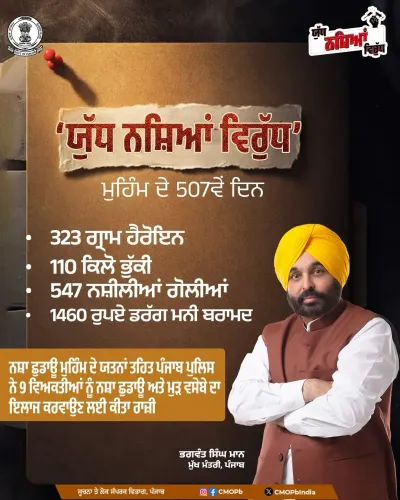
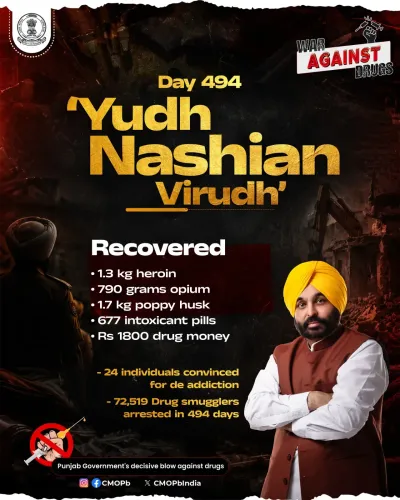
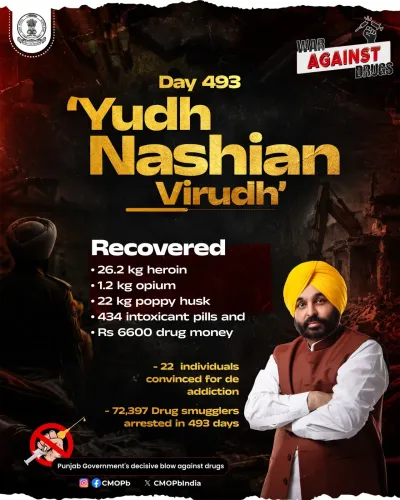
The Yudh Nashian Virudh ('War Against Drugs') drive was launched by Chief Minister Bhagwant Mann's government after the Aam Aadmi Party came to power in Punjab in March 2022, with drug enforcement positioned as a flagship governance commitment. The campaign has operated on a daily-action model, with the Chief Minister's Office releasing updates that track arrests and seizures in near-real time — a communications strategy designed to signal accountability and continuity to a public that has watched previous administrations launch and quietly wind down similar drives.
Punjab has contended with entrenched drug trafficking for decades, a consequence of its long border with Pakistan and its position as a transit zone for narcotics moving deeper into India. Successive state governments have mounted enforcement responses; what distinguishes the current campaign, at least in its stated metrics, is the unbroken daily cadence now stretching past the 629-day mark.
The 94,085-arrest figure and what follows it
A cumulative arrest count of 94,085 over roughly 21 months averages to approximately 150 arrests per day — a figure that underscores both the breadth of enforcement activity and the depth of the trafficking problem it is responding to. Analysts and civil society groups tracking Punjab's drug crisis have consistently argued that arrest numbers, while necessary, must be paired with robust rehabilitation infrastructure to produce durable outcomes for affected families and communities.
The state government has flagged de-addiction and rehabilitation as parallel priorities alongside enforcement, though consolidated data on treatment outcomes and programme reach remains a key metric to watch as the campaign continues its daily march.
At 629 days and counting, the only real question left for Punjab's anti-drug campaign is whether the arrest curve eventually bends the addiction curve — and that answer will come from clinics and communities, not just police stations.
Point of View
Visible enforcement — communicated daily through official channels — can rebuild public trust on an issue where Punjab's electorate has long felt let down. At 94,085 arrests over 629 days, the sheer operational tempo is difficult to dismiss, but the campaign's long-term credibility will hinge on whether it can demonstrate downstream impact on drug availability and addiction rates, not just arrest tallies. Border states like Punjab sit at the intersection of federal border management and state-level policing, meaning any durable solution requires coordination that no single campaign can deliver alone. The daily update model is as much a governance communication strategy as an enforcement one — and both dimensions will face scrutiny as the numbers climb.
NationPress
21 Nov 2026
Frequently Asked Questions
What is the Yudh Nashian Virudh campaign in Punjab?
'Yudh Nashian Virudh' means 'War Against Drugs' and is an anti-narcotics enforcement drive launched by the Punjab government under Chief Minister Bhagwant Mann after the AAP came to power in March 2022. It involves daily police operations to arrest drug smugglers and seize narcotics across the state.
How many drug smugglers have been arrested in Punjab's anti-drug campaign?
According to the Chief Minister's Office of Punjab, the total number of drug smugglers arrested under the 'Yudh Nashian Virudh' campaign reached 94,085 by Day 629 of the drive.
What drugs were seized by Punjab Police on Day 629?
On Day 629 of the campaign, Punjab Police seized 6.2 kg of heroin, 2.5 kg of opium, 10 kg of poppy husk, 82 intoxicant tablets and capsules, and ₹1.88 lakh in drug money.
Why is Punjab particularly affected by drug trafficking?
Punjab shares a long border with Pakistan and lies along the 'Golden Crescent' narcotics trafficking corridor, making it a key transit and consumption zone for heroin and other drugs entering India. This geographic reality has fuelled chronic drug abuse and trafficking in the state for decades.
Is the Yudh Nashian Virudh campaign only about arrests?
While arrests and seizures are the most visible metrics of the campaign, the Punjab government has stated that de-addiction and rehabilitation form parallel priorities alongside enforcement action against drug smugglers.