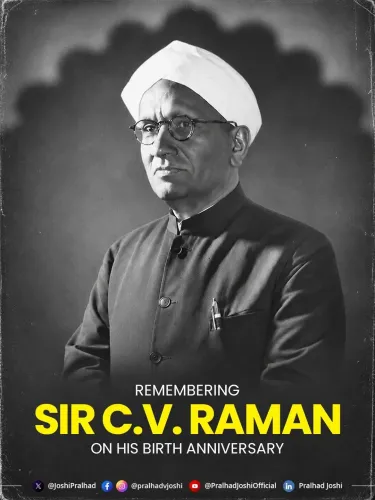
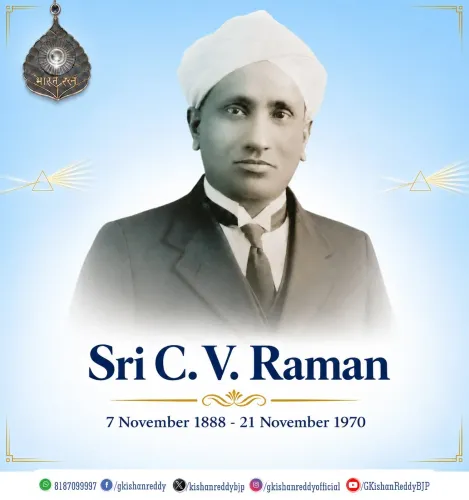
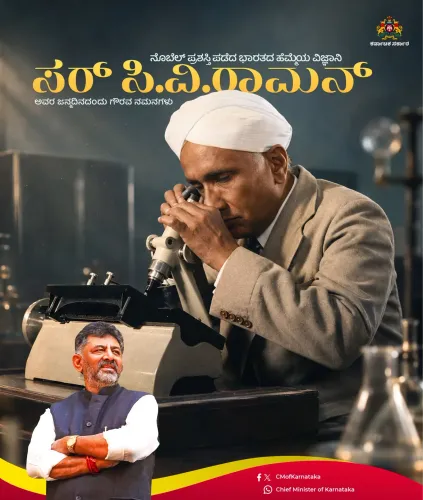
Kishan Reddy Pays Tribute to C.V. Raman on Punyatithi
Synopsis
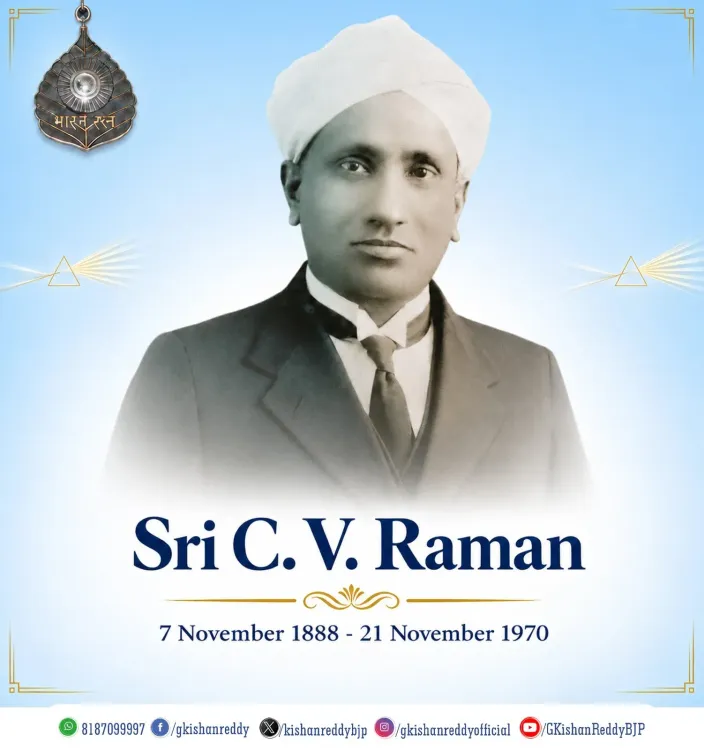
Union Minister G. Kishan Reddy marked the death anniversary of Nobel Laureate Sir C.V. Raman, honouring the physicist's discovery of the Raman Effect in 1928 and his enduring influence on Indian scientific thought.
Key Takeaways
Raman won the Nobel Prize in Physics in 1930 , the first Asian to do so in a science category.
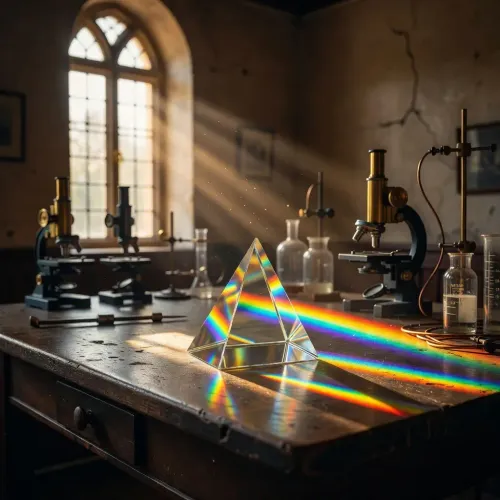
The Raman Effect , discovered on 28 February 1928 , describes how light scatters and shifts wavelength through transparent materials.
28 February is commemorated as National Science Day in India in honour of the discovery.
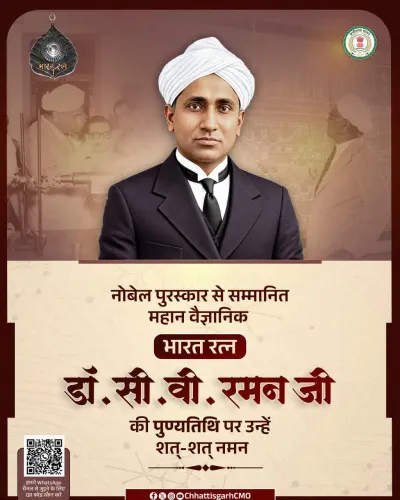
Kishan Reddy posted the tribute on the scientist's punyatithi (death anniversary).
The Raman Effect remains foundational to modern spectroscopy, with applications in medicine, materials science, and space research.
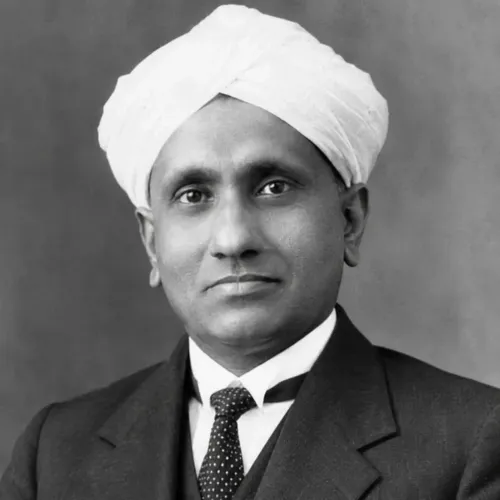
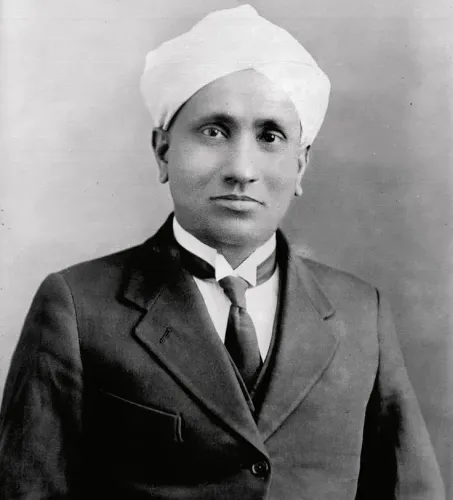
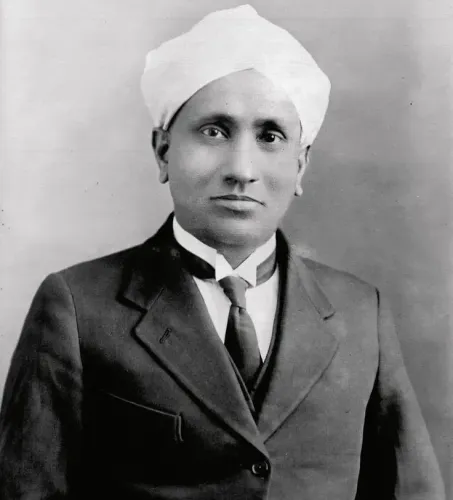
A giant of Indian science is remembered today — Sir Chandrasekhara Venkata Raman, the physicist whose Nobel Prize-winning discovery reshaped how humanity understands light. On his punyatithi (death anniversary), Union Coal and Mines Minister G. Kishan Reddy paid tribute to the legendary scientist, honouring a legacy that stretches far beyond any single generation.
The discovery that put Indian science on the world map
Sir C.V. Raman was awarded the Nobel Prize in Physics in 1930 — the first Asian scientist to receive the honour in a science category — for his discovery of the Raman Effect, a phenomenon describing how light changes wavelength when it passes through a transparent material. The finding was announced on 28 February 1928, a date now celebrated across India as National Science Day. The effect itself became foundational to modern spectroscopy, with applications ranging from pharmaceutical research to materials science and even space exploration.Routine tribute, enduring resonance
Indian ministers and public figures routinely mark the death anniversaries of the country's most celebrated scientists, and Raman's punyatithi draws particular attention each year. Minister Reddy's post described Raman's contributions as 'pioneering work and dedication to scientific excellence' that 'continue to inspire generations' — a sentiment that lands differently when the scientist in question remains, nearly a century on, the benchmark for homegrown scientific ambition. The tribute carries no direct link to coal or mines policy; it is, plainly, a moment of national remembrance. For a country that has made science and technology investment a centrepiece of its development narrative, keeping Raman's memory visible in public discourse is itself a small act of institutional continuity.Point of View
Reflecting a broader state effort to anchor national identity in intellectual achievement. For the BJP, such tributes also serve to reinforce a narrative of civilisational pride in homegrown excellence. Raman's story — a scientist who made a world-changing discovery with minimal equipment in colonial India — carries particular resonance at a time when India is aggressively expanding its science and technology funding. The tribute is ceremonial, but the symbolism it draws on is very much alive in contemporary policy discourse.
NationPress
21 Nov 2026
Frequently Asked Questions
Who was Sir C.V. Raman?
Sir Chandrasekhara Venkata Raman was an Indian physicist who discovered the Raman Effect in 1928 and was awarded the Nobel Prize in Physics in 1930, making him the first Asian to win a Nobel Prize in a science category.
What is the Raman Effect?
The Raman Effect is a phenomenon in which light changes its wavelength when it passes through a transparent material due to scattering. It is foundational to spectroscopy and has wide applications in medicine, materials science, and space research.
Why is 28 February celebrated as National Science Day in India?
India celebrates National Science Day on 28 February each year to mark the anniversary of C.V. Raman's announcement of the Raman Effect discovery in 1928.
Why did G. Kishan Reddy pay tribute to C.V. Raman?
Union Coal and Mines Minister G. Kishan Reddy posted a tribute to Sir C.V. Raman on his death anniversary, honouring the physicist's contributions to science and his enduring inspirational legacy.
When did C.V. Raman win the Nobel Prize?
Sir C.V. Raman was awarded the Nobel Prize in Physics in 1930 for his discovery of the Raman Effect.