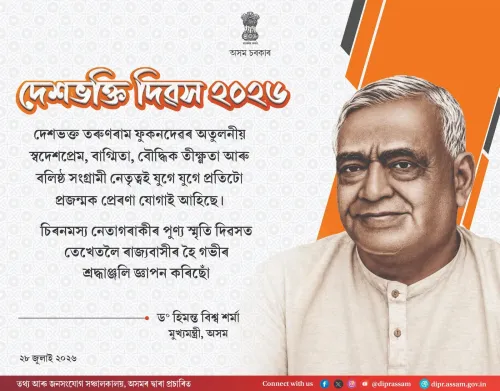
CM Himanta Remembers C.V. Raman on Death Anniversary
Synopsis
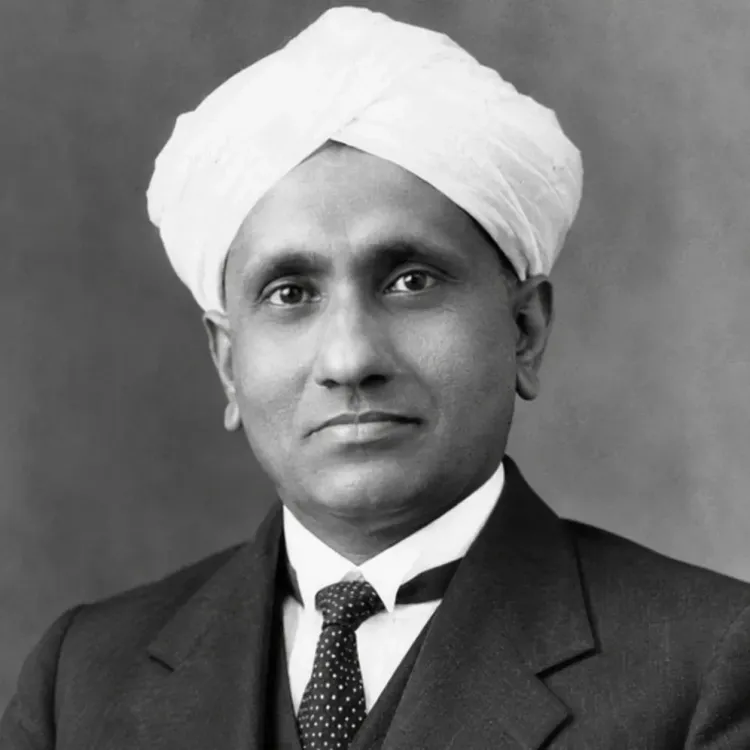
Assam Chief Minister Himanta Biswa Sarma marked the death anniversary of Sir C.V. Raman on 21 November 2026, honouring the Nobel laureate physicist whose 1930 discovery of the Raman Effect made him the first Asian to win a Nobel in science.
Key Takeaways
Assam CM Himanta Biswa Sarma posted a tribute to Sir C.V.
Raman on his death anniversary on 21 November 2026 .
Sir Raman discovered the Raman Effect — inelastic scattering of light by molecules — announced on 28 February 1928 .
He was awarded the Nobel Prize in Physics for 1930 , becoming the first Asian scientist to win a Nobel in science.
28 February is commemorated as National Science Day in India to mark the Raman Effect's announcement.
Sarma called on 'young India' to carry forward Raman's 'spirit of discovery.'
A Nobel Prize won in 1930. A discovery so fundamental it still underpins modern spectroscopy, cancer diagnostics, and deep-space research. On the death anniversary of Sir Chandrasekhara Venkata Raman, Assam Chief Minister Himanta Biswa Sarma paused to honour the physicist whose curiosity reshaped how humanity understands light.
Sarma's tribute captured the essence of the man in a single line: 'Curiosity changed the way we understand light. A scientist changed the way the world looked at Indian science.' The post, shared on Saturday, 21 November 2026, invoked Sir Raman's 'spirit of discovery' as a beacon for young India.
The discovery that made India a Nobel nation
Sir C.V. Raman's landmark finding — that light scatters inelastically when it passes through a transparent medium, shifting wavelength in ways unique to the molecules involved — was announced on 28 February 1928. Two years later, it earned him the Nobel Prize in Physics for 1930, making him the first Asian and first non-white scientist to win a Nobel in science. The phenomenon, now universally known as the Raman Effect, became a cornerstone of analytical chemistry and materials science.
That date, 28 February, is now observed as National Science Day across India — an annual reminder that one scientist's restless questioning changed what the world thought was possible from this subcontinent.
A pattern of political tribute to scientific legacy
Sarma's post fits a broader, deliberate pattern among Indian political leaders: marking the birth and death anniversaries of pre-independence scientific icons to publicly affirm the nation's intellectual heritage. For Sir Raman, the remembrances carry a particular charge — his achievement predates independence by nearly two decades, arriving at a moment when Indian science had to fight for global credibility on its own terms.
That context gives Sarma's closing appeal — 'May his spirit of discovery continue to inspire young India' — a quietly urgent undertone. It is less ceremony, more challenge: a call to the next generation to treat curiosity as a civic virtue.
Point of View
BJP leaders signal that India's scientific ambition is not borrowed from the post-1947 state but rooted in an older, indigenous tradition of inquiry. The appeal to 'young India' also quietly frames scientific aspiration as a nationalist project, linking heritage to contemporary priorities like deep-tech investment and research university reform. These commemorations are soft power at work — low-cost, high-recall anchors in the public imagination.
NationPress
21 Nov 2026
Frequently Asked Questions
When did Sir C.V. Raman die?
Sir C.V. Raman died on 21 November 1970 in Bangalore, aged 82.
What is the Raman Effect?
The Raman Effect is the inelastic scattering of light when it passes through a transparent medium — the scattered light shifts wavelength in a way that is unique to the molecules involved, allowing scientists to identify substances. Sir C.V. Raman announced the discovery on 28 February 1928 .
Why did C.V. Raman win the Nobel Prize?
Sir C.V. Raman was awarded the Nobel Prize in Physics for 1930 for the discovery of the Raman Effect, which fundamentally advanced the understanding of how light interacts with matter.
What is National Science Day and why is it on 28 February?
National Science Day is observed on 28 February every year in India to commemorate the date in 1928 on which Sir C.V. Raman announced the discovery of the Raman Effect.
Why do Indian politicians tribute C.V. Raman every year?
Sir Raman is celebrated as the first Asian and first non-white scientist to win a Nobel Prize in science, making him a defining symbol of India's scientific heritage. Politicians mark his death and birth anniversaries to publicly affirm national pride in that legacy.