PM Modi at India-ASEAN Summit: 'India's development and ASEAN's prosperity deeply interconnected'
Synopsis
At the 23rd India-ASEAN Summit in Manila, PM Modi linked India's Viksit Bharat 2047 vision directly to ASEAN's own 2045 blueprint — framing the two as complementary rather than parallel. With 100-plus initiatives, 250 Quick Impact Projects, and 10,000 scholarships since 2014, Modi is making the case that the Act East Policy has moved from slogan to substance, even as global instability raises the stakes for regional solidarity.
Key Takeaways
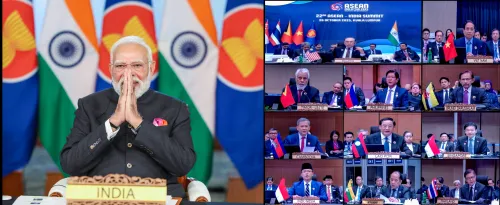
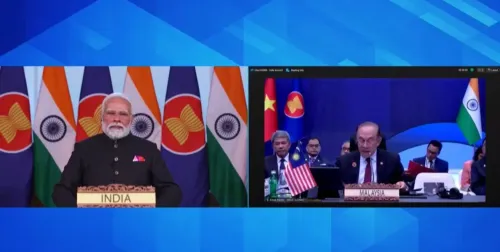
PM Narendra Modi addressed the 23rd India-ASEAN Summit in Manila on 17 November 2026 .
Modi declared India's development and ASEAN's prosperity 'deeply interconnected' , urging cooperation over competition.
India has launched more than 100 initiatives and around 250 Quick Impact Projects with ASEAN since 2014 , along with over 10,000 skill-building scholarships .
Modi linked ASEAN Community Vision 2045 and Viksit Bharat 2047 as complementary frameworks for shared regional goals.
Philippines President Ferdinand Romualdez Marcos Jr. was thanked for his ASEAN chairmanship and role as India's Country Coordinator.
Modi called the summit theme 'Navigating Our Future Together' especially significant amid ongoing global crises.
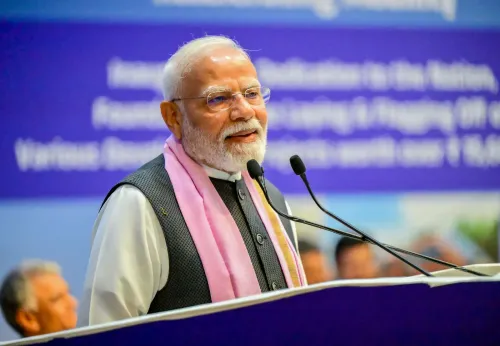
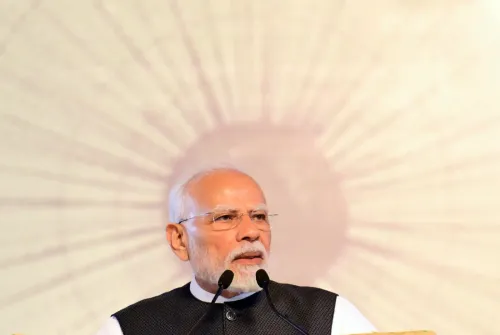
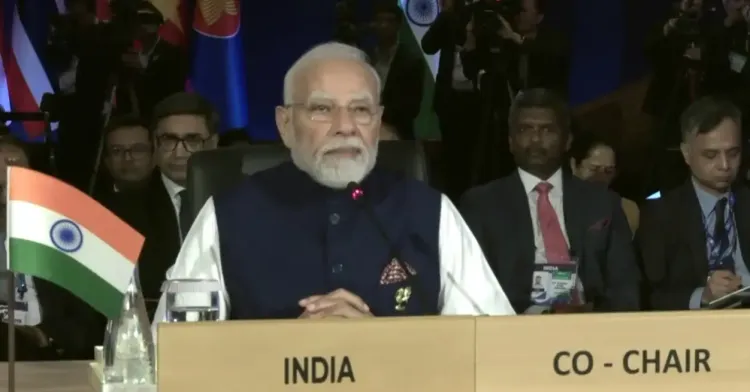
Prime Minister Narendra Modi on Tuesday, 17 November 2026, declared that India's development and ASEAN's prosperity are 'deeply interconnected', calling for cooperation over competition as the defining principle of the partnership. Speaking at the 23rd India-ASEAN Summit in Manila, Modi outlined a sweeping vision anchored in digital collaboration, defence ties, and shared demographic weight.
The Core Message: Cooperation Over Competition
Addressing leaders gathered at the summit, Modi said, 'India and ASEAN together represent nearly one-fourth of the world's population. Therefore, it is essential to ensure that our future is shaped not by competition but by cooperation. We have both the capability and the resolve. Together, we can make this region a symbol of peace and stability.'
He framed the summit as more than a diplomatic ritual, linking two landmark frameworks — ASEAN Community Vision 2045 and India's own Viksit Bharat 2047 — as complementary blueprints for realising shared regional aspirations. This comes amid intensifying great-power competition in the Indo-Pacific, making Modi's emphasis on multilateral consensus notably pointed.
Act East Policy: New Dimensions in Digital, Defence and Space
Modi credited India's Act East Policy — launched under his government in 2014 — with giving 'new momentum and depth' to India-ASEAN relations. He noted that the partnership has moved well beyond cultural and heritage links into strategic domains.
'Our partnership is now moving beyond shared culture and heritage to explore new dimensions in areas such as digital, defence and space. Since 2014, we have undertaken more than 100 initiatives to strengthen people-to-people ties,' he said.
The Prime Minister also highlighted concrete deliverables: approximately 250 Quick Impact Projects launched across ASEAN member states, more than 10,000 skill-building scholarships provided, and an expansion of direct flight connectivity that has boosted bilateral tourism. These numbers represent a significant scaling-up of engagement compared to the pre-2014 era of more limited outreach.
Philippines Chairmanship and President Marcos Jr.
Modi specifically congratulated Philippines President Ferdinand Romualdez Marcos Jr. for his successful stewardship of ASEAN's chairmanship and for his role as Country Coordinator for India-ASEAN ties. The acknowledgement was notable given the Philippines' growing strategic alignment with India on maritime security and trade, two areas where both nations share overlapping interests in the South China Sea corridor.
Global Instability and the Summit's Significance
Modi situating the summit against a backdrop of cascading global crises added urgency to the gathering. 'Over the past few years, the world has faced one crisis after another. Today, the world needs peace, stability and predictability more than ever,' he said, calling the summit's theme — 'Navigating Our Future Together' — especially timely.
Notably, this was Modi's third visit to an ASEAN country, which he cited as evidence of the bloc's strategic importance to India. The remark underscores a consistent foreign policy priority: deepening Asia-Pacific engagement as a counterbalance to volatility elsewhere. With ASEAN's combined GDP exceeding $3 trillion and India's economy growing at among the fastest rates globally, the economic logic of deeper integration is increasingly hard to ignore.
What happens next will depend on whether the declared ambitions translate into binding agreements — on trade review, digital frameworks, and defence cooperation — in the months ahead.
Point of View
Raising the cost of backsliding on either side. Yet the gap between initiative counts and binding deliverables remains wide. Over 100 initiatives since 2014 is an impressive headline; what is less clear is how many have produced measurable, verifiable outcomes on trade, digital interoperability, or defence cooperation. With the ASEAN-India Free Trade Agreement review still unresolved and India's goods trade deficit with the bloc widening, the 'cooperation not competition' framing will need institutional teeth to outlast the summit communiqué.
NationPress
17 Nov 2026
Frequently Asked Questions
What did PM Modi say at the 23rd India-ASEAN Summit in Manila?
PM Modi declared that India's development and ASEAN's prosperity are 'deeply interconnected' and called for the partnership to be shaped by cooperation rather than competition. He also linked India's Viksit Bharat 2047 vision with the ASEAN Community Vision 2045 as complementary frameworks for regional progress.
What is India's Act East Policy and how does it relate to ASEAN?
India's Act East Policy, launched in 2014, is a foreign policy initiative aimed at deepening economic, strategic, and cultural ties with Southeast Asia and the broader Indo-Pacific. Under this policy, India has undertaken more than 100 initiatives with ASEAN, launched 250 Quick Impact Projects, and offered over 10,000 skill-building scholarships.
Why is the India-ASEAN Summit significant in 2026?
The 23rd India-ASEAN Summit in Manila takes place amid heightened global instability, great-power rivalry in the Indo-Pacific, and converging long-term visions — ASEAN's 2045 blueprint and India's Viksit Bharat 2047. Modi's presence marks his third visit to an ASEAN country, underscoring the bloc's strategic priority for New Delhi.
Who is Philippines President Ferdinand Marcos Jr. and what role did he play?
Ferdinand Romualdez Marcos Jr. is the President of the Philippines and served as ASEAN's chair as well as the Country Coordinator for India-ASEAN relations. PM Modi specifically acknowledged his leadership of the chairmanship and his contributions to strengthening bilateral India-ASEAN ties.
What areas is India-ASEAN cooperation expanding into?
Beyond traditional cultural and heritage ties, India-ASEAN cooperation is now extending into digital connectivity, defence, and space. Direct flights, growing tourism, Quick Impact Projects, and skill-building scholarships are among the key people-to-people initiatives highlighted at the summit.