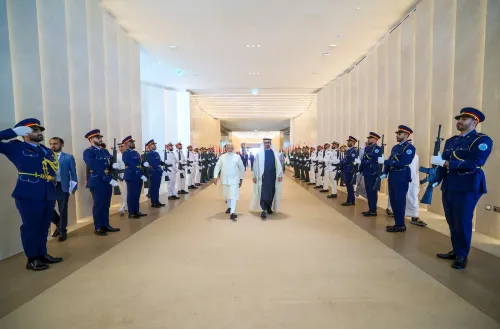
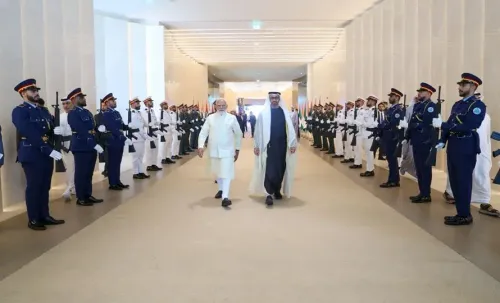
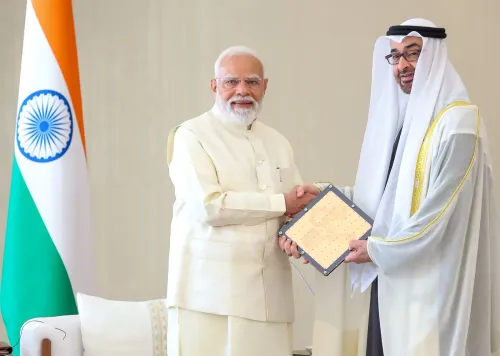
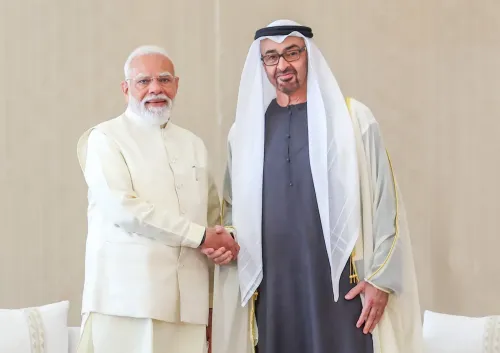
Modi's UAE visit forges new India-Gulf axis amid West Asia tensions
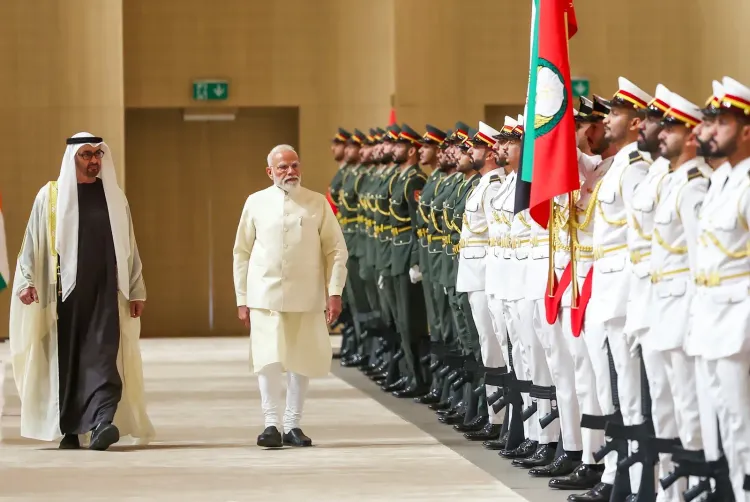
Synopsis
Modi's UAE visit is not a routine diplomatic stopover — it is a calculated strategic move at the precise moment West Asia is most volatile. A $5 billion investment pledge, a new Strategic Defence Partnership, and energy agreements anchored to Fujairah's Hormuz-bypass advantage together signal that India and the UAE are positioning themselves as the Gulf's most consequential bilateral axis — one built on sovereign pragmatism rather than external alliance politics.
Key Takeaways
PM Modi visited the UAE amid heightened US-Iran tensions and growing concerns over Strait of Hormuz security.
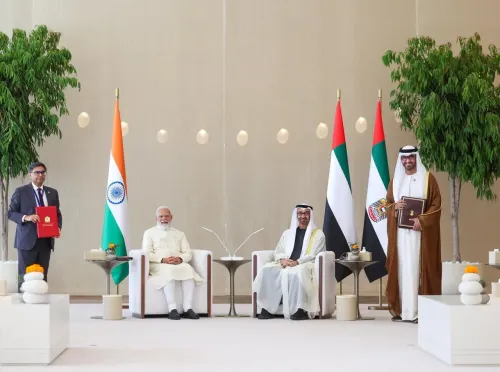
Both countries signed a Strategic Defence Partnership and agreements on crude oil reserves and LPG supplies .
The UAE committed up to $5 billion in investment into India during the visit.
Fujairah , located outside the Strait of Hormuz on the Gulf of Oman, is identified as a critical energy corridor for uninterrupted India-UAE oil trade.
More than 4.5 million Indians reside in the UAE — the world's largest Indian expatriate community.
Analysts describe India's balanced ties with the UAE, Saudi Arabia, Iran, and Israel as giving New Delhi a unique stabilising role in the region.
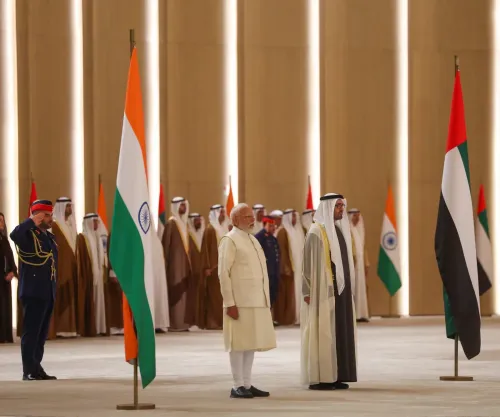
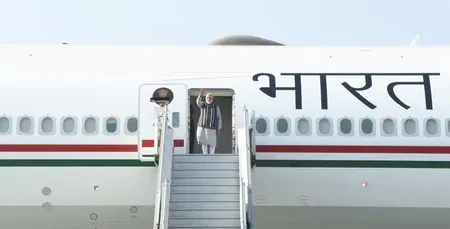
Prime Minister Narendra Modi's visit to the United Arab Emirates (UAE) has drawn fresh strategic significance as West Asia navigates a period of compounding uncertainty — marked by US-Iran tensions, mounting concerns over the security of the Strait of Hormuz, and rapidly shifting geopolitical alignments across the Gulf. According to analysts, India's decision to deepen engagement with the UAE at this juncture is both timely and consequential for regional stability.
Key Agreements and Strategic Outcomes
During the visit, the two countries elevated bilateral ties through a Strategic Defence Partnership, new agreements covering crude oil reserves and LPG supplies, collaboration on a ship repair cluster, and a commitment of up to $5 billion in UAE investment into India. These outcomes build on the Comprehensive Economic Partnership Agreement (CEPA) — signed in an earlier phase of the relationship — which has already accelerated trade, investment, and financial connectivity between the two nations.
The UAE ranks among India's largest trading partners and is a significant source of foreign direct investment. Sovereign wealth funds from Abu Dhabi and Dubai have committed billions of dollars into Indian infrastructure, logistics, renewable energy, ports, and digital platforms. More than 4.5 million Indians live and work in the UAE — the largest Indian expatriate community in the world — contributing through remittances, entrepreneurship, and sustained cultural ties.
The Fujairah Advantage: Energy Security Beyond Hormuz
A strategically significant dimension of the partnership centres on Fujairah — the UAE's port city situated on the Gulf of Oman, outside the Strait of Hormuz. Analysts note that Fujairah provides both countries an energy gateway insulated from any disruption or closure of the Hormuz chokepoint, one of the world's most sensitive maritime corridors.
For India, Fujairah represents a proximate and dependable source for crude oil, LNG, and petroleum products that can move directly across the Arabian Sea to India's western coast. Existing cooperation on strategic petroleum reserves and long-term crude storage reflects this shared understanding. Analysts argue that expanding Fujairah's port infrastructure, storage facilities, and pipeline networks could institutionalise a permanent India-UAE energy corridor — strengthening India's long-term energy security while deepening the strategic partnership.
Defence, Technology, and the Broader Partnership
Defence cooperation between the two countries has expanded steadily through joint exercises, intelligence sharing, maritime security coordination, and counter-terrorism frameworks. Both nations share concerns over regional instability, cyber threats, and the security of vital sea lanes.
On the technology front, collaboration in artificial intelligence, semiconductors, and digital infrastructure is emerging as one of the most forward-looking dimensions of the relationship. India's software talent and cost-effective innovation capacity, combined with the UAE's investment capital and ambition to become a global technology hub, are seen as complementary strengths. A jointly funded India-UAE AI Innovation Centre — focused on cybersecurity, governance, smart infrastructure, healthcare, and defence applications — has been proposed as a transformative next step.
India's Role as a Regional Stabiliser
Analysts and former diplomats observe that India occupies a distinctive position in West Asia: it maintains constructive ties with the UAE, Saudi Arabia, Iran, Israel, and other Gulf states simultaneously. This balanced posture — grounded in development, connectivity, and non-interference in regional rivalries — gives India a credibility that few external powers can claim.
This approach, according to commentators, is consistent with India's broader foreign policy philosophy of Vasudhaiva Kutumbakam — the world is one family — and positions New Delhi as a potential bridge between South Asia, West Asia, Central Asia, East Africa, and Southeast Asia through economic corridors, energy arrangements, and people-to-people exchanges.
As the India-UAE partnership deepens, India's role in the Gulf is evolving from that of an important economic partner to a trusted strategic stakeholder — a shift, analysts argue, whose implications extend well beyond the bilateral relationship and into the broader architecture of regional stability.
Point of View
But it is also a tightrope: the same evenhandedness that gives New Delhi credibility with Tehran limits how far it can go in formalising security guarantees with Abu Dhabi.
NationPress
30 Sept 2026
Frequently Asked Questions
What were the key outcomes of PM Modi's UAE visit?
PM Modi's visit to the UAE produced a Strategic Defence Partnership, agreements on crude oil reserves and LPG supplies, collaboration on a ship repair cluster, and a UAE commitment of up to $5 billion in investment into India. The visit also reinforced the existing Comprehensive Economic Partnership Agreement (CEPA) framework.
Why is the Strait of Hormuz relevant to India-UAE ties?
The Strait of Hormuz is a critical maritime chokepoint through which a significant share of global oil and gas shipments pass. Any disruption there — due to US-Iran tensions or other conflicts — can immediately affect India's energy imports. The UAE's Fujairah port, located outside the Strait on the Gulf of Oman, offers India a secure alternative energy corridor.
What is the significance of Fujairah in the India-UAE energy partnership?
Fujairah is a UAE port city on the Gulf of Oman, positioned outside the Strait of Hormuz. It allows crude oil, LNG, and petroleum products to reach India's western coast without passing through the Hormuz chokepoint. Analysts argue that expanding Fujairah's infrastructure could institutionalise a permanent India-UAE energy corridor that insulates both countries from Gulf disruptions.
How large is the Indian community in the UAE?
More than 4.5 million Indians live and work in the UAE, making it home to the world's largest Indian expatriate community. Their contributions through remittances, entrepreneurship, and cultural ties are considered a foundational pillar of the bilateral relationship.
How does India maintain balanced relations across competing Gulf powers?
India maintains constructive ties with the UAE, Saudi Arabia, Iran, Israel, and other Gulf states simultaneously — without formally aligning with any regional bloc or military alliance. This posture, grounded in development cooperation and non-interference, gives India a credibility that analysts say positions it as a potential mediating force in West Asia.