NCPOR teams set out from Maitri on Antarctica ice-shelf surveys
Synopsis
Two NCPOR-led teams have left India's Maitri Station on field traverses — one across the 10,400-square-km Nivlisen Ice Shelf to map melt interactions, the other 100 km south into the Gruber Mountains. The paired ice-and-rock campaign is meant to sharpen India's reading of climate-linked change in East Antarctica.
Key Takeaways
NCPOR researchers have set out on two field traverses from India's Maitri Station in Antarctica, reported on 25 November .
Scientist-D Dr Vikram is leading a Nivlisen Ice Shelf team with Dr Tobias Tal of Australia and NCPOR's Dr Anirudha Mahagaokar .
The Nivlisen Ice Shelf covers nearly 10,400 square km in Dronning Maud Land, with ice 150–700 metres thick and flow of about 100 metres per year .
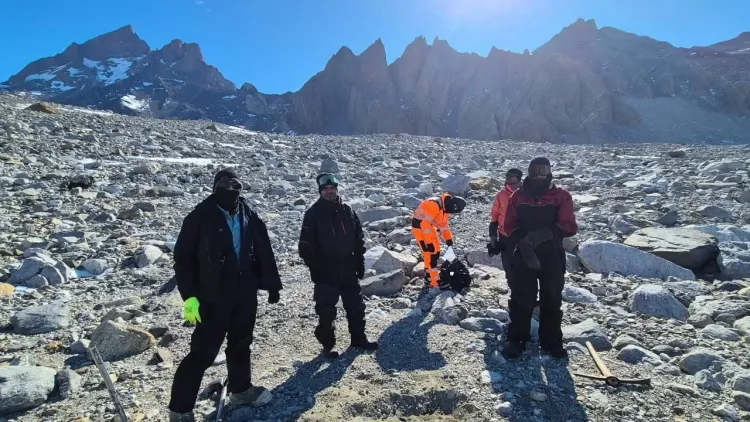
Scientist-F Dr Yogesh Ray is leading a separate traverse 100 km south to the Gruber Mountains, with GSI senior geologist Vikas Chandra .
Ritscher Peak in the Gruber Mountains rises to 2,791 metres ; Lake Untersee lies beside the Anuchin Glacier.
Researchers said the work is to study features, collect samples, and understand climate change and other factors.
Researchers from the National Centre for Polar and Ocean Research (NCPOR) have set out on two scientific field traverse expeditions from India's Maitri Station in Antarctica to study ice-shelf dynamics and geological formations in the polar region. One team is crossing the Nivlisen Ice Shelf to examine melt interactions, while a second is heading about 100 km south to the Gruber Mountains. The work, reported on 25 November, is intended to strengthen India's scientific understanding of East Antarctica.
Nivlisen Ice Shelf melt study
The Nivlisen Ice Shelf traverse is being led by NCPOR Scientist-D Dr Vikram, accompanied by Dr Tobias Tal from Australia, NCPOR's Dr Anirudha Mahagaokar, and a dedicated operational team from Maitri Station. The group is investigating melt interactions on the shelf to improve understanding of ice-shelf processes.
The Nivlisen Ice Shelf is a floating ice shelf along the coast of central Dronning Maud Land in East Antarctica, extending into the Lazarev Sea. It covers nearly 10,400 square km, stretching about 80 km north to south and 130 km east to west between the ice rises of Leningradkollen in the east and Djupranen in the west.
Ice thickness ranges from around 150 metres at the seaward front to nearly 700 metres in the southeast. Central east-to-west transects commonly measure between 210 metres and 330 metres. Fed by glaciers draining inland ice, including the Potsdam Glacier and flows through Wohlthatmassivet, the shelf typically moves at around 100 metres per year, with tidal and wind-driven variations.
The shelf borders the Schirmacher Oasis and nearby blue ice areas, where katabatic winds and sublimation expose dense, snow-free glacial ice. Summer warming creates surface meltwater ponds, slush, and supraglacial drainage channels — features that make the Nivlisen a useful natural laboratory for melt processes close to Maitri.
Gruber Mountains geological traverse
In a separate scientific field traverse, NCPOR Scientist-F Dr Yogesh Ray is leading a team to the Gruber Mountains, located about 100 km south of Maitri Station. The team includes Geological Survey of India senior geologist Vikas Chandra, NCPOR researchers, and Maitri Station operational personnel.
The Gruber Mountains form a compact mountain group in Dronning Maud Land, also known as Queen Maud Land, and make up the northeastern section of the Wohlthat Mountains. The range consists of a main massif and several rocky outliers, with Ritscher Peak rising to 2,791 metres alongside peaks such as Bastei, Mentzelberg, and Zuckerhut.
Lake Untersee sits within a large cirque on the northern slopes beside the Anuchin Glacier. Maitri and Russia's Novolazarevskaya Station lie closest to the northwest of the range. The geology of this compact massif offers a window into the region's rock record and glacial history, complementary to the ice-shelf work farther north.
Why the expeditions matter
Ice shelves such as the Nivlisen act as floating extensions of the inland ice. Their melt behaviour, thickness, and flow speed influence how inland ice is discharged toward the ocean. Mapping melt ponds, slush, and drainage channels helps scientists interpret how summer warming is altering shelf surfaces in this sector of East Antarctica.
A researcher said the purpose of sending teams to Antarctica is to study such features and collect samples. “The purpose of sending researchers to Antarctica is to study such features and collect samples. This helps in understanding the impact of climate change and other factors,” the researcher said.
Notably, the two traverses pair glaciological work on a floating shelf with geological sampling in a nearby mountain group, giving NCPOR a combined ice-and-rock dataset from the same sector of Dronning Maud Land. This comes amid wider scientific attention on polar melt and ice-shelf stability, and on how field observations from stations such as Maitri feed into that picture.
India's presence at Maitri
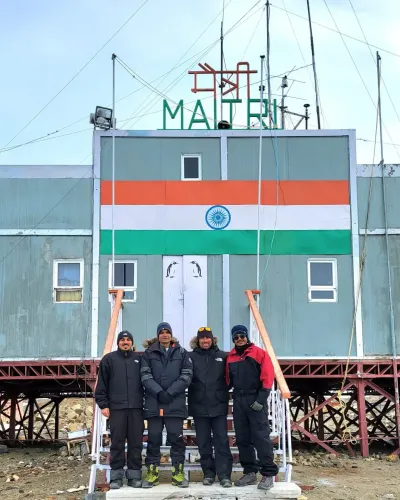
Maitri Station is India's research base in the Schirmacher Oasis and the launch point for both expeditions. Operational personnel from the station are supporting the scientific teams in the field, underscoring that polar science depends as much on logistics as on instruments.
NCPOR coordinates India's polar and ocean research programme, and field traverses of this kind extend the station's observational reach well beyond the oasis — onto a 10,400-square-km ice shelf and into mountains 100 km inland. The Australian participation on the Nivlisen traverse and the Geological Survey of India role on the Gruber traverse also point to the collaborative character of work in this part of Antarctica.
What happens next
The teams are collecting samples and field observations that will feed into studies of ice-shelf processes and geological formations. Findings on melt interactions at Nivlisen could refine understanding of how this East Antarctic shelf responds to summer warming, while Gruber Mountains sampling should add to the geological picture of the Wohlthat range.
India's polar research community will watch how these datasets sit alongside earlier work from Maitri and neighbouring stations, including Russia's Novolazarevskaya. The expeditions underline a continuing Indian scientific footprint in Dronning Maud Land as questions around ice shelves, melt, and climate remain central to polar science.
Point of View
GSI and Australian scientists onto a moving ice shelf and into the Wohlthat massif is how a polar programme turns occupancy into evidence. Ice-shelf melt is not an abstract talking point: shelves buttress inland ice, and what happens on Nivlisen feeds sea-level questions that eventually reach Indian coasts. The real test is whether these traverses yield open, comparable datasets rather than one-off field notes — polar science is costly, and the return has to be usable knowledge.
NationPress
26 Nov 2026
Frequently Asked Questions
What are the NCPOR Antarctica field traverse expeditions?
They are two scientific field traverses launched from India's Maitri Station in Antarctica by the National Centre for Polar and Ocean Research. One team is studying melt interactions on the Nivlisen Ice Shelf; the other is conducting geological work in the Gruber Mountains about 100 km south of Maitri.
What is the Nivlisen Ice Shelf and why is it being studied?
The Nivlisen Ice Shelf is a floating ice shelf of nearly 10,400 square km along central Dronning Maud Land in East Antarctica, extending into the Lazarev Sea. NCPOR is studying melt interactions there — including ponds, slush and drainage channels — to better understand ice-shelf processes and climate-related change.
Who is leading the Gruber Mountains expedition?
NCPOR Scientist-F Dr Yogesh Ray is leading the Gruber Mountains traverse. The team includes Geological Survey of India senior geologist Vikas Chandra, NCPOR researchers, and operational personnel from Maitri Station.
How does this research relate to climate change?
A researcher said the expeditions are meant to study polar features and collect samples to understand the impact of climate change and other factors. Ice-shelf melt, thickness and flow on Nivlisen are among the processes that influence how inland ice is discharged toward the ocean.
Where is Maitri Station and how far are the survey sites?
Maitri Station is India's research base in the Schirmacher Oasis in Dronning Maud Land, East Antarctica, and is the launch point for both traverses. The Gruber Mountains lie about 100 km south of Maitri; the Nivlisen Ice Shelf borders the oasis and stretches up to about 80 km north–south into the Lazarev Sea.