Pakistan hosts 48% of MENAAP region's $3-a-day poor: World Bank report
Synopsis
A World Bank report reveals Pakistan is home to nearly half of the MENAAP region's extreme poor — more than war-ravaged Afghanistan, Syria, and Yemen combined. With poverty rates rising 6.4 percentage points in six years and per-capita GDP growth stuck near 2%, the data makes a stark case that Pakistan's economic crisis has crossed into a humanitarian one.
Key Takeaways
Pakistan accounts for 48 per cent of the MENAAP region's population living below the $3-per-day poverty line, according to a World Bank report.
Poverty rates at the $3-per-day level rose by 6.4 per cent in Pakistan between 2018-19 and 2024-25 , driven by the COVID-19 pandemic , 2022 floods , and a macroeconomic crisis.
The MENAAP region accounts for 14 per cent of the world's extreme poor — second only to Sub-Saharan Africa .
Pakistan's economy is projected to grow 3.8 per cent in 2026-27 , but population-adjusted real GDP growth is just 2.2 per cent .
Only 3 per cent of Pakistani firms reported product innovation, versus a lower-middle-income average of 23 per cent .
Petrol and diesel prices in Pakistan have surged more than 40 per cent since the start of the Middle East conflict.
Nearly half of all people living below the $3-per-day poverty line in the Middle East, North Africa, Afghanistan and Pakistan (MENAAP) region reside in Pakistan, according to a World Bank report cited by The Express Tribune. The findings place Pakistan at the centre of a worsening regional poverty crisis, driven by a cascade of economic shocks over the past six years.
Pakistan's share of regional poverty
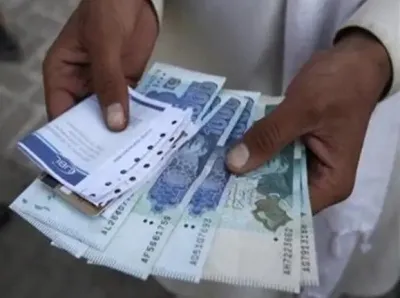
Pakistan accounts for approximately 48 per cent of the MENAAP region's population living below the $3 per day threshold — equivalent to roughly ₹840 in daily income. The remaining poor are concentrated in Afghanistan, Syria, and Yemen, three conflict-affected nations that together account for another 47 per cent of the regional poor.
Poverty rates at the $3-per-day line approached or exceeded 20 per cent in Djibouti, Pakistan, Syria, and Yemen. Notably, the World Bank has formally separated Pakistan from the South Asia grouping and reclassified it within the MENAAP region — a shift that underscores the country's deepening economic alignment with its western neighbours.
What drove the surge in Pakistani poverty
The poverty rate in Pakistan rose by 6.4 per cent at the $3-per-day line and 3.2 per cent at the $4.2-per-day line between 2018-19 and 2024-25, according to the report. The increase was driven by a succession of adverse shocks: the COVID-19 pandemic, the devastating 2022 floods, a macroeconomic crisis marked by high inflation and currency depreciation, and a prolonged period of economic adjustment that eroded real household incomes and employment.
The MENAAP region as a whole accounts for 14 per cent of the world's extreme poor — second only to Sub-Saharan Africa. After sustained declines during the 2000s and 2010s, poverty reduction in the region stalled around 2019 and reversed following the COVID-19 shock, with Pakistan's deterioration identified as the primary regional driver.
Economic outlook and fiscal pressures
The report projects 3.8 per cent economic growth and 8.2 per cent inflation for Pakistan in the current fiscal year 2026-27. However, population-growth-adjusted real GDP growth is estimated at just 2.2 per cent — barely above last year's 2.1 per cent — indicating that per-capita gains remain negligible.
The current account deficit is pegged at 0.8 per cent of GDP and the budget deficit at 3.5 per cent — higher than the previous fiscal but described as within manageable limits. Oil-importing countries in the region, including Pakistan, remain exposed to rising inflation, shrinking fiscal space, declining remittances from the Gulf, and higher borrowing costs linked to the ongoing Middle East conflict. Petrol and diesel prices in Pakistan have risen by more than 40 per cent since the start of the conflict, compounding household-level distress.
Innovation gap and digital divide
The report also flags Pakistan's weak innovation record: just 3 per cent of firms reported product innovation and 1 per cent process innovation — far below the lower-middle-income country average of 23 per cent and 14 per cent respectively. While Pakistan recorded the highest absolute uptake of artificial intelligence in the MENAAP region, its use remains concentrated in arts and media — such as graphic design and content creation — rather than in productivity-enhancing industrial or services applications.
Eight MENAAP countries, including Pakistan, fall below the benchmark for mobile broadband subscriptions relative to income peers, pointing to a structural digital divide that could further constrain economic mobility. The report's findings suggest that without addressing structural vulnerabilities — energy costs, fiscal constraints, and low innovation — Pakistan's poverty trajectory is unlikely to reverse meaningfully in the near term.
Point of View
Inflation, and currency crises have been recurring features, not outliers. What is missing is a credible structural response — on energy subsidies, fiscal consolidation, and industrial policy — that goes beyond IMF programme compliance. The innovation gap, where Pakistani firms lag even lower-middle-income peers by a factor of seven, points to an underlying productivity crisis that cheap labour and remittances cannot paper over indefinitely.
NationPress
8 Oct 2026
Frequently Asked Questions
What did the World Bank report say about poverty in Pakistan?
The World Bank report found that Pakistan accounts for approximately 48 per cent of all people in the MENAAP region living below the $3-per-day poverty line. The poverty rate in Pakistan rose by 6.4 per cent at that threshold between 2018-19 and 2024-25, driven by the COVID-19 pandemic, the 2022 floods, high inflation, and currency depreciation.
Why has the World Bank grouped Pakistan with the MENAAP region instead of South Asia?
The World Bank formally separated Pakistan from the South Asia region and placed it in the MENAAP grouping, which covers the Middle East, North Africa, Afghanistan and Pakistan. The report does not detail the precise rationale, but the reclassification reflects Pakistan's distinct economic profile and vulnerability patterns relative to South Asian peers.
How does Pakistan's poverty compare with other MENAAP countries?
Pakistan holds the largest share of the region's poor at 48 per cent, ahead of Afghanistan, Syria, and Yemen — three war-affected nations — which together account for 47 per cent. Poverty rates at the $3-per-day line approached or exceeded 20 per cent in Pakistan, Djibouti, Syria, and Yemen.
What is Pakistan's economic growth forecast for 2026-27?
The World Bank has projected 3.8 per cent GDP growth and 8.2 per cent inflation for Pakistan in fiscal 2026-27. However, after adjusting for population growth, real GDP growth is estimated at just 2.2 per cent — barely above last year's 2.1 per cent — meaning per-capita gains remain marginal.
How does Pakistan rank on innovation compared to similar economies?
Pakistan performs significantly below peers: only 3 per cent of firms reported product innovation and 1 per cent process innovation, against a lower-middle-income country average of 23 per cent and 14 per cent respectively. AI adoption in Pakistan is the highest in absolute terms in MENAAP but is concentrated in arts and media rather than industrial or services productivity.