Nepal eyes economic gains between India and China, FM Khanal says
Synopsis
Nepal's Foreign Minister Shisir Khanal used a UN platform in New York to reframe his country's geography — long seen as a strategic liability — as a commercial asset. With two-thirds of trade tied to India and BRI deals with China still unimplemented, Nepal's ambition to become a 'land-linked' hub rather than a buffer state is bold, but the gap between vision and execution remains wide.
Key Takeaways
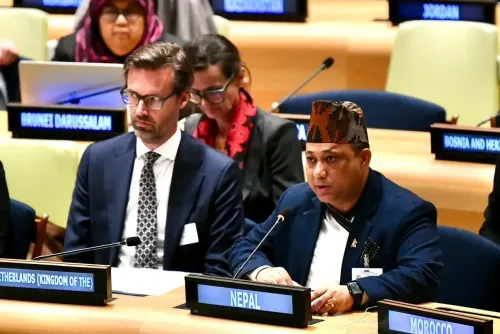
Nepal FM Shisir Khanal spoke at a United Nations event in New York on 27 September 2026 , outlining Nepal's dual-engagement strategy with India and China.
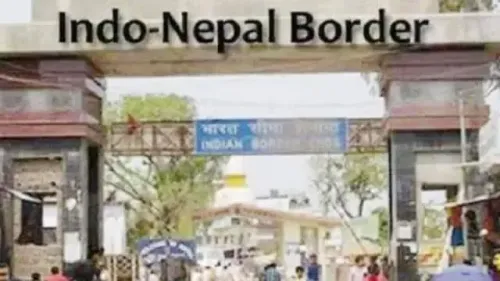
Roughly two-thirds of Nepal's trade is with India; the two countries share an open border of over 1,700 km across five Indian states .
Nepal signed a BRI memorandum with China in 2017 and a framework agreement in December 2024 , but no projects have been implemented yet.
Nepal aims to export hydropower to India and onward to Bangladesh as a key economic driver.
Kathmandu targets middle-income status within 10 years and high-income status by 2050 under its 'development autonomy' framework.
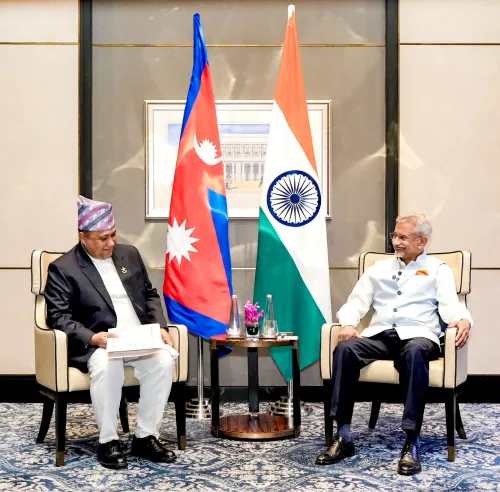
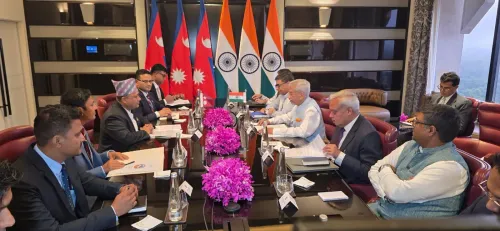
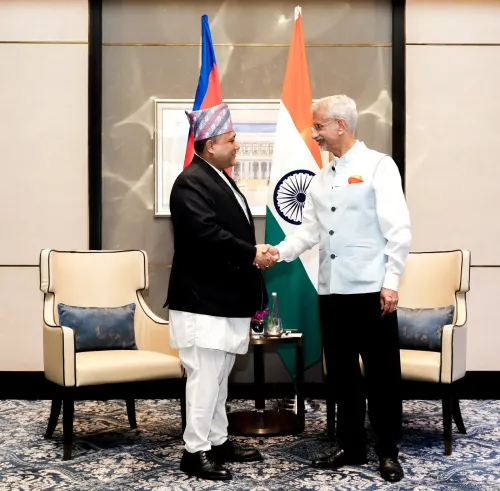
Khanal described Nepal-India ties as 'Excellent' and confirmed a meeting with India's External Affairs Minister on the sidelines of the UN gathering.
Nepal is working to convert its unique geographic position between India and China into a sustained economic advantage, Foreign Minister Shisir Khanal said on 27 September 2026 at a United Nations event in New York. Khanal framed stronger trade ties with India and improved connectivity with China not as competing priorities but as two pillars of the same national strategy.
The 'Land-Linked' Vision
Khanal told the gathering that Nepal's fundamental question in what he described as 'a rising Asian century' had shifted. 'We did not see our northern and southern corridors as competing directions,' he said. 'We see Nepal land linked to two of the world's largest markets, home to nearly three billion people.'
He argued that Nepal's goal was no longer survival between two giant neighbours but the creation of economic value — for Nepal and for the region. The framing signals a deliberate departure from the traditional 'buffer state' narrative that has long defined Kathmandu's foreign-policy posture.
India: The Dominant Partner
India remains the cornerstone of Nepal's economic landscape. Khanal noted that roughly two-thirds of Nepal's total trade flows through India, and the country depends heavily on Indian routes for port access. Nepal also shares an open border of more than 1,700 kilometres with five Indian states, giving it unparalleled overland integration.
On the sidelines of the UN proceedings, Khanal described the current bilateral relationship as 'Excellent, I'd say,' adding that he had met India's External Affairs Minister in New York and that high-level exchanges had continued. He highlighted hydropower as a key growth lever, with Nepal seeking to expand electricity generation and export clean power to India and, eventually, onwards to Bangladesh.
Asked about border disagreements — a recurring friction point — Khanal said his government was concentrating on practical cooperation and cited positive momentum in energy trade as evidence that progress was achievable despite unresolved differences.
China: Connectivity and Investment
China is Nepal's second-largest trading partner, and Chinese investors are among the largest foreign investors in the country, according to Khanal. Kathmandu is pursuing better road connectivity across the Himalayas and envisions rail links over time.
Nepal signed a memorandum of understanding on China's Belt and Road Initiative (BRI) in 2017 and a framework agreement in December 2024. Khanal acknowledged, however, that no BRI projects had yet moved to implementation. Beyond infrastructure, Nepal is also seeking Chinese cooperation on glacial monitoring, disaster early-warning systems, and climate adaptation — areas of particular urgency given the Himalayan ecosystem's vulnerability.
Development Autonomy and Governance
Khanal placed Nepal's foreign-engagement strategy within a broader framework he called 'development autonomy' — the principle that external partnerships should build productive capacity and generate jobs domestically rather than create dependency. Nepal's stated target is to reach middle-income status within 10 years and achieve developed, high-income status by 2050.
He linked these ambitions directly to governance reform, noting that young Nepalis had demanded action on corruption and the poor delivery of public services. On relations with the United States, Khanal said Nepal welcomed greater American investment and described ongoing official exchanges as robust, while clarifying that his government was not actively seeking security alliances, given Nepal's geography and regional sensitivities.
With BRI projects still unimplemented and hydropower exports in early stages, the coming months will test whether Kathmandu's balancing act translates from diplomatic rhetoric into tangible economic outcomes.
Point of View
But Nepal's structural realities complicate the pitch. The BRI framework agreement has been in place since December 2024 and no project has broken ground — a gap that suggests Kathmandu's leverage with Beijing is more aspirational than operational. Meanwhile, the two-thirds trade dependence on India is not a diplomatic card Nepal can play freely; it is a constraint. The hydropower export story is genuine, but scaling it to Bangladesh via India requires regulatory and grid cooperation that New Delhi controls the pace of. 'Development autonomy' is a meaningful goal, but the path runs almost entirely through decisions made in New Delhi and Beijing, not Kathmandu.
NationPress
27 Sept 2026
Frequently Asked Questions
What is Nepal's strategy for managing relations with India and China?
Nepal is pursuing what Foreign Minister Shisir Khanal calls a 'land-linked' approach — treating improved trade with India and better connectivity with China as complementary, not competing, goals. The aim is to convert Nepal's geographic position into economic value rather than viewing it as a geopolitical liability.
How significant is India to Nepal's economy?
India accounts for roughly two-thirds of Nepal's total trade and is the primary route through which Nepal accesses international ports. The two countries share an open border of more than 1,700 kilometres with five Indian states, reflecting deep economic and cultural integration.
What is the current status of Nepal's Belt and Road Initiative projects with China?
Nepal signed a BRI memorandum with China in 2017 and a framework agreement in December 2024, but Khanal acknowledged that no projects under the initiative have yet been implemented. Nepal is separately pursuing road and eventual rail connectivity across the Himalayas.
What are Nepal's long-term development targets?
Nepal aims to achieve middle-income status within 10 years and reach developed, high-income status by 2050, according to Khanal. This framework — which he calls 'development autonomy' — requires foreign partnerships to generate productive capacity and jobs domestically.
Does Nepal plan to align with US security interests?
Khanal said Nepal values US investment and described official exchanges as robust, but clarified that his government was not actively pursuing security alliances or deep security cooperation, citing Nepal's geography and regional sensitivities.