Nepal FM Khanal pitches proximity with India as production edge in New York speech
Synopsis
Nepal's Foreign Minister Sishir Khanal used a New York platform to reframe his country's geography — a 1,700-km open border touching 400 million Indians — as an industrial production opportunity, not just a diplomatic talking point. With a 28,000 MW hydropower target, border SEZs, and a 'land-linked' China corridor all on the table, Kathmandu is pitching itself as South Asia's next manufacturing and clean-energy pivot — and doing so without choosing between New Delhi and Beijing.
Key Takeaways
Nepal FM Sishir Khanal addressed the Asia Society in New York on 25 September 2026 , outlining Nepal's economic strategy with India and China.
Nepal shares a more than 1,700 km open border with five Indian states — Uttarakhand, Uttar Pradesh, Bihar, West Bengal, and Sikkim — covering over 400 million people .
Nepal is targeting 28,000 MW of hydropower capacity by 2035 from an estimated 43 GW economically viable potential, with plans to export clean power to India and Bangladesh.
Khanal proposed border SEZs to attract global and Indian manufacturing firms seeking resilient supply chains with access to green electricity.
Nepal rejects the India-China binary, framing itself as a land-linked gateway to two markets of nearly 3 billion people .
The government's doctrine of 'Developmental Autonomy' targets middle-income status within 10 years and developed status by 2050 .
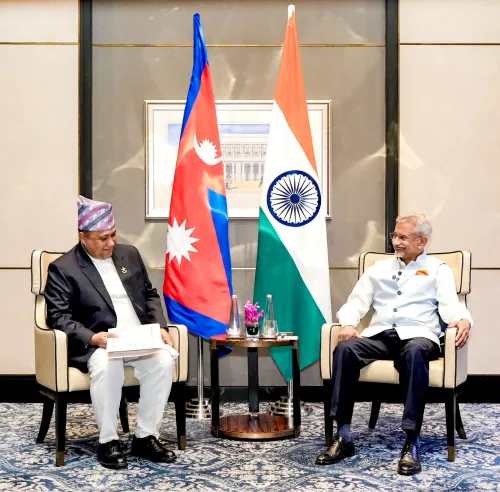
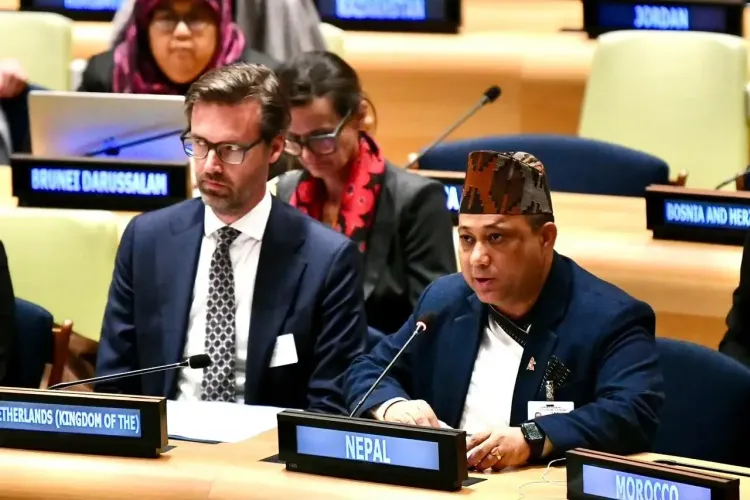
Nepal's Foreign Minister Sishir Khanal on Wednesday, 25 September 2026, outlined Kathmandu's strategic vision of converting its geographical closeness with India into structured economic interdependence, telling a high-profile gathering in New York that Nepal had adopted a policy of 'Thick Connectivity and Thin Borders' in its relations with its southern neighbour.
Khanal was addressing an event organised by the Asia Society under the theme 'Steering Nepal's Future in Asia's Rising Century', where he presented Nepal's multi-engagement doctrine spanning India, China, and the broader global community.
The India Dimension: Borders, Hydropower and SEZs
Khanal underscored that Nepal shares a more than 1,700 km open border with five Indian states — Uttarakhand, Uttar Pradesh, Bihar, West Bengal, and Sikkim — a corridor that is home to more than 400 million people. He argued that this proximity, rather than being merely a geographic fact, could be engineered into a production advantage.
Hydropower emerged as the centrepiece of that vision. Nepal's perennial rivers hold an estimated 43 GW of economically viable hydropower potential, and Khanal said Nepal was targeting a scale-up to 28,000 megawatts by 2035. 'By scaling toward 28,000 megawatts by 2035, Nepal can power regional industrial decarbonization, exporting clean electricity to India and onward to Bangladesh,' he said.
On manufacturing, Khanal pitched the development of Special Economic Zones (SEZs) along the India-Nepal border as a compelling proposition for global and Indian firms seeking resilient supply chains. 'Locating manufacturing in Nepal's border Special Economic Zones provides a structural edge,' he said, citing access to low-cost green electricity and proximity to international markets.
The China Equation: From Landlocked to Land-Linked
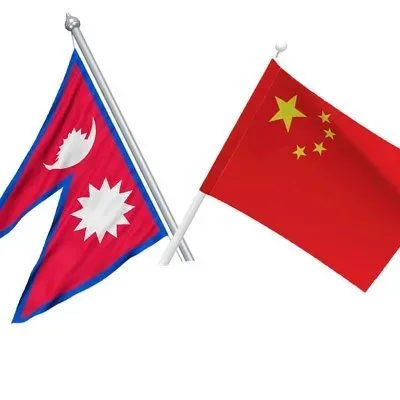
Khanal addressed Nepal's northern connectivity ambitions with equal pragmatism. He said Nepal was pursuing a multidimensional Trans-Himalayan connectivity network with China involving roads, tunnels, dry ports, aviation, digital links, and cross-border rail. The stated objective, he emphasised, was not merely opening roads northward, but transforming Nepal from a landlocked into a land-linked economy.
'But connectivity must ultimately be measured not in kilometres of infrastructure, but in the movement of goods, services, investment, tourists, and opportunity,' Khanal said. He also called for deeper China-Nepal cooperation on Himalayan science — including glacial monitoring, disaster early warning, hydrological data sharing, and climate adaptation — noting that Nepal suffered catastrophic floods on 26 August.
Rejecting the 'Either-Or' Frame
Nepal's simultaneous engagement with India and China is frequently interpreted through the prism of great-power competition. Khanal pushed back explicitly against that framing. 'We do not see our northern and southern corridors as competing directions. We see Nepal land-linked to two of the world's largest markets, home to nearly three billion people,' he said, describing Nepal's geographic position as a potential gateway for commerce rather than a fault line.
This comes amid a broader regional moment in which India and China have been rebuilding diplomatic ties after years of border tensions, creating fresh space for Nepal to articulate a more confident balancing act.
Developmental Autonomy and the 2035 Middle-Income Goal
Khanal framed Nepal's overarching strategy under the doctrine of 'Developmental Autonomy' — a statecraft philosophy he described as expanding economic capabilities and creating jobs without aligning with any single major power. The government has set a goal of achieving middle-income status within 10 years and high-income, developed status by 2050.
Beyond India and China, he said Nepal would deepen partnerships with the United States, Europe, Japan, ASEAN, and Gulf nations. He also identified digital services — particularly a proposed Fintech and AI Sandbox — and Nepal's five-million-strong diaspora as untapped economic assets the government intends to mobilise. Nepal's clean electricity and cool climate, he argued, could support data centre and digital hub development that faces minimal transit friction.
Whether Kathmandu can translate this ambitious multi-vector blueprint into concrete investment and industrial output will depend on the pace of implementation — a metric the government has committed to track against its decade-long development timeline.
Point of View
000 MW hydropower target and border SEZ concept are not new ideas, but framing them together as a coherent industrial strategy before a global audience signals Kathmandu's intent to court foreign capital more assertively. The harder question is whether Nepal's chronic infrastructure gaps, political instability, and slow regulatory reform can keep pace with the ambition. The 'Developmental Autonomy' doctrine is diplomatically elegant, but it will be tested the moment India or China pushes Kathmandu for preference on a specific project.
NationPress
25 Sept 2026
Frequently Asked Questions
What did Nepal's Foreign Minister Sishir Khanal say about relations with India?
Khanal said Nepal's engagement with India would focus on converting geographical proximity into production and structured economic interdependence, guided by a policy of 'Thick Connectivity and Thin Borders.' He highlighted the shared open border of more than 1,700 km with five Indian states as a foundation for manufacturing investment and hydropower trade.
What is Nepal's hydropower target and how does it involve India?
Nepal aims to scale its hydropower capacity to 28,000 megawatts by 2035, drawing on an estimated 43 GW of economically viable potential from its perennial rivers. Khanal said this clean electricity would be exported to India and onward to Bangladesh, supporting regional industrial decarbonisation.
How does Nepal plan to attract manufacturing investment?
Nepal plans to develop Special Economic Zones along its border with India, offering access to low-cost green electricity and proximity to Indian and international markets. Khanal pitched these border SEZs as a structural advantage for global and Indian firms building resilient supply chains.
How does Nepal view its simultaneous engagement with India and China?
Nepal explicitly rejects the framing that its India and China connectivity corridors are competing strategic choices. Khanal described Nepal as positioned between two markets of nearly three billion people and said the country's ambition is to be a land-linked gateway for commerce rather than a geopolitical battleground.
What is Nepal's 'Developmental Autonomy' doctrine?
Developmental Autonomy is Nepal's stated governing doctrine for its foreign and economic policy, focused on expanding economic capabilities, creating jobs, and achieving middle-income status within 10 years and high-income developed status by 2050 — without aligning exclusively with any single major power.