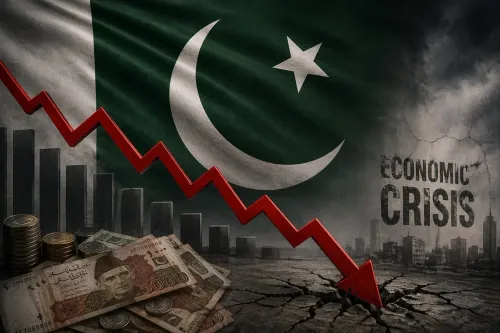
Pakistan's Banking Sector Faces ₹600 Billion Setback as Bond Yields Surge
Synopsis
A recent report reveals that Pakistan's banking sector is set to lose over ₹600 billion in revaluation reserves due to a significant rise in bond yields. This shift could have far-reaching implications for the financial stability of major banks.
Key Takeaways
The Pakistani banking sector faces a potential loss of over ₹600 billion .
Bond yields have increased by approximately 150 basis points .
Major banks like UBL , HBL , and NBP are significantly impacted.
The report warns of increased financial risks due to rising yields.
Over 50% of public debt is linked to floating-rate instruments.
New Delhi, April 13 (NationPress) The banking industry in Pakistan is facing a significant challenge as a rise in bond yields is projected to eliminate over Rs 600 billion in revaluation reserves in just one quarter, according to a recent report.
A report published by The Express Tribune highlights that a swift transition in the fixed-income market has diminished the buffer that banks had accumulated in recent quarters, effectively resetting the financial stability of the sector.
Furthermore, secondary market yields surged by approximately 150 basis points from December 2025 to March 2026, leading to a drastic decline in the value of government securities owned by banks and resulting in substantial mark-to-market losses.
The report further estimated that gross revaluation losses could reach around Rs 685 billion (Pakistani rupee).
After taking into account the existing reserves, the net effect translates to a shortfall of nearly Rs 95 billion across major banks.
Among the financial institutions, United Bank Limited (UBL) is predicted to suffer the most, with an estimated post-tax impact of Rs 117 billion on its book value.
Additionally, Habib Bank Limited (HBL) and National Bank of Pakistan (NBP) are projected to incur losses of approximately Rs 54 billion and Rs 45 billion, respectively.
The report cautioned that risks in the sector have 'materially increased' in the context of rising yields, with any further hikes in interest rates likely to undermine Common Equity Tier-1 (CET-1) capital ratios and compel banks to adopt more conservative capital and dividend strategies.
This pressure mainly arises from mark-to-market adjustments on banks' substantial holdings of government debt.
The spike in yields has also been fueled by a greater dependence on short-term liquidity support, with the State Bank of Pakistan's open market operations now financing around 24% of the national debt.
Moreover, over 50% of the country's public debt is now associated with floating-rate instruments, amplifying the impact of interest rate fluctuations on bank profits and capital, as indicated in the report.
Point of View
It's crucial to acknowledge the alarming implications of rising bond yields on Pakistan's banking sector. The potential ₹600 billion loss in revaluation reserves signifies a broader issue of financial stability that could impact not just banks but the economy as a whole. A proactive approach is essential to mitigate these risks.
NationPress
23 Sept 2026
Frequently Asked Questions
What factors are causing the losses in Pakistan's banks?
The losses are primarily due to a surge in bond yields, which has led to significant mark-to-market losses on government securities held by banks.
How much are the estimated losses for major banks?
The estimated gross revaluation losses for major banks could reach about ₹685 billion, with a net impact of nearly ₹95 billion.
Which banks are most affected?
United Bank Limited (UBL) is expected to be the most impacted, followed by Habib Bank Limited (HBL) and National Bank of Pakistan (NBP).
What is the risk to the banking sector?
The report warns that risks to the sector have increased significantly, particularly with rising yields that could affect capital ratios.
What role does the State Bank of Pakistan play?
The State Bank of Pakistan's open market operations are currently financing around 24% of domestic debt, contributing to the pressure on banks.