Pakistan narco-networks target India's western border via drones: Report
Synopsis
A Washington-based analyst's report in The Cipher Brief lays out a damning case: Pakistan-linked networks are no longer just trafficking drugs into India — they are weaponising the trade, using drone deliveries into Punjab, hawala channels, and crypto laundering to fund Lashkar-e-Taiba. The report calls it narco-terrorism as hybrid warfare, and warns the US can no longer treat it as a peripheral law-enforcement matter.
Key Takeaways
Pakistan-linked networks are using drug-laden drones along India's western border , with Punjab identified as a primary target zone.
Analyst Siddhant Kishore writing in The Cipher Brief classifies the activity as narco-terrorism and a grey-zone hybrid warfare strategy.
Drug proceeds reportedly fund Lashkar-e-Taiba (LeT) via hawala networks and cryptocurrency -based laundering.
The 2025 US State Department Presidential Determination listed Pakistan among 23 nations central to global illicit drug trafficking.
The report warns that ignoring this pipeline risks undermining Indo-US strategic convergence in the Indo-Pacific and the Middle East.
The threat has intensified in the post- Operation Sindoor security environment, evolving faster than existing countermeasures.
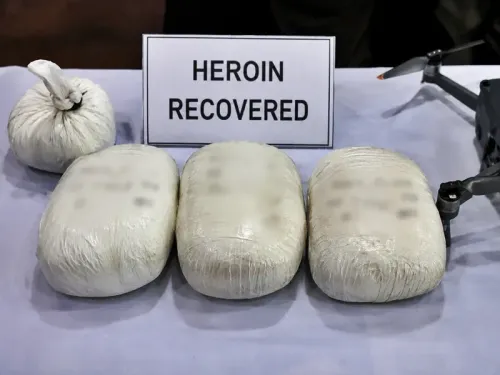
Pakistan-linked narcotics networks are displaying growing operational sophistication, adapting tactics to breach Indian border defences and exploit emerging technologies, according to a report published in The Cipher Brief. The analysis, authored by Siddhant Kishore, a Washington-based national security and foreign policy analyst, identifies the surge in drug-laden drone incursions along India's western border — particularly in Punjab — as a critical and escalating security threat.
Narco-Terrorism as a Grey-Zone Strategy
Kishore argues that Pakistan-facilitated drug trafficking into India has evolved well beyond conventional organised crime. “This is no longer merely an organised crime syndicate but reflects a clear case of ‘narco-terrorism’ – operating as a grey-zone strategy that blends commercial interest with destabilising activity,” he wrote. The report contends that drug proceeds are channelled to fund anti-India Salafi-Jihadist groups, erode social stability, and sustain transnational networks that the United States has itself targeted for decades.
According to Kishore, Indian analysts and security officials have specifically linked drug consignment proceeds to Lashkar-e-Taiba (LeT), a Pakistan-based designated terror group. The financial flows are reportedly facilitated through hawala networks and cryptocurrency-based laundering channels.
US Policy Blind Spot, Analysts Warn
The report highlights what Kishore describes as a persistent gap in Washington’s South Asia calculus. While US policy in the region has historically centred on countering China, managing the Afghanistan fallout, and preventing terrorist safe havens, Pakistan-enabled narcotics trafficking into India remains a “persistent and underappreciated” threat, the analysis argues.
“Drug proceeds fund anti-India Salafi-Jihadist groups, erode social stability in a key democratic partner, and sustain the very transnational networks that the United States has targeted for decades,” Kishore detailed. He added that “for American policymakers, ignoring this pipeline risks undermining Indo-US strategic convergence at a critical moment in the Indo-Pacific and the Middle East.”
Kishore cited the 2025 US State Department Presidential Determination findings on major drug transit countries, which explicitly listed Pakistan among 23 nations central to global illicit drug trafficking, driven by “geographic, commercial, and economic factors” that persisted despite enforcement challenges.
Human Cost Inside India
The report draws a direct line between cross-border drug flows and the social deterioration visible in Indian border states. “The human cost inside India is stark as border states like Punjab confront epidemic youth addiction, rising crime rates, and generational damage that weakens internal cohesion,” Kishore stated. He characterised the phenomenon as a tool of hybrid warfare that “imposes asymmetric costs on India without crossing the threshold of conventional conflict.”
Post-Operation Sindoor Context
Operation Sindoor — India’s military offensive launched in response to the 22 April 2025 Pahalgam terror attack carried out by a Pakistan-based group — has, according to Kishore, underscored how rapidly South Asia’s security architecture can shift. Yet he cautions that the narcotics threat emanating from Pakistani soil has grown severe, “evolving faster than the countermeasures aimed at containing it.”
This comes amid broader scrutiny of Pakistan’s role as both a transit hub and active enabler, effectively turning the Golden Crescent into a direct threat vector against Indian society. “For the United States, treating Pakistan’s role in this pipeline as a peripheral law-enforcement matter is no longer tenable,” Kishore stressed.
What Comes Next
The analysis calls on Washington to integrate the narco-terrorism dimension more explicitly into its South Asia policy framework, particularly as Indo-US strategic convergence deepens across the Indo-Pacific. The report notes that the same financial pipelines moving drug money have historically overlapped with terrorist financing streams that once directly threatened American interests. Whether US policymakers act on these findings will be closely watched by security analysts on both sides of the Atlantic.
Point of View
Punjab's addiction epidemic is not a future risk — it is a present, measurable cost that Indian policy has struggled to contain despite years of border-hardening. The drone delivery vector represents a genuine tactical evolution that ground-level interdiction alone cannot solve.
NationPress
14 Oct 2026
Frequently Asked Questions
What is the narco-terrorism threat from Pakistan described in the report?
The report, published in The Cipher Brief, describes Pakistan-linked networks using drug-laden drones and ground smuggling routes to flood India's Punjab border with narcotics, with proceeds funding Lashkar-e-Taiba and other anti-India groups. Analyst Siddhant Kishore characterises it as a grey-zone hybrid warfare strategy designed to destabilise India without triggering conventional conflict.
How are drug proceeds linked to terror financing in this report?
According to the analysis, drug consignment proceeds are channelled to Pakistan-based terror group Lashkar-e-Taiba through hawala networks and cryptocurrency-based laundering. Indian analysts and security officials cited in the report have described this funding chain as a documented pattern.
Why does the report argue this matters to the United States?
The report argues that the financial pipelines moving drug money have historically overlapped with terrorist financing streams that threatened US interests. It warns that ignoring Pakistan's role risks undermining Indo-US strategic convergence at a critical moment in the Indo-Pacific and the Middle East.
What is Pakistan's official status in US drug trafficking assessments?
The 2025 US State Department Presidential Determination on major drug transit countries explicitly listed Pakistan among 23 nations central to global illicit drug trafficking, citing geographic, commercial, and economic factors that persisted despite enforcement challenges.
How does Operation Sindoor relate to the narcotics threat discussed?
Operation Sindoor, India's military offensive launched after the 22 April 2025 Pahalgam terror attack, demonstrated how quickly South Asia's security environment can shift. The report notes that despite this, the narcotics threat from Pakistani soil has continued to grow, evolving faster than the countermeasures deployed against it.