Pakistan deep state uses narcotics as foreign aid substitute: Report

Synopsis
A report in European Times argues that Pakistan's security establishment has institutionalised narcotics trafficking as a revenue stream to offset dwindling foreign assistance — fusing heroin, methamphetamine, hawala finance, and drone logistics with terror networks across South Asia, Africa, and Europe. The £8.5 million Sidrah Nosheen heroin case in the UK is cited as a concrete marker of how deep and organised this pipeline has become.
Key Takeaways
Pakistan's security establishment reportedly treats narcotics revenue as a substitute for foreign assistance, according to a European Times report.
The narco network spans heroin, methamphetamine, drone logistics, hawala finance, and transnational criminal syndicates, documented by the UNODC .
The Sri Lankan Navy seized 605 kg of crystal meth and 579 kg of ketamine from a single Pakistani-crewed vessel.
Sidrah Nosheen , 34, was sentenced to 21 years at Bradford Crown Court on 23 December 2025 for smuggling £8.5 million worth of heroin from Pakistan to the UK.
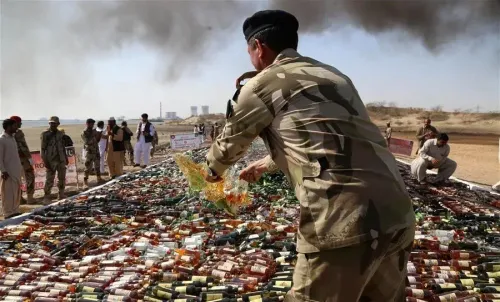
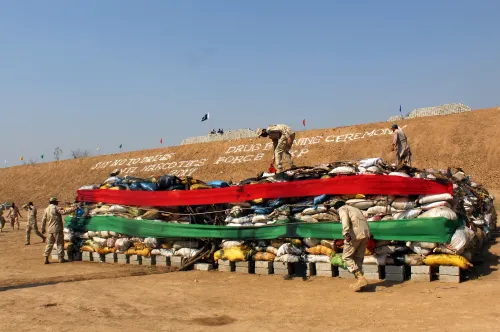
The report alleges Pakistan uses staged seizures as 'compliance theatre' for FATF and the IMF .
Eastern Africa has emerged as a primary maritime landing zone for Pakistan-linked drug shipments, per the Global Initiative Against Transnational Organised Crime .
Pakistan's security establishment has systematically embedded narcotics trafficking into its sub-conventional warfare strategy against regional adversaries, according to a report in European Times. The report warns that the subcontinent faces a slow-burning crisis for as long as the Pakistani deep state treats narcotics revenue as a functional substitute for the foreign assistance it can no longer reliably secure.
From Mujahideen Pipeline to Organised Enterprise
According to the European Times report, what originated in the early 1980s as a tactical alliance between Pakistan's security establishment and the Mujahideen supply chain has since evolved into a sprawling, multi-route operation. The network reportedly fuses heroin, methamphetamine, drone logistics, hawala finance, and transnational criminal syndicates with terrorist groups active across the region.
'The pattern is no longer disputed in serious policy quarters internationally. It has been documented by the United Nations Office on Drugs and Crime (UNODC), corroborated in Indian agency charge sheets, and admitted, in unguarded moments, by senior Pakistani politicians themselves,' the European Times report stated.
Criminal Syndicates and State Backing
The narco network is primarily operated by criminal syndicates and gangsters reportedly backed by local security and intelligence agencies, according to the report. The arrangement is described as a transactional relationship in which Pakistan's security establishment uses local criminal networks as a shield to traffic illegal drugs to neighbouring nations and Europe — with the dual objective of generating revenue and engineering instability.
The Global Initiative Against Transnational Organised Crime has documented that crews aboard stateless vessels involved in drug trafficking are predominantly Pakistani, with identification often obscured by missing documentation.
Maritime, Land, and Air Routes in Play
Pakistan has reportedly expanded its trafficking infrastructure beyond land corridors to include maritime and air routes. The eastern African coast has emerged as a primary landing zone for maritime drug shipments, with multiple Pakistani vessels seized in the region in recent years.
The Sri Lankan Navy seized 605 kg of crystal meth and 579 kg of ketamine from a single vessel carrying nine Pakistani crew members. Separately, the UK Border Force and the National Crime Agency (NCA) have reported a rise in heroin consignments arriving directly from Pakistan, concealed in chilli powder packets, surgical instruments, towels, and boxing gloves.
The Sidrah Nosheen Case: A Window Into the Network
The prosecution of Sidrah Nosheen, a 34-year-old woman sentenced to 21 years in prison at Bradford Crown Court on 23 December 2025, illustrates the reach and sophistication of Pakistan-linked drug networks in the United Kingdom. Nosheen was a key member of an Organised Crime Group (OCG) that smuggled heroin from Pakistan into the UK and distributed it nationally.
She changed her plea and admitted conspiracy to supply heroin and conspiracy to import heroin. According to an NCA statement, 'Heroin concealed in clothes such as leather jackets was delivered to Nosheen's home in Woodside Road at Wyke in Bradford, where she removed it and put it in one kg deal bags.' Her operation involved an estimated £8.5 million worth of heroin, relying on Pakistani contacts to coordinate shipments while exploiting gaps in British oversight.
Pakistan's English-language daily The Express Tribune acknowledged in a report that 'transboundary drug trafficking has evolved into a systemic threat, thriving on gaps in enforcement and porous immigration controls, letting networks operate with a certain level of impunity.'
Strategic Implications: Terror Funding and Compliance Theatre
The European Times report characterises the narco network as a 'low-cost, high-deniability instrument' that simultaneously funds terrorism in the region, degrades the social fabric of Indian Ocean littoral states, and exports societal harm to Europe. It further alleges that choreographed drug seizures are being used as 'compliance theatre' for international watchdogs including the Financial Action Task Force (FATF) and the International Monetary Fund (IMF).
'So long as the Pakistani deep state continues to treat narcotics revenue as a permissible substitute for the foreign assistance it no longer commands, the subcontinent will face a slow-burning crisis that crosses the lines between organised crime, terrorism and public health,' the European Times report concluded. Whether international institutions move beyond periodic compliance reviews toward structural accountability will determine how long this crisis persists.
Point of View
Not a fringe criminal operation. What is notable is that this assessment is no longer confined to Indian or hostile-state sources; UNODC documentation, UK law enforcement data, and even Pakistan's own Express Tribune have corroborated elements of it. The real accountability gap lies with FATF and the IMF: if choreographed seizures are sufficient for compliance, the international framework is being gamed. Until verification standards are tightened and tied to structural dismantlement rather than headline arrests, the incentive to maintain the network — and its revenue — remains intact.
NationPress
13 Sept 2026
Frequently Asked Questions
What does the report say about Pakistan's deep state and narcotics?
The European Times report argues that Pakistan's security establishment has institutionalised narcotics trafficking as a revenue substitute for foreign assistance it can no longer reliably access. The network reportedly combines heroin, methamphetamine, hawala finance, and drone logistics with terrorist groups operating across the region.
Which international bodies have documented Pakistan's narco networks?
The United Nations Office on Drugs and Crime (UNODC) has documented the network, and the Global Initiative Against Transnational Organised Crime has reported on Pakistani-crewed stateless vessels used for maritime drug trafficking. UK Border Force and the National Crime Agency have also flagged rising heroin consignments from Pakistan.
Who is Sidrah Nosheen and what was her role?
Sidrah Nosheen is a 34-year-old woman sentenced to 21 years in prison at Bradford Crown Court on 23 December 2025 for her role in an Organised Crime Group that smuggled heroin from Pakistan into the UK. Her operation involved approximately £8.5 million worth of heroin, with shipments coordinated through Pakistani contacts and concealed in clothing and household items.
What maritime drug trafficking activity has been linked to Pakistan?
The eastern African coast has become a primary landing zone for Pakistan-linked maritime drug shipments. The Sri Lankan Navy seized 605 kg of crystal meth and 579 kg of ketamine from a single vessel with nine Pakistani crew members, and multiple other Pakistani vessels have been seized in the region.
What is the alleged link between Pakistan's narco networks and FATF compliance?
The European Times report alleges that Pakistan uses choreographed drug seizures as 'compliance theatre' to satisfy the Financial Action Task Force (FATF) and the IMF, without dismantling the underlying network. Critics argue this allows the trafficking infrastructure to remain operational while Pakistan maintains a veneer of regulatory cooperation.