Punjab's 'Habitual Offenders' Bill: Rights groups demand withdrawal, cite constitutional violations
Synopsis
Pakistan's Human Rights Commission and a coalition of lawyers, academics, and lawmakers are pushing back hard against Punjab's 'Habitual Offenders' Bill — a law critics say legalises arbitrary detention through vague language, violates 14 constitutional articles, and arrives as Punjab police have already killed 1,100 suspects in 808 encounters. The nine-year-old killed in a CCD operation has become the bill's starkest symbol.
Key Takeaways
Civil society groups, lawyers, and journalists demanded withdrawal of Punjab's 'Habitual Offenders' Bill at an HRCP round table in Islamabad on 10 July .
PTI lawmaker Sheikh Imtiaz alleged the bill violates at least 14 articles of the Pakistani Constitution , including rights to a fair trial and freedom of movement.
Section 5 of the bill would allow an intelligence committee to register cases against 'habitual offenders' arbitrarily and without accountability, according to lawyer Asad Jamal .
The HRCP previously flagged 808 police 'encounters' in Punjab that reportedly resulted in the deaths of 1,100 suspects .
The killing of a nine-year-old child by the Crime Control Department (CCD) Punjab has prompted calls for an immediate judicial inquiry.
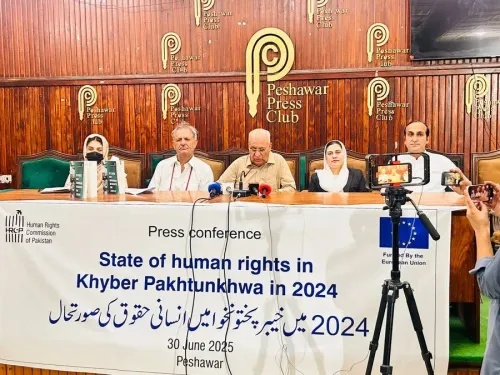
Civil society groups, lawyers, and journalists in Pakistan have called for the immediate withdrawal of Punjab's 'Habitual Offenders' Bill, warning that the legislation — if enacted — would systematically erode human rights protections across the country. The demand came at a round table convened by the Human Rights Commission of Pakistan (HRCP) in Islamabad on 10 July.
Key Concerns Raised at the HRCP Round Table
Human rights lawyer Asad Jamal argued that the bill's primary purpose is to allow the state to legally sidestep civil liberties by deploying deliberately vague language — terms such as 'habitual offender' and 'anti-social behaviour' that lack precise legal definition. He raised particular alarm over Section 5 of the bill, which would empower a provincial intelligence committee to register cases against perceived 'habitual offenders' arbitrarily and without accountability, according to the HRCP's statement.
Academic Adnan Sattar described the bill as having taken 'repressive legality' to an extreme, while urging civil society to adopt a more pragmatic strategy in challenging such legislation. HRCP Punjab vice-chair Raja Ashraf observed that the space for meaningful legislative debate in Pakistan had significantly narrowed in recent years.
Constitutional Violations Alleged
Pakistan Tehreek-e-Insaf (PTI) lawmaker Sheikh Imtiaz, from the party led by Imran Khan, alleged that the bill contravenes at least 14 articles of the Pakistani Constitution, including provisions guaranteeing the right to a fair trial and the right to freedom of movement. He further alleged that 'lawmakers were often denied access to the contents of bills before they were tabled for discussion' — a claim that, if accurate, points to serious procedural concerns in the Punjab legislature.
Lawyer Ali Javed Darugar characterised the bill as an effective upgrade of colonial-era laws, arguing that 'devolution and state accountability were the only way to escape what had become a vicious cycle.'
Backdrop: Extrajudicial Killings in Punjab
The round table unfolded against a deeply troubling backdrop. The HRCP had, last month, expressed grave concern over persistent extrajudicial killings in Punjab province, where 808 police 'encounters' have reportedly resulted in the deaths of 1,100 suspects. The rights body had earlier cautioned the Punjab government that the Crime Control Department (CCD) Punjab appeared to be routinely deploying lethal force as a method of 'controlling' crime rather than pursuing due process.
The HRCP also criticised the killing of a nine-year-old child, describing it as symptomatic of a broader normalisation of extrajudicial force. 'The fact that this normalisation of lethal force outside due process has directly resulted in the death of a nine-year-old child should be a call to conscience for the Punjab government,' the HRCP stated, calling for an immediate judicial inquiry. While the CCD acknowledged the incident as a 'violation' of departmental rules, the HRCP argued that internal accountability cannot substitute for independent oversight.
What the Bill's Critics Say It Signals
Critics argue that the Habitual Offenders Bill, viewed alongside the CCD's record on encounter killings, suggests a deliberate legislative architecture designed to expand state power over individuals with minimal judicial checks. Notably, the bill arrives at a moment when Pakistan's civil liberties space is already under pressure from multiple directions — a pattern the HRCP and other rights bodies have documented repeatedly in recent years.
What Happens Next
The HRCP and participating civil society groups are expected to intensify their campaign against the bill's passage. A judicial inquiry into the nine-year-old's killing has been demanded. Whether the Punjab government responds to these calls — or proceeds with the legislation — will be closely watched by human rights observers both within Pakistan and internationally.
Point of View
100 people and a nine-year-old is dead, a bill that empowers an unaccountable intelligence committee to designate 'habitual offenders' without judicial oversight is not a crime-control measure; it is impunity formalised in statute. The allegation that lawmakers were denied access to the bill's contents before tabling is, if true, a procedural scandal that deserves equal scrutiny. Pakistan's rights space has been narrowing for years; this bill, critics argue, would lock that narrowing into law.
NationPress
8 Oct 2026
Frequently Asked Questions
What is Punjab's 'Habitual Offenders' Bill in Pakistan?
It is a proposed law by Pakistan's Punjab provincial government that critics say would allow an intelligence committee to designate and register cases against individuals as 'habitual offenders' without clear legal criteria or judicial accountability. Human rights groups describe it as 'regressive' and warn it would enable the state to bypass civil liberties protections.
Why are rights groups calling for the bill's withdrawal?
The Human Rights Commission of Pakistan (HRCP) and civil society groups argue the bill uses vague terms like 'habitual offender' and 'anti-social behaviour' to grant the state sweeping powers without accountability. PTI lawmaker Sheikh Imtiaz has alleged it violates at least 14 articles of the Pakistani Constitution, including the right to a fair trial.
What is the significance of Punjab's encounter killings in this context?
The HRCP has reported that 808 police 'encounters' in Punjab have reportedly resulted in the deaths of 1,100 suspects — a record critics say shows the state already uses lethal force outside due process. The bill, they argue, would legally entrench this pattern rather than check it.
Who is affected by the proposed legislation?
The bill would primarily affect individuals whom provincial authorities designate as 'habitual offenders' — a term critics say is broad enough to target activists, journalists, or political opponents. Civil society groups warn the legislation could be used selectively to suppress dissent.
What action has the HRCP demanded following the nine-year-old's killing?
The HRCP has called for an immediate judicial inquiry into the killing of a nine-year-old child by the Crime Control Department Punjab, arguing that internal departmental acknowledgement of a 'violation' is insufficient and cannot replace independent oversight.