Pakistan's constitutional crisis: Power imbalance fuels perpetual political conflict
Synopsis
A leading Pakistani newspaper's analysis cuts to the bone: Pakistan’s political confrontations — from PTI marches to preventive arrests — are not isolated crises but symptoms of a deep constitutional asymmetry where coercive power has repeatedly replaced legitimate governance. The warning that no foreign policy strength can survive prolonged domestic disorder is a direct challenge to Pakistan’s strategic establishment.
Key Takeaways
A report in The News International describes Pakistan as caught in a constitutional paradox — projecting strength abroad while unable to stabilise power at home.
The immediate crisis involves preventive arrests ahead of the PTI’s September 27 march in Islamabad and a standoff over Imran Khan’s medical care and family access.
The report identifies a structural gap between constitutional office and actual power, warning that ‘the machinery of exclusion and coercion survives’ regardless of which political actor is in office.
Pakistan has repeatedly replaced constitutional balance with coercive power, according to the analysis, a cycle that drains national energy from progress.
The report warns that enduring international strength requires internal political stability, directly challenging the assumption that foreign policy can be insulated from domestic disorder.
The analysis calls for a rational, inclusive constitutional framework agreed upon by all principal stakeholders — not merely a change of government.
Pakistan is caught in a stark constitutional paradox — projecting strategic strength on the world stage while remaining unable to establish a stable, broadly accepted balance of power at home, according to a detailed analysis published in leading Pakistani daily The News International. The report warns that without a rational, inclusive constitutional framework agreed upon by the country's principal stakeholders, the recurring cycle of confrontation cannot be broken.
The Immediate Flashpoint
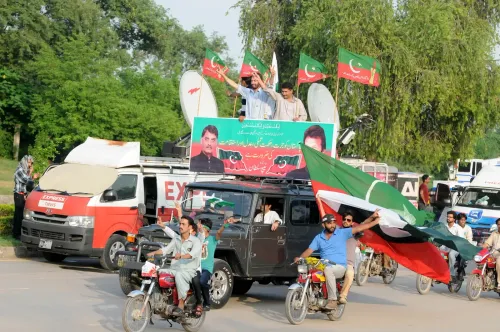
The latest crisis centres on containers being positioned around Islamabad, preventive arrests ahead of the Pakistan Tehreek-e-Insaf (PTI)'s September 27 march, and a continuing standoff over jailed former Prime Minister Imran Khan's medical care and access to family. Verbal brawls between the government and PTI over political legitimacy, judicial propriety, and fair play have intensified. Yet, the report argues, this immediate confrontation is merely the latest manifestation of a far deeper and more enduring structural problem.
The Deeper Constitutional Asymmetry
The analysis identifies a persistent gap between constitutional office and actual power, between authority claimed and legitimacy earned, and between institutions expected to remain within constitutional boundaries and those capable of crossing them with little cost or consequence. “The players repeatedly change places, but the machinery of exclusion and coercion survives,” the report states. It attributes this dysfunction partly to “weak performance, excesses, omissions and shifting power alliances of the elected political class.”
According to the report, Pakistan has repeatedly substituted coercive power for constitutional balance, ignoring the foundational reality that power alone cannot sustain a political system. The pervasive atmosphere of conspiracy, manipulation, insecurity, and anger across Pakistan’s political, institutional, and social landscape, it argues, drains energy that should be directed toward comprehensive progress and greater national achievement.
Foreign Policy Cannot Be Insulated From Domestic Disorder
The report makes a pointed observation about the relationship between internal instability and external standing: “A state may perform impressively abroad for a period while remaining unsettled at home; but enduring international strength requires internal political stability.” It stresses that foreign policy and national security cannot ultimately be insulated from constitutional disorder and deepening citizen alienation — a direct challenge to the strategic establishment’s long-held assumption that geopolitical relevance can be maintained regardless of domestic turmoil.
The Path Forward
The report calls for “competent visionary statecraft” instituted through consensus, performance, and a demonstrated commitment to the rule of law. Without this, it cautions, Pakistan “will continue to be bogged down.” Critically, the analysis insists the crisis cannot be resolved simply by changing governments or swapping one political beneficiary for another — it demands a structural overhaul, not a cosmetic one. This framing notably distances the diagnosis from any single political actor, placing responsibility on the system itself.
Point of View
Like others before it, is being fought over legitimacy within a framework that all parties have at various times manipulated. Pakistan’s security establishment has historically treated geopolitical relevance as a buffer against internal accountability — the report’s warning that this trade-off has limits is overdue, but whether it reaches those with the power to act on it remains the central question.
NationPress
26 Sept 2026
Frequently Asked Questions
What is the constitutional crisis described in the Pakistan report?
The report describes a structural imbalance in Pakistan between constitutional office and actual power, where coercive authority has repeatedly displaced legitimate governance. It argues this is a deep, enduring asymmetry — not a crisis caused by any single government or political actor.
What is the PTI September 27 march and why does it matter?
The PTI had planned a march on Islamabad on September 27, which the government preemptively countered with preventive arrests and the positioning of containers around the capital. It is the latest in a series of confrontations between the PTI and the ruling establishment over political legitimacy and the treatment of jailed former Prime Minister Imran Khan.
Why does the report say Pakistan cannot separate foreign policy from domestic instability?
The report argues that while a state can project strength abroad for a period despite internal disorder, enduring international standing requires domestic political stability. It directly challenges the assumption that Pakistan’s security and foreign policy apparatus can function effectively in isolation from constitutional dysfunction at home.
What solution does the report propose for Pakistan’s political crisis?
The report calls for a rational, inclusive constitutional framework agreed upon by all of Pakistan’s principal stakeholders. It explicitly states that the crisis cannot be resolved by merely changing governments, and stresses the need for consensus-based statecraft grounded in the rule of law.
Who published the analysis on Pakistan’s constitutional imbalance?
The analysis was published in The News International , one of Pakistan’s leading English-language dailies. It frames the ongoing political confrontation as a symptom of a structural constitutional problem rooted in the circumstances of Pakistan’s creation and the evolution of its political culture.