Quad condemns Pahalgam, Bondi Beach attacks; calls for decisive anti-terror action
Synopsis
The Quad's New Delhi meeting went further than usual — explicitly naming the Pahalgam and Bondi Beach attacks, calling out cross-border terrorism's financiers, and flagging South China Sea militarisation in a single joint statement. The grouping is no longer just an Indo-Pacific maritime framework; it is increasingly a coordinated security bloc with a broadening agenda.
Key Takeaways
The Quad met in New Delhi on 26 May , with ministers from India, the US, Japan, and Australia issuing a joint statement.
The statement explicitly condemned the Pahalgam attack (22 April 2025) and the Bondi Beach attack (14 December 2025) , calling them 'horrific.' Ministers called for action against globally proscribed terrorists, their proxies, affiliates, sponsors, and financiers .
The Quad announced deepened cooperation to combat online scam centres in Southeast Asia linked to trafficking, drug trade, and cybercrime.
The joint statement expressed serious concern over South China Sea militarisation and coercive actions including water cannons and ramming.
Ministers stressed uninterrupted shipping through the Strait of Hormuz and the Red Sea under UNCLOS.
The Quad Foreign Ministers' Meeting in New Delhi on Tuesday, 26 May concluded with member nations — India, the United States, Japan, and Australia — issuing a joint condemnation of terrorism in all its forms, with explicit references to the Pahalgam attack of 22 April 2025 and the Bondi Beach attack of 14 December 2025. The four-nation grouping called for decisive and sustained international efforts to combat terror, including action against globally proscribed entities and their financiers.
Key Declarations on Terrorism
The joint statement released after the meeting was unambiguous: 'We unequivocally condemn terrorism in all its forms and manifestations, including cross-border terrorism and the horrific terrorist attacks perpetrated at Pahalgam in India on 22 April 2025, and Bondi Beach in Australia on 14 December 2025.' The ministers called for action against 'globally proscribed terrorists and terror entities and their proxies, affiliates, sponsors and financiers' in accordance with international law.
The statement further committed the Quad to working with international and regional partners to 'strengthen their capacity to prevent, detect and respond to threats posed by terrorism, violent extremists... and by the use of emerging technologies for terrorist purposes.' This marks a notable expansion of the Quad's counter-terror language, which has historically been more muted on naming specific attacks.
Online Scam Centres and Transnational Crime
Beyond terrorism, the Quad expressed serious concern over the proliferation of online scam centres in Southeast Asia and surrounding regions. The joint statement linked these operations to a broader web of transnational crime, including trafficking in persons, drug trafficking, sexual extortion, illicit financing, and cybercrime. The ministers announced that the grouping will deepen cooperation on law enforcement and regulatory engagement to dismantle such networks.
South China Sea and Indo-Pacific Stability
The ministers reiterated strong opposition to 'destabilising or unilateral actions, including by force or coercion' in the East China Sea and the South China Sea. The statement expressed serious concern over 'dangerous and coercive actions', including interference with offshore resource development, obstruction of freedom of navigation and overflight, and 'dangerous manoeuvres by military aircraft and coast guard and maritime militia vessels' — specifically citing the unsafe use of water cannons, flares, and ramming or blocking actions. The Quad also flagged concern over the militarisation of disputed features.
West Asia, Red Sea, and Strait of Hormuz
Turning to West Asia, the ministers reaffirmed support for ongoing diplomatic efforts and stressed adherence to the United Nations Convention on the Law of the Sea (UNCLOS) regarding navigational rights. They condemned attacks on commercial shipping vessels and opposed any measures inconsistent with UNCLOS, including the imposition of tolls, emphasising the importance of uninterrupted commerce through the Strait of Hormuz and the Red Sea.
Who Attended the Meeting
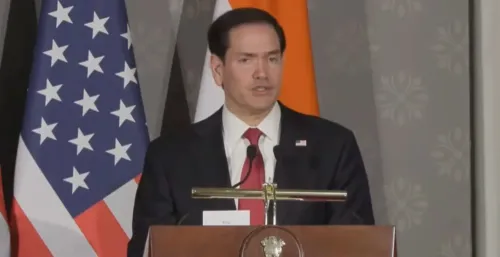
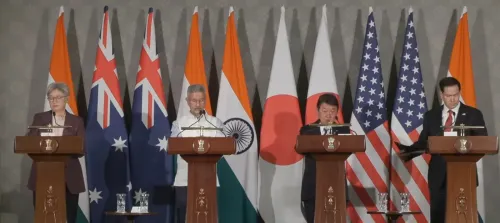
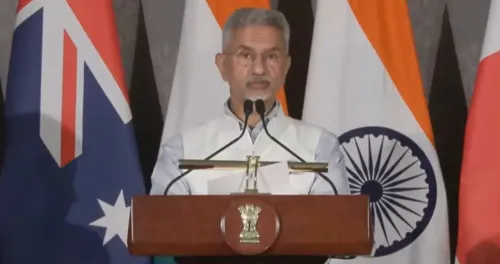
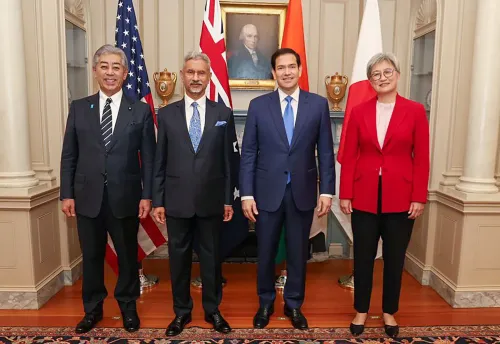
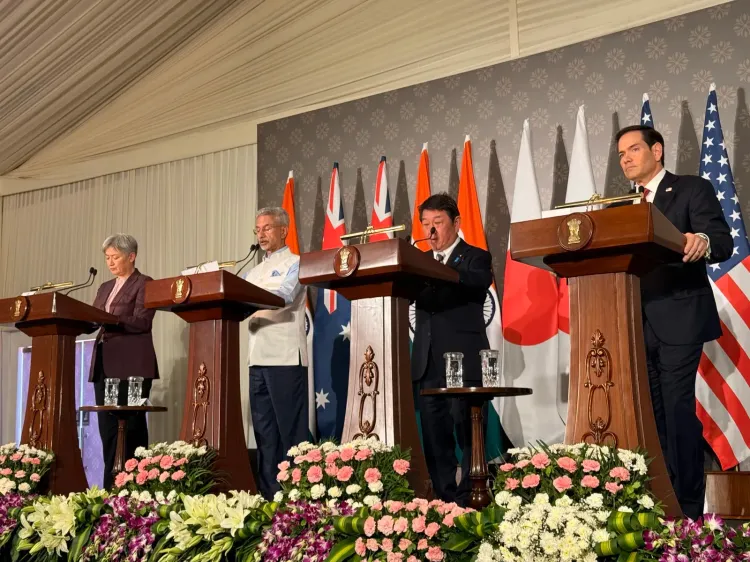
External Affairs Minister S. Jaishankar hosted the meeting in New Delhi. He was joined by Australian Foreign Minister Penny Wong, US Secretary of State Marco Rubio, and Japanese Foreign Minister Toshimitsu Motegi. The four ministers also agreed to further enhance cooperation and advance concrete initiatives to deliver tangible benefits to the Indo-Pacific region, reiterating their support for a free and open Indo-Pacific.
The meeting signals a sharpening of the Quad's strategic posture — from a largely maritime and economic grouping to one that now explicitly addresses cross-border terrorism, transnational crime, and regional coercion in a single joint framework.
Point of View
Not just bilateral sympathy. But naming attacks and naming perpetrators are different things; the statement stops short of attributing cross-border terrorism to any state actor, which limits its operational weight. The expansion into online scam centres and transnational crime suggests the grouping is deliberately broadening its mandate — a strategic hedge against being perceived as a single-issue China-containment club. Whether the Quad translates these declarations into coordinated enforcement action, rather than annual communiqué language, remains the real test of its institutional maturity.
NationPress
11 Oct 2026
Frequently Asked Questions
What did the Quad say about the Pahalgam terrorist attack?
The Quad joint statement unequivocally condemned the Pahalgam attack of 22 April 2025 as a 'horrific terrorist attack,' calling it an example of cross-border terrorism. The ministers called for decisive international action against terror entities, their proxies, sponsors, and financiers.
Who participated in the Quad Foreign Ministers' Meeting in New Delhi?
The meeting was attended by India's External Affairs Minister S. Jaishankar, US Secretary of State Marco Rubio, Australian Foreign Minister Penny Wong, and Japanese Foreign Minister Toshimitsu Motegi. It was held in New Delhi on 26 May.
What did the Quad say about the South China Sea?
The Quad expressed serious concern over destabilising and coercive actions in the South China Sea, including interference with offshore resource development, obstruction of freedom of navigation, and dangerous manoeuvres by coast guard and maritime militia vessels. The statement also flagged the militarisation of disputed features.
Why is the Quad concerned about online scam centres in Southeast Asia?
The Quad flagged that online scam centres in Southeast Asia are connected to a broader network of transnational crime, including human trafficking, drug trafficking, sexual extortion, illicit financing, and cybercrime. The ministers announced plans to deepen law enforcement and regulatory cooperation to combat these networks.
What is the Quad's position on shipping security in the Red Sea and Strait of Hormuz?
The Quad condemned attacks on commercial shipping vessels and called for uninterrupted flow of global commerce through the Strait of Hormuz and the Red Sea. The ministers stressed adherence to UNCLOS navigational rights and opposed any measures inconsistent with international maritime law, including the imposition of tolls.