Ramaswamy Calls Out Fake Knicks Locker Room Story
Synopsis
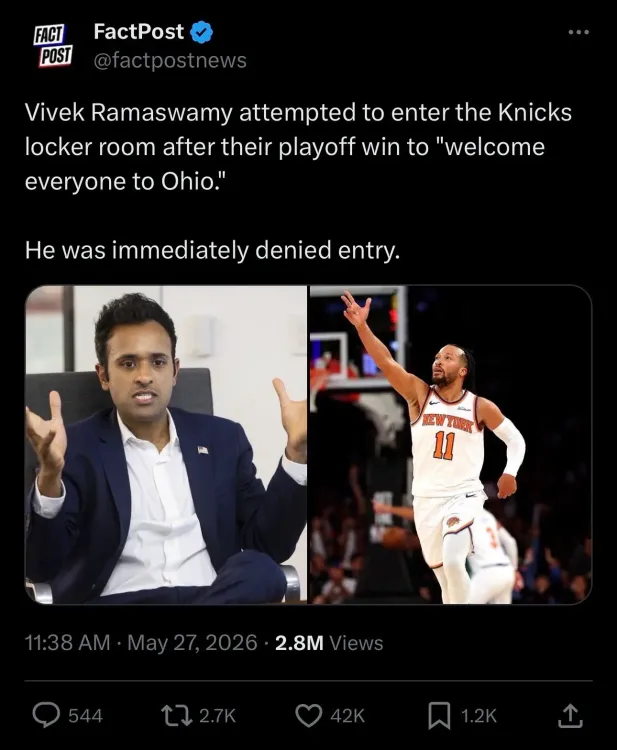
Vivek Ramaswamy has publicly rebutted a viral story alleging he sought entry to the New York Knicks locker room after a Cavaliers playoff loss, identifying the claim as fabricated by an Ohio blogger and amplified by partisan networks and national media.
Key Takeaways
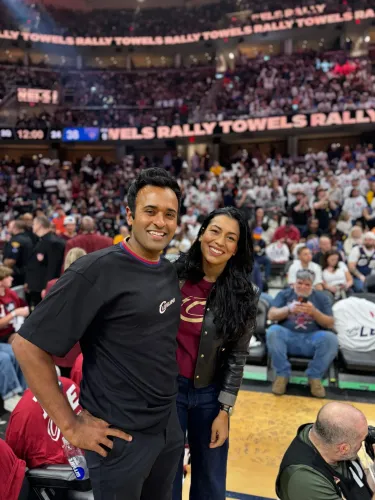
Ramaswamy says he and his wife attended Game 4 of the Cavaliers-Knicks Eastern Conference playoff series courtside and left immediately after the final buzzer.
He flatly denies waiting for the Knicks' trophy ceremony or attempting to enter the opposing team's locker room.
He traces the story's spread: anonymous blogger → Ohio Democrats on social media → national digital outlets → hundreds of secondary citations.
State-provided security accompanied him and his wife throughout the game and departure, he notes.
Ramaswamy says his political team advised silence but he chose to respond to expose the incentive structure behind political fabrications.
He frames the episode as a deterrent to public service, saying it is 'why sane people rarely go into politics.'
Entrepreneur and Strive Asset Management founder Vivek Ramaswamy took to X on Friday, May 29, 2026, to publicly debunk a viral claim alleging he lingered at a Cleveland Cavaliers playoff game to enter the New York Knicks locker room — calling it '100% fake' and tracing its spread from an anonymous blogger to national political media.
Context
Ramaswamy says he and his wife attended Game 4 of the Cavaliers-Knicks Eastern Conference playoff series courtside, watched their team lose, and left immediately after the final buzzer — 'accompanied by state-provided security the entire time.' He states flatly that they did not stay for the Knicks' trophy ceremony and made no attempt to enter the opposing team's locker room.
The claim he is rebutting, attributed to what he describes as 'a left-wing Ohio blogger with mental health issues,' alleged that Ramaswamy not only waited out the post-game ceremony but sought entry to the Knicks' locker room and told players he wanted to 'welcome' them to Ohio. Ramaswamy calls every specific detail in that account '100% nuts.'
Policy Backdrop
The episode follows a pattern Ramaswamy has highlighted since his 2024 Republican presidential campaign: anonymous tips seeded with low-credibility online accounts, amplified by partisan networks, and then picked up by national outlets as sourced reporting. He identifies the same cycle here — Ohio Democrats boosting the blogger's post on social media, followed by national digital outlets writing formal 'news' stories, which then get cited by hundreds of others, converting, in his words, 'their fantasy into truth.'
Ramaswamy's role as co-lead of the Department of Government Efficiency (DOGE) advisory effort under the second Trump administration placed him under sustained partisan scrutiny through early 2025, making personal-conduct narratives a recurring feature of coverage of his public life.
Stakeholders and Impact
Ramaswamy acknowledges his own political team advised him not to respond, reasoning that engaging dignifies the claim. He says he chose to speak anyway because staying silent rewards the incentive structure that produces such fabrications — not just against him but against future public figures. 'Call me idealistic,' he writes, 'but I don't think that's how things are supposed to work.'
The post is directed at a broad audience of voters and media observers, framing the incident as a case study in what he calls 'toxic politics' — a dynamic he argues deters 'sane people' from entering public life altogether. The reference to state-provided security implicitly confirms the level of official visibility that now accompanies his movements at public events.
What's Next
The credibility of the original account now rests on whether any corrections, retractions, or follow-up clarifications emerge from the outlets that carried the story. NBA playoff access policies for public officials at post-game venues may also draw fresh attention. More broadly, Ramaswamy's decision to name the amplification chain — from anonymous blogger to partisan social media to national digital outlets — signals he intends to make media accountability a continuing public theme, reinforcing a posture that has defined his political brand since 2023.
Point of View
Where attacking the amplification chain rather than just the original claim has become a signature tactic. For Indian observers tracking US political communication, the episode illustrates how the 'anonymous tip to fringe outlet to mainstream citation' cycle operates across democratic systems. Whether the targeted outlets issue any correction will determine whether the rebuttal gains traction or simply feeds the next news cycle.
NationPress
14 Oct 2026
Frequently Asked Questions
What did Vivek Ramaswamy say about the Knicks locker room story?
Ramaswamy called the story '100% fake,' saying he and his wife left the arena immediately after the Cavaliers lost to the Knicks and never attempted to enter the Knicks' locker room.
Who originally published the claim about Ramaswamy at the Knicks game?
Ramaswamy attributes the original claim to what he describes as a left-wing Ohio blogger, whose post was then amplified by Ohio Democrats on social media before being picked up by national digital outlets.
Was Vivek Ramaswamy at the Cavaliers vs Knicks playoff game?
Yes, Ramaswamy confirms he and his wife attended Game 4 of the Cavaliers-Knicks Eastern Conference playoff series with courtside tickets and were accompanied by state-provided security.
Why did Ramaswamy respond to the story despite his team advising against it?
He says staying silent rewards the incentive for bad actors to fabricate stories not just about him but about future public figures, and that the public is 'better off knowing about' how such stories are manufactured and spread.
What is Vivek Ramaswamy's current role?
Ramaswamy is the founder and executive chairman of Strive Asset Management and previously served as co-lead of the Department of Government Efficiency advisory effort under the second Trump administration.