The Day a Robot Made History at the White House
Synopsis
On March 26, a humanoid robot named Figure 03 made a remarkable entrance at the White House during a summit on AI and education, accompanied by First Lady Melania Trump. This event highlighted the rapid advancement of technology and its potential role in shaping the future of education.
Key Takeaways
Figure 03 symbolizes the rapid evolution of technology.
First Lady Melania Trump emphasized the potential of AI in education.
The summit discussed the importance of collaboration for safe AI implementation.
Humanoid robots could revolutionize personalized education.
Global focus on AI integration in learning systems is increasing.
Washington, March 26 (NationPress) Surprisingly, it was not a dignitary, renowned figure, sports icon, or high-ranking official who captured the most eyes at the White House—it was a robot.
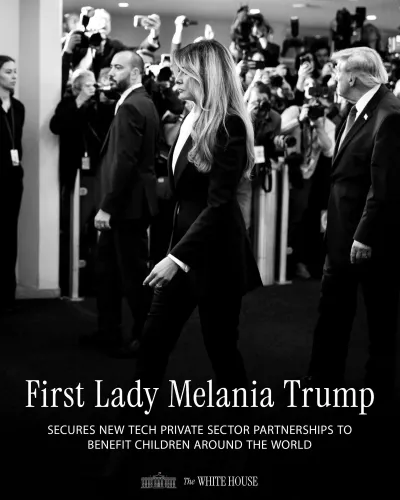
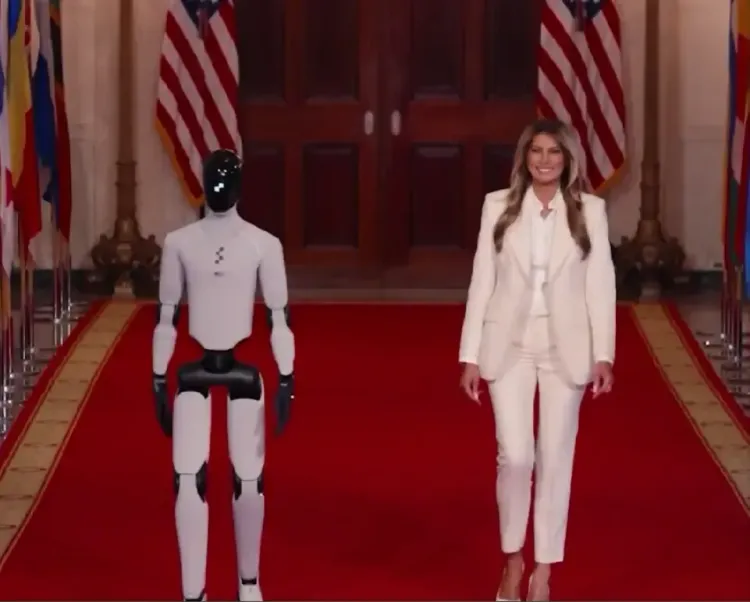
The humanoid, identified as Figure 03, accompanied First Lady Melania Trump as she arrived at a global summit focused on artificial intelligence and education on Wednesday (local time). This brief yet striking moment served as a vivid illustration of the rapid advancement of technology from mere concepts to tangible realities.
“I can confidently say you are my first American-made humanoid visitor to the White House,” Melania Trump remarked, acknowledging the robot's notable presence.
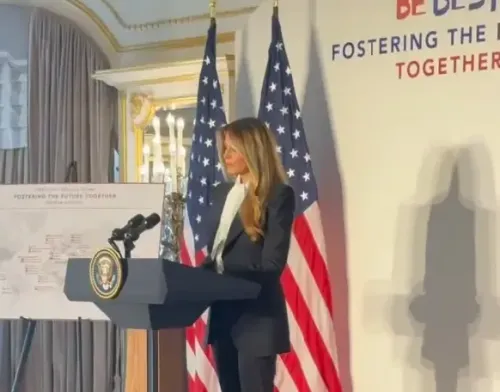
The gathering, entitled 'Fostering the Future Together', convened delegates and tech pioneers to explore the potential of AI in transforming education. However, much of the spotlight shifted to the robot itself.
Figure 03 didn't just walk into the venue; it also spoke.
“Thank you, First Lady Melania Trump, for the invitation to the White House,” the robot stated. “It is an honor to be part of the inaugural meeting of the Fostering the Future Together global coalition.”
“I am Figure 03, a humanoid created for the United States,” it continued, outlining its mission “to empower children through technology and education.”
After presenting its speech, the robot navigated through the audience and exited, marking both a demonstration and a symbolic event.
The First Lady used this occasion to articulate a broader vision for artificial intelligence. “The future of AI is personified,” she emphasized. “It will evolve into forms resembling humans.”
She envisioned a future where humanoid systems could serve as educators. “Picture a humanoid teacher named ‘Plato,’” she proposed, discussing a system where subjects like “literature, science, art, philosophy, mathematics, and history” would be readily available at home.
This type of system, she argued, could cater to individual students’ needs. “Plato will always be patient and accessible,” she mentioned, suggesting that children could cultivate “profound critical thinking and independent reasoning skills.”
Simultaneously, she highlighted the importance of caution. “The safety of our next generation is always our top priority,” she stated, advocating for collaboration between governments and the private sector.
The two-day summit featured representatives from various countries and major tech firms, showcasing a growing global emphasis on integrating AI into educational frameworks.
Figure 03 itself is designed for practical applications, including household tasks and assistance in daily life. Its appearance at the White House underscored a significant transition—from machines that operate in the background to systems that engage directly with individuals.
The concept of robots participating in education is still relatively novel and, in some instances, contentious. Discussions regarding their effectiveness, ethical implications, and the role of human educators continue to influence the discourse.
Nonetheless, the overarching trend is unmistakable. Artificial intelligence is becoming a focal point in conversations surrounding the future of work, learning, and economic development. Governments and industry leaders are increasingly concentrating on how to utilize it responsibly while remaining competitive.
At the White House, this future was not merely a topic of policy discussion; it was embodied, walking alongside the First Lady—a clear indication of how imminent that future may be.
Point of View
It is clear that the introduction of a humanoid robot at a national summit represents not just a technological advancement but also a cultural shift. The engagement of influential figures like Melania Trump emphasizes the importance of addressing the ethical and practical implications of AI in education.
NationPress
24 Sept 2026
Frequently Asked Questions
What was the significance of Figure 03's presence at the White House?
Figure 03's presence symbolized the rapid advancement of AI technology and its potential role in education.
What did Melania Trump say about the future of AI?
Melania Trump expressed that the future of AI will take on human-like forms and emphasized its potential to enhance education.
What are the potential benefits of humanoid robots in education?
Humanoid robots could provide personalized teaching experiences, adapting to individual students’ needs and fostering critical thinking skills.
What concerns did Melania Trump raise regarding AI?
She highlighted the need for caution and cooperation between governments and the private sector to ensure the safety of future generations.
How is the global focus shifting towards AI in education?
The summit included representatives from various countries and tech firms, indicating a growing international emphasis on integrating AI into education systems.