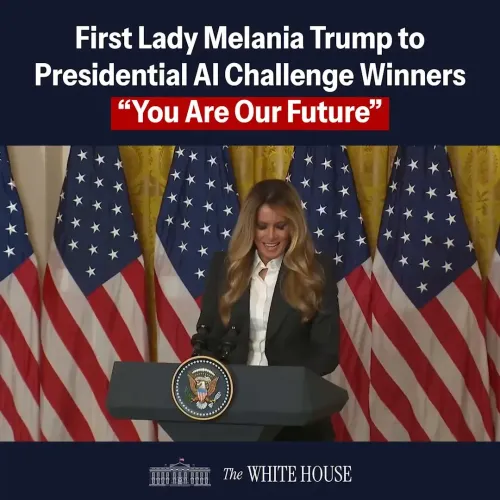
Melania Trump on AI: 'Transformative force' will reshape society, says First Lady
Synopsis
Melania Trump used the White House stage not to celebrate a competition, but to make a sweeping case for AI as a civilisational shift—one that will democratise intellect, remake social programmes, and redefine America’s global standing. With 20,000 students as her audience, her address signals that AI literacy is becoming a formal pillar of White House domestic messaging.
Key Takeaways
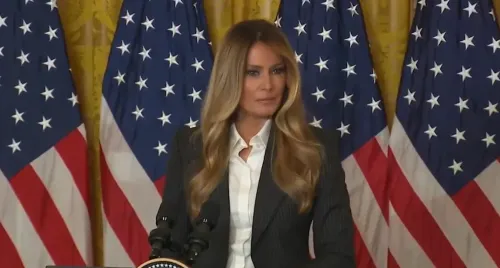
Melania Trump addressed winners of the inaugural Presidential AI Challenge at the White House on 10 June .
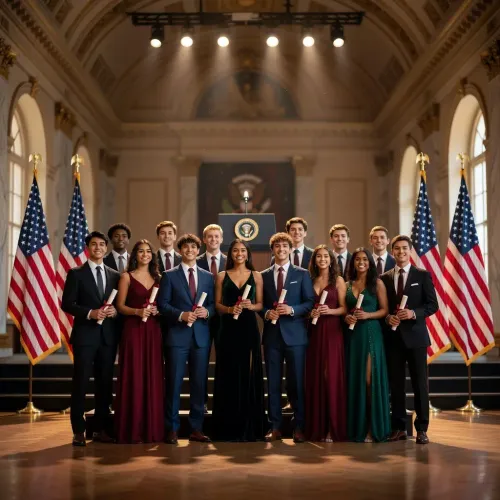
The Challenge drew more than 20,000 student participants from across the US and overseas Department of Defense schools.
She described AI as ‘the largest democratisation of intellect in human history,’ with impact spanning healthcare, nutrition, and public safety.
The First Lady called on students to use AI to ‘safeguard America’s leading position in the world of technology.’ The address comes amid a global race for AI leadership among the US , China , and the European Union .
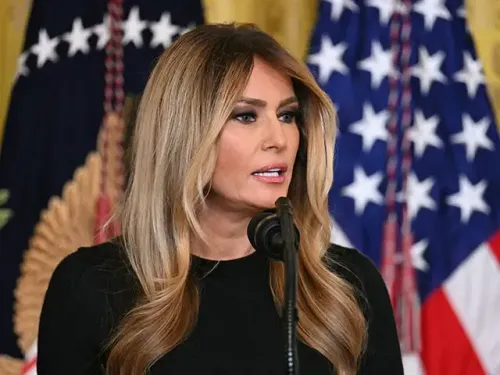
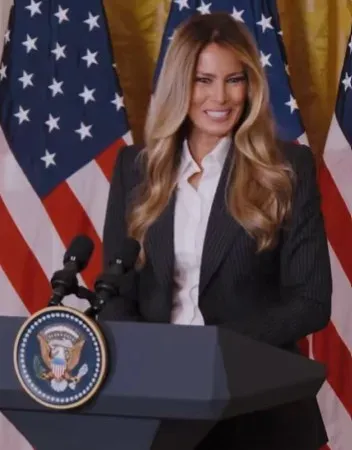
First Lady Melania Trump on 10 June called artificial intelligence a transformative force capable of reshaping industries, strengthening communities, and expanding educational access, urging young Americans to embrace the technology boldly and responsibly. Her remarks came at a White House ceremony honouring winners of the inaugural Presidential AI Challenge, which drew more than 20,000 student participants from across the United States and overseas Department of Defense schools.
Key Remarks from the White House Address
Addressing students, educators, and parents, Melania Trump framed AI not merely as a technological tool but as a catalyst for social and economic change. “Today is about opening doors,” she said. “When new doors open, passions flow, courage blossoms, and dreams are realized. AI inspires.”
She urged students to channel the technology toward national ambition: “Use this chapter of your life to sail away with your dreams—to continue to build boldly, and importantly, to safeguard America’s leading position in the world of technology.”
AI as a Democratising Force
Melania Trump reserved some of her strongest language for AI’s societal implications, describing access to information as one of the technology’s defining characteristics. “Artificial intelligence gives our communities access to the largest amount of information ever recorded in humanity’s history,” she said. “This fundamental democratization of intellect will profoundly alter society, our industries, our social safety net, and even our open-mindedness toward cultural diversity.”
She added: “Wisdom is tolerance and change will be enhanced at hyper-speed.”
Impact on Government Services and Education
The First Lady argued that AI could make publicly funded social programmes more efficient and unlock personalised learning at scale. “AI can help us build a stronger community, making our publicly funded social programs more efficient and more effective,” she said. “It allows us to deliver more personalized education and in turn, will unlock growth in America’s economy.”
She also highlighted AI’s reach across sectors, noting that student participants had already developed ideas spanning healthcare, nutrition, public safety, and other domains.
The Presidential AI Challenge
The inaugural Presidential AI Challenge served as the backdrop for the address, with winners gathered at the White House from across the country and from overseas Department of Defense schools. The competition marks a broader White House effort to cultivate AI literacy and innovation among younger Americans.
Notably, this comes as the United States, China, the European Union, and other major economies race to assert leadership in advanced technologies, each announcing initiatives spanning AI research, education, and workforce development. The Challenge positions the US government as an active participant in shaping the next generation of AI practitioners, rather than a passive observer of private-sector momentum.
What Comes Next
Melania Trump concluded by calling on students to keep using AI “as a muse—to open new pathways, and ultimately, to achieve personal growth and success.” The White House has not yet detailed follow-up policy steps tied to the Challenge, but the event signals that AI education will remain a visible priority for the administration in the months ahead.
Point of View
’ not ‘build carefully.’ That framing sits in tension with growing bipartisan concern over AI safety, deepfakes, and labour displacement. Whether the Presidential AI Challenge becomes a sustained institution or a one-cycle headline will determine whether this speech marks a genuine shift in youth-focused technology policy or simply a well-staged photo opportunity.
NationPress
24 Oct 2026
Frequently Asked Questions
What did Melania Trump say about artificial intelligence at the White House?
Melania Trump described AI as a transformative force that will reshape industries, strengthen communities, and expand educational opportunities. Speaking at the inaugural Presidential AI Challenge ceremony, she urged young Americans to use the technology boldly and responsibly, calling it ‘the largest democratisation of intellect in human history.’
What is the Presidential AI Challenge?
The Presidential AI Challenge is an inaugural White House-backed competition that drew more than 20,000 student participants from across the United States and overseas Department of Defense schools. Winners were honoured at a White House ceremony where Melania Trump delivered the keynote address.
Why does Melania Trump’s AI speech matter?
The address signals that AI education and youth engagement with technology are becoming visible priorities for the White House. It comes as the US, China, and the EU compete for global AI leadership, making the administration’s framing of AI as an opportunity—rather than a risk—a notable policy posture.
Which sectors did Melania Trump highlight as being shaped by AI?
She cited healthcare, nutrition, and public safety as areas where student participants had already developed AI-driven ideas. She also referenced government social programmes and personalised education as domains where AI could deliver greater efficiency and impact.
How does this fit into the broader US AI policy landscape?
The US, alongside China, the European Union, and other major economies, has been announcing initiatives to expand AI research, education, and workforce development. The Presidential AI Challenge positions the federal government as an active force in cultivating the next generation of AI practitioners.