Rubio, Philippines FM reaffirm alliance at 80-year diplomatic milestone
Synopsis
Two high-level US-Philippines contacts in under a week — Rubio's call with President Marcos and his face-to-face with Foreign Affairs Secretary Lazaro — reveal a deliberate diplomatic acceleration, not routine anniversary optics. With the Philippines holding the ASEAN chair and South China Sea frictions unresolved, Washington is doubling down on its most consequential Southeast Asian alliance at a pivotal moment.
Key Takeaways
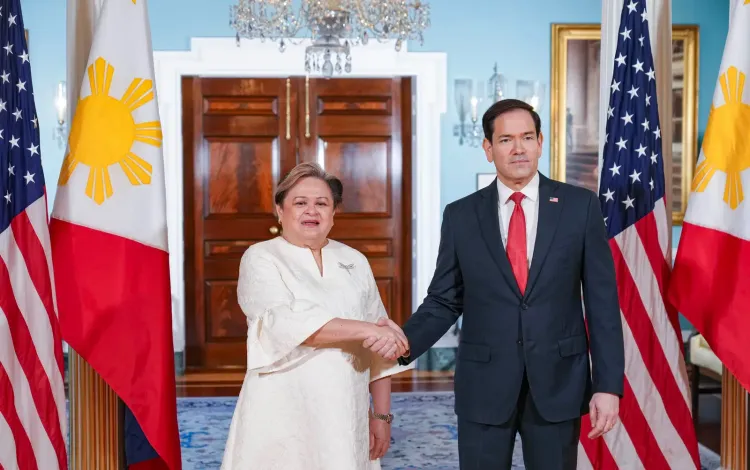
US Secretary of State Marco Rubio met Philippines FM Maria Theresa Lazaro on 5 June 2026 , reaffirming alliance commitments.
The meeting marks 80 years of US-Philippines diplomatic relations and 75 years as treaty allies.
Rubio also spoke with President Ferdinand Marcos Jr. on 31 May , covering the same security and economic priorities.
The Luzon Economic Corridor and South China Sea stability featured in both engagements.
Bilateral trade in goods and services exceeded $36.9 billion in 2024 ; more than 4.6 million Americans are of Philippine ancestry.
A US House resolution introduced last week honours the 80th anniversary and reaffirms the 1951 Mutual Defense Treaty .
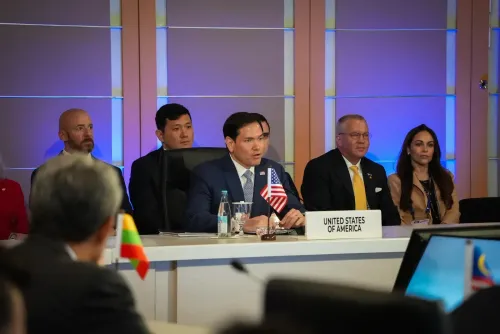
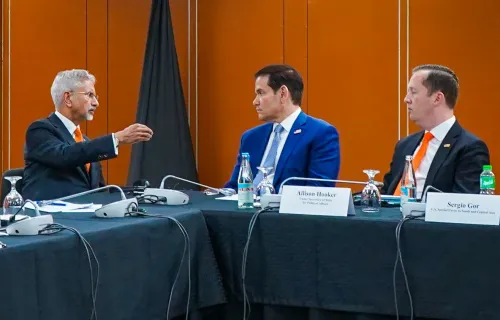
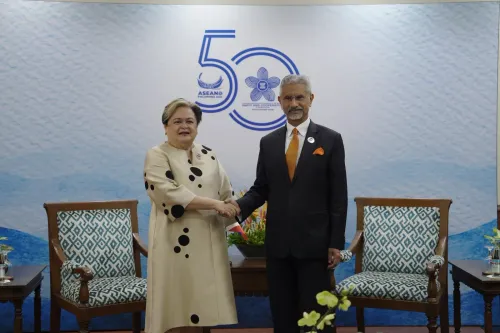
US Secretary of State Marco Rubio met Philippines Secretary of Foreign Affairs Maria Theresa Lazaro on Friday, 5 June 2026, reaffirming Washington's ironclad commitment to its alliance with Manila as the two nations marked 80 years of diplomatic relations and 75 years as treaty allies. The high-level engagement comes amid sustained security tensions in the South China Sea, underscoring how central the US-Philippines alliance has become to Washington's Indo-Pacific strategy.
Key Developments from the Meeting
Rubio and Lazaro covered 'a range of bilateral economic and security priorities', according to a US Department of State readout. Central among them were the Philippines' role as Chair of the Association of Southeast Asian Nations (ASEAN) and ongoing efforts to advance peace and stability in the South China Sea.
Rubio also reaffirmed Washington's commitment to developing the Luzon Economic Corridor and exploring ways to address energy challenges across the region — a priority that has featured prominently in recent bilateral exchanges.
A Week of Intensive Diplomacy
The Rubio-Lazaro meeting came fewer than seven days after Rubio held a telephone call with Philippine President Ferdinand Marcos Jr. on 31 May. That conversation covered broadly similar ground: bilateral economic and security priorities, efforts to advance peace in the South China Sea, the Luzon Economic Corridor, and regional energy cooperation, according to the State Department readout issued the same day.
The back-to-back engagements signal a deliberate intensification of diplomatic contact, not routine protocol. This is the third notable high-level US-Philippines interaction in 2026, reflecting a pattern of accelerated alliance management as Chinese maritime activity in the region remains a persistent flashpoint.
Congressional Recognition and the 80-Year Milestone
The diplomatic momentum has found a parallel on Capitol Hill. Members of the US House of Representatives last week introduced a resolution honouring the 80th anniversary of US-Philippine relations, dating to 4 July 1946. The measure highlights the alliance's foundations in 'mutual security and economic interests' and recognises close people-to-people ties.
Notably, the resolution points to the more than 4.6 million US citizens of Philippine ancestry and the fact that nearly one in four working Filipino adults in the United States are frontline healthcare workers. It also reaffirms support for the US-Philippines Mutual Defense Treaty and recognises the service of Filipinos and Filipino Americans in the US Armed Forces.
Trade, Defence and the Indo-Pacific Architecture
The resolution cites expanded defence cooperation, growing trade links, and the April 2024 trilateral summit involving the United States, Japan, and the Philippines as evidence of a deepening strategic relationship. Bilateral trade in goods and services exceeded $36.9 billion in 2024, underlining the economic dimension of a partnership often framed primarily in security terms.
The Mutual Defense Treaty, signed in 1951, remains the legal bedrock of the alliance. In recent years it has been reinforced through enhanced military cooperation, joint exercises, and new defence access arrangements — developments that have drawn pointed responses from Beijing.
With the Philippines holding the ASEAN chair and South China Sea incidents showing no sign of abating, the next phase of this alliance will test whether economic corridor commitments translate into tangible regional influence.
Point of View
And Washington's repeated reaffirmation of the Mutual Defense Treaty is as much a signal to Beijing as it is a reassurance to Manila. What is less clear is whether the Luzon Economic Corridor will deliver concrete infrastructure before Chinese maritime pressure forces a harder security choice on the Philippines. The $36.9 billion trade figure is significant, but economic interdependence has not historically deterred Chinese assertiveness in the region. The real test of this intensified engagement is execution, not communiqués.
NationPress
19 Sept 2026
Frequently Asked Questions
Why did Marco Rubio meet Philippines FM Maria Theresa Lazaro on 5 June 2026?
Rubio met Lazaro to reaffirm the US commitment to its alliance with the Philippines as the two countries marked 80 years of diplomatic relations and 75 years as treaty allies. The talks covered South China Sea security, the Luzon Economic Corridor, and the Philippines' role as ASEAN Chair.
What is the Luzon Economic Corridor and why does it matter?
The Luzon Economic Corridor is a joint US-Philippines infrastructure and economic development initiative that Washington has repeatedly committed to advancing. It is seen as a key tool for deepening economic ties and providing an alternative to Chinese-led investment in the region.
How significant is the US-Philippines Mutual Defense Treaty?
Signed in 1951, the Mutual Defense Treaty is the legal foundation of the US-Philippines alliance, obligating both countries to support each other in the event of an armed attack. It has been reinforced in recent years through joint military exercises, expanded defence cooperation, and new access arrangements.
What did the US House resolution on US-Philippines relations highlight?
The resolution, introduced last week, honours the 80th anniversary of bilateral ties and reaffirms the Mutual Defense Treaty. It notes that more than 4.6 million US citizens are of Philippine ancestry, that nearly one in four working Filipino adults in the US are frontline healthcare workers, and that bilateral trade exceeded $36.9 billion in 2024.
What is the broader context of these US-Philippines diplomatic meetings?
The engagements come amid continuing Chinese maritime activity in the South China Sea, which has repeatedly brought Philippine and Chinese vessels into confrontation. The Philippines currently holds the ASEAN chair, giving Manila — and by extension Washington — added diplomatic leverage in shaping the regional agenda.