Russia-ASEAN Kazan Declaration 2026: Strategic partnership expanded at summit
Synopsis
At their 35th-anniversary summit in Kazan, Russia and ASEAN signed four formal documents — including a partnership action plan through 2030 — while explicitly endorsing a 'multipolar world order.' With SCO and Eurasian Economic Commission heads at the table, Moscow is clearly positioning ASEAN as a pillar of its alternative global architecture.
Key Takeaways
Russia and ASEAN adopted the Kazan Declaration 2026 on 18 June at a commemorative summit in Kazan .
Four outcome documents were signed, including a Plan of Action for 2026–2030 and joint statements on energy and cultural cooperation.
The summit was co-chaired by Philippine President Ferdinand Marcos Jr (ASEAN Chair 2026) and President Vladimir Putin .
Cooperation areas include energy security, AI, transport, agriculture, and tourism .
The declaration explicitly endorsed a 'multipolar world order' based on UN Charter principles, according to Russian presidential aide Yuri Ushakov .
ASEAN was founded in 1967 and currently has 11 member states .
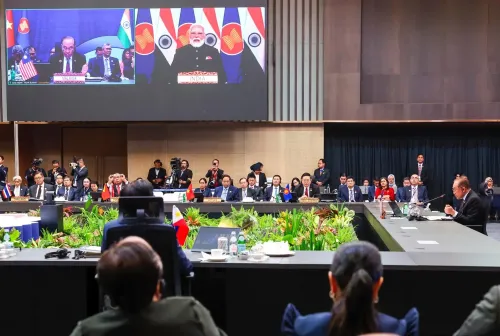
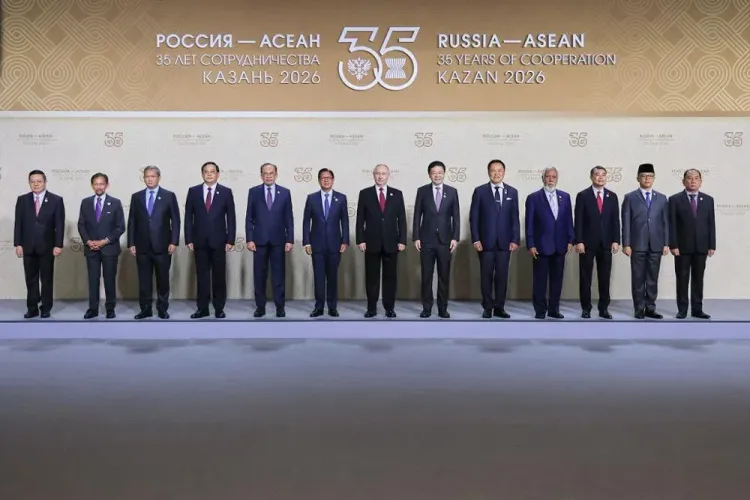
Russian President Vladimir Putin and leaders of the Association of Southeast Asian Nations (ASEAN) on Thursday, 18 June adopted the Kazan Declaration 2026 at the Russia-ASEAN Commemorative Summit in Kazan, marking 35 years of ASEAN-Russia relations and formalising a renewed strategic partnership framework through 2030.
Four Outcome Documents Adopted
The summit produced four formal outcome documents: the Kazan Declaration 2026 titled 'ASEAN-Russian Federation: Unity in Diversity – 35 Years Together'; a Joint Statement on Energy Cooperation; a Joint Statement on Cultural Cooperation; and a Plan of Action to Implement the ASEAN-Russia Strategic Partnership (2026–2030).
ASEAN said in a post on X that the adoption of these documents 'underscores ASEAN and Russia's shared commitment to advancing the ASEAN-Russia Strategic Partnership and provides a forward-looking framework to guide their cooperation in the coming years.'
Summit Leadership and Attendance
The commemorative summit was co-chaired by Philippine President Ferdinand Marcos Jr, serving as ASEAN Chair for 2026, and President Putin. ASEAN Secretary-General Kao Kim Hourn attended alongside ASEAN leaders or their designated representatives and respective delegations.
Following the summit, Kao Kim Hourn joined ASEAN leaders at a Working Lunch hosted by Putin, focused on integration processes in the Eurasian space. The lunch also included the Secretary-General of the Shanghai Cooperation Organisation (SCO) and the Chairman of the Board of the Eurasian Economic Commission (EEC) — signalling a deliberate effort to align the ASEAN-Russia track with broader Eurasian multilateral architecture.
Key Themes: Multipolarity and Cooperation Sectors
Russian presidential aide Yuri Ushakov noted that 'a commitment to the formation of a just and democratic multipolar world order based on the universally recognised principles of international law and the UN Charter was particularly emphasised' at the summit.
According to the declaration, both sides confirmed readiness to 'deepen cooperation in key sectors, including energy and food security, transport and logistics, agriculture, digitalisation, science and technology, including artificial intelligence, tourism, and innovative production,' according to state media reports.
Context: ASEAN-Russia Relations at 35
The Association of Southeast Asian Nations, founded in 1967, comprises 11 member states: Brunei, East Timor, Vietnam, Indonesia, Cambodia, Laos, Malaysia, Myanmar, Singapore, Thailand, and the Philippines. The Russia-ASEAN relationship, which dates to 1991, has gained renewed salience as both sides pursue diversified partnerships amid shifting global alignments.
Notably, the Kazan summit's emphasis on a 'multipolar world order' and the presence of SCO and EEC leadership signals Russia's intent to embed the ASEAN relationship within a wider non-Western multilateral framework — a dynamic that will draw close scrutiny from Western capitals and India alike.
The 2026–2030 Plan of Action will now serve as the operational roadmap for the partnership, with implementation timelines and sectoral working groups expected to be detailed in the months ahead.
Point of View
And the 'Unity in Diversity' framing papers over real fault lines. The test will be whether the 2026–2030 action plan produces measurable economic outcomes or remains, like previous frameworks, a document of aspiration.
NationPress
18 Sept 2026
Frequently Asked Questions
What is the Kazan Declaration 2026?
The Kazan Declaration 2026, titled 'ASEAN-Russian Federation: Unity in Diversity – 35 Years Together,' is a formal diplomatic document adopted at the Russia-ASEAN Commemorative Summit in Kazan on 18 June 2026. It reaffirms the ASEAN-Russia Strategic Partnership and sets out a cooperation framework through 2030 covering energy, trade, AI, and cultural ties.
What documents were adopted at the Russia-ASEAN Kazan summit?
Four documents were adopted: the Kazan Declaration 2026, a Joint Statement on Energy Cooperation, a Joint Statement on Cultural Cooperation, and a Plan of Action for the ASEAN-Russia Strategic Partnership covering 2026 to 2030.
Who co-chaired the Russia-ASEAN summit in Kazan?
The summit was co-chaired by Philippine President Ferdinand Marcos Jr, in his capacity as ASEAN Chair for 2026, and Russian President Vladimir Putin. ASEAN Secretary-General Kao Kim Hourn also attended.
Why does the Kazan Declaration's 'multipolar world' language matter?
Russian presidential aide Yuri Ushakov highlighted that a commitment to a 'just and democratic multipolar world order' was a central theme of the summit. The framing signals Russia's effort to present its ASEAN engagement as part of a broader challenge to Western-led global institutions — a position that not all ASEAN members uniformly share.
Which sectors does the ASEAN-Russia partnership cover under the new plan?
According to the declaration, cooperation will deepen across energy and food security, transport and logistics, agriculture, digitalisation, science and technology including artificial intelligence, tourism, and innovative production.